
💡 The Quick Answer
When it comes to facial mist vs toner, most people think they do the same thing—but they actually serve very different roles in your skincare routine.
A toner is typically used right after cleansing to help control excess oil, refine the look of pores, and prepare your skin to absorb the next steps.
A facial mist, on the other hand, is more about quick hydration and refreshment you can use anytime during the day.
The real difference isn’t just when you use them—it’s why: toner is about treating and balancing your skin (especially if it’s oily or acne-prone), while a mist is more of a convenient boost when your skin feels dry, tight, or dull.

In this guide, we’ll break down toner vs facial mist in the simplest way possible—so you can finally stop guessing and start choosing what actually works for your skin.
You’ll learn the key differences, when to use each one, whether you really need both, and most importantly, which option is better if you have oily or acne-prone skin.
Toner Explained (What It Really Does for Your Skin)
A toner is a lightweight liquid you apply right after cleansing, designed to remove leftover impurities, rebalance your skin, and prepare it for the next steps in your routine.
In simple terms, it’s not just an “extra” step—it helps your skin absorb serums and moisturizers more effectively while targeting specific concerns like excess oil or breakouts.
How Toner Helps Oily Skin
If you have oily or acne-prone skin, toner can be one of the most useful steps in your routine. The right formula helps:
- Reduce the appearance of enlarged pores.
- Control excess sebum (oil production).
- Prevent clogged pores that lead to breakouts.
- Keep your skin feeling clean without that heavy or greasy layer.
This is why, in most toner vs facial mist comparisons, toner is usually the better choice for managing oily skin—it actually works on the root of the problem, not just the surface.
For dry skin, toners can still be helpful—but only if you choose a hydrating, alcohol-free formula. Instead of controlling oil, they focus on restoring moisture and preventing tightness after cleansing.
Key Ingredients to Look For
Not all toners are the same. The effectiveness depends heavily on the ingredients inside:
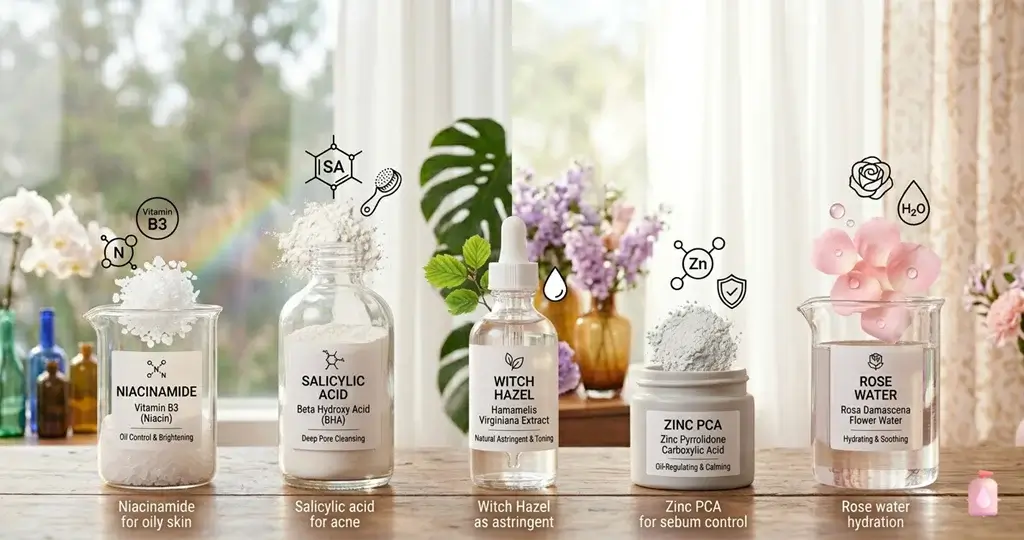
- Niacinamide: Helps regulate oil production, minimize the look of pores, and improve overall skin texture. It’s ideal for oily and combination skin types.
- Salicylic Acid: A powerful ingredient for acne-prone skin. It penetrates deep into pores to remove excess oil and prevent breakouts, making it a top choice in many best toner for oily skin routines.
- Witch Hazel: A natural astringent that helps tighten the appearance of pores and control shine. It’s especially useful if your skin gets greasy quickly throughout the day.
- hyaluronic acid and Glycerin: for hydration.
👉 The key takeaway: if your goal is oil control, clearer pores, and a more balanced complexion, a well-formulated toner will always outperform a simple hydrating product like a facial mist.
Facial Mist Explained (What It Actually Does)
A facial mist (also called a face mist or facial spray) is a lightweight, water-based product designed to give your skin a quick boost of hydration and refreshment.
Unlike toner, it’s not meant to deeply cleanse or treat the skin—it simply adds a layer of moisture on the surface and helps your skin feel more comfortable throughout the day.

When Should You Use a Facial Mist?
One of the main advantages of a facial mist is flexibility. You can use it:
- After skincare, to add extra Dewy finish.
- During the day, when your skin feels dry or oily.
- Over makeup, to refresh your look.
- In hot weather, to cool and revive your skin.
This is why many people include it in their routine when comparing toner vs facial mist—it’s convenient, quick, and easy to use anytime.
Is Facial Mist Really Necessary?
Here’s the honest answer: most people don’t need a facial mist every day.
If you already use a good moisturizer, your skin is getting the hydration it needs. A facial mist is more of a “nice-to-have” product rather than a must-have—especially for oily skin.
where controlling excess oil is usually more important than adding extra layers of Instant cooling effect.
At this point, you might be wondering:
👉 Can face mist replace toner?
The short answer is no. A facial mist cannot replace a toner because it doesn’t target oil control, clogged pores, or skin balance. It simply hydrates and refreshes the surface, while toner works deeper to treat and prepare your skin.
Now that you understand what each product actually does, let’s break down the real difference between facial mist vs toner—and which one makes more sense for your skin type.
Toner vs Facial Mist (Comparison Table)
Here’s a simple side-by-side breakdown to help you clearly understand the difference between facial mist vs toner and when to use each one:
| Feature | Toner | Facial Mist |
|---|---|---|
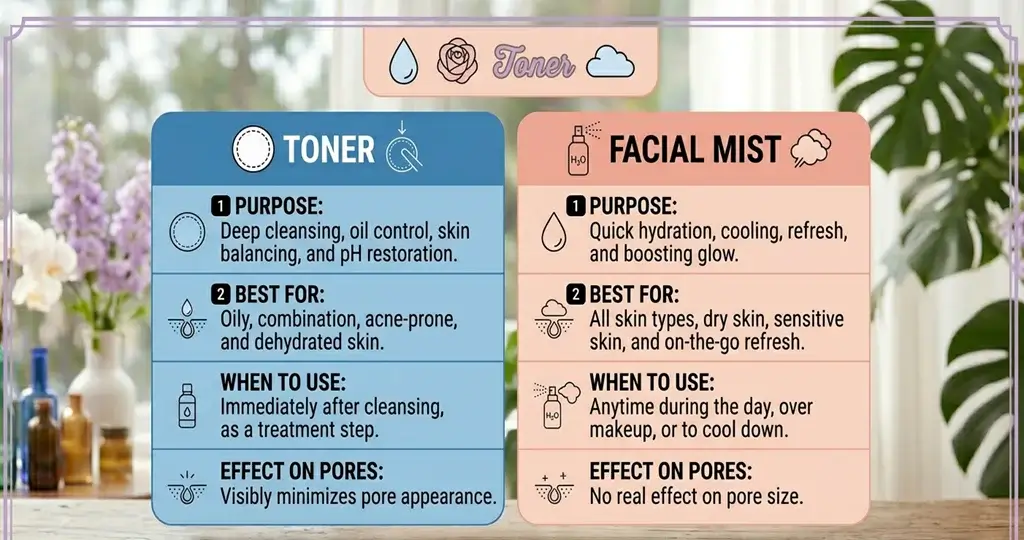
| Purpose | Deep cleansing, oil control, skin prep | Hydration, refresh, quick glow |
| Best For | Oily, acne-prone, combination skin | Dryness, dehydration, quick boost |
| When to Use | Right after cleansing (AM & PM) | Anytime during the day |
| Effect on Pores | Helps minimize the appearance of pores | No real effect on pores |
| Skin Role | Treats and balances skin | Refreshes and hydrates surface |
| Routine Importance | Essential step (especially for oily skin) | Optional step |
So… Which One Should You Choose?
Now let me ask you something (and be honest 😄):
👉 Which is better toner or face mist?
If your skin is oily or acne-prone, the answer is pretty clear—toner wins. It helps control oil, unclog pores, and actually improve your skin over time.
That’s why in most toner vs facial mist comparisons, toner is considered a core step, not an extra.
A facial mist, on the other hand, is great for quick hydration and refreshment—but it won’t replace a proper skincare step like toner. Think of it as a bonus, not a solution.
👉 Simple rule to remember:
- Want to fix oiliness and breakouts? → Go for a toner
- Want a quick refresh during the day? → Use a facial mist
And if you’re still comparing face mist vs toner, just ask yourself:
“Am I trying to treat my skin… or just refresh it?”
Which One Should You Choose? (The Decision Guide)
If you’re still stuck choosing between facial mist vs toner, don’t overcomplicate it. The right choice depends on what your skin actually needs—not what looks good on your shelf.
Choose Toner if:
- You have oily or combination skin that gets shiny quickly
- You’re dealing with acne, clogged pores, or breakouts
- You want to regulate excess sebum and keep your skin balanced
- You need a product that actually treats your skin, not just refreshes it
👉 In most cases, a toner for oily skin will give you real, visible results over time—especially if it contains ingredients like niacinamide or salicylic acid.
Choose Facial Mist if:
- Your skin feels dry, tight, or dull during the day
- You want a quick hydration boost without touching your face
- You wear makeup and need something to refresh your look
- You’re looking for a light, convenient way to revive tired skin
👉 A facial mist is perfect for on-the-go use, especially when you need that instant “fresh skin” feeling.
Use Both if:
- You follow a complete skincare routine and want to level it up
- You want the benefits of both oil control and hydration
- You use toner as a treatment step, and mist as a throughout-the-day refresher
👉 This is where the real balance happens. In a smart routine, toner vs facial mist isn’t about choosing one over the other—it’s about using each product at the right time for the right purpose.
💡 Quick takeaway:
If your goal is clearer, less oily skin → toner is your priority
If your goal is comfort and quick hydration → facial mist does the job
And if you’re aiming for the best of both worlds, combining them strategically can give your skin a more complete routine without overloading it.
The Science Behind It (Simple but Powerful)
Let’s break this down in a way that actually makes sense—no complicated science, just what you really need to know.
🧪 pH Balance (Why Toner Matters More)
Your skin has a natural pH balance (slightly acidic), which helps protect it from bacteria, excess oil, and irritation.
When you cleanse your face—especially if you have oily skin—this balance can get disrupted.
👉 This is where a toner for oily skin comes in:
- It helps restore your skin’s natural pH.
- Keeps oil production more stable.
- Prepares your skin to absorb treatments better.
A facial mist, on the other hand, doesn’t really fix pH—it just sits on the surface and hydrates.
💧 TEWL (Why Your Skin Gets Oily and Dehydrated)
TEWL stands for Transepidermal Water Loss (simple meaning: water escaping from your skin).
When your skin barrier is weak:
- Water evaporates faster.
- Skin becomes dehydrated.
- Your body produces more oil to compensate.
💡 Yes—this is why your skin can feel oily but still dry underneath.
📊 Scientific Fact: A 2026 clinical study on skin barrier function confirmed that Transepidermal Water Loss (TEWL) is the primary cause of “dehydrated oily skin.” This is why balancing your skin with a toner is more than just a beauty step—it’s a biological necessity to prevent over-oiling. [Source: Pubmed 2025].
Can You Use Toner and Facial Mist Together?
Yes—you absolutely can use both. In fact, combining facial mist vs toner the right way can give your skin a more balanced routine, especially if you have oily or combination skin.
Now, I know you might be wondering:
👉 Which comes first, toner or face mist?
Quick answer: Toner always comes first.
It goes right after cleansing to treat and prep your skin, while a facial mist is used later for hydration or refreshment.
How to Use Facial Mist and toner Together (Simple Routine)
The key is not to overcomplicate things. Think of it like this:
- Toner = treatment step?
- Facial mist = support step?
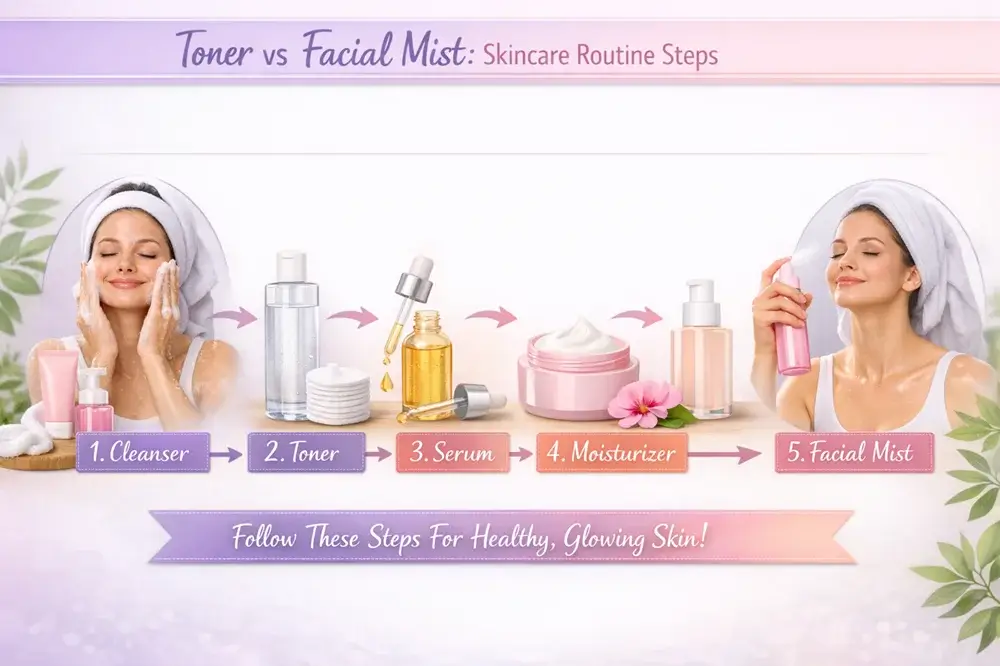
💡 Smart Routine for Oily Skin:
- Cleanser – remove dirt and excess oil?
- Toner – balance pH, control oil, prep skin?
- Serum – target concerns (like acne or texture)?
- Moisturizer – lock in hydration?
- Facial Mist (optional) – use anytime during the day for a quick refresh?
👉 You can also lightly use a face mist after moisturizer if your skin feels tight, or even over makeup for a refreshed look.
check this Guide: best routine for oily skin 2026.
Usage Order (Keep It Simple)
- Toner → always after cleansing.
- Facial mist → anytime (after skincare or during the day).
👉 If you’re still comparing toner vs facial mist, just remember:
one treats your skin, the other refreshes it
Final Note (Your Turn 💬)
Now I’m curious…
👉 Have you ever tried using both toner and facial mist in your skincare routine?
Tell me in the comments about your personal experience—did you notice less oil, better hydration, or no real difference? Your results might help someone else with oily or acne-prone skin make the right choice.
And if you’re still testing face mist vs toner, don’t worry—you’re now making a much smarter decision than most people 😉.
Common Mistakes When Using Toner and Facial Mist
This is where most people get it wrong—even if they already understand the basics of facial mist vs toner. Small mistakes in how you use these products can completely cancel their benefits (or even make your skin worse).
Let’s fix that 👇
❌ Using Facial Mist Without Moisturizer
This is one of the biggest mistakes.
A facial mist adds a light layer of hydration—but if you don’t seal it with a moisturizer, that water can evaporate quickly.
👉 Result:
- Skin feels dry again.
- Sometimes even more oily (because your skin tries to compensate).
💡 Always follow with a moisturizer if you’re using a mist as part of your routine.
❌ Using a Harsh Toner (Especially for Oily Skin)
Not all toners are good for your skin.
Using a toner with strong alcohol or harsh ingredients can:
- Strip your skin.
- Damage your skin barrier.
- Trigger even more oil production.
👉 If you’re choosing a toner for oily skin, go for:
- Alcohol-free formulas.
- Ingredients like niacinamide or salicylic acid.
❌ Thinking Facial Mist Can Treat Acne
A lot of people assume that a face mist can replace treatment products.
But here’s the truth:
👉 Facial mist does NOT treat acne.
It doesn’t unclog pores, control oil, or fight breakouts. It only gives temporary hydration and refreshment.
💡 If your goal is clearer skin, stick with a proper toner vs facial mist strategy—where toner handles the treatment.
❌ Overusing Too Many Products
More products ≠ better skin.
Layering too many toners, mists, serums, and creams can:
- Overwhelm your skin.
- Cause irritation or breakouts.
- Make your routine confusing and ineffective.
👉 Keep it simple:
- Toner (for treatment).
- Moisturizer (for protection).
- Mist (only if needed).
💡 Final Tip:
If you avoid these mistakes, you’re already ahead of most people comparing face mist vs toner.
Because at the end of the day, it’s not just about what you use—
👉 it’s about how you use it.
FAQ About facial mist or toner
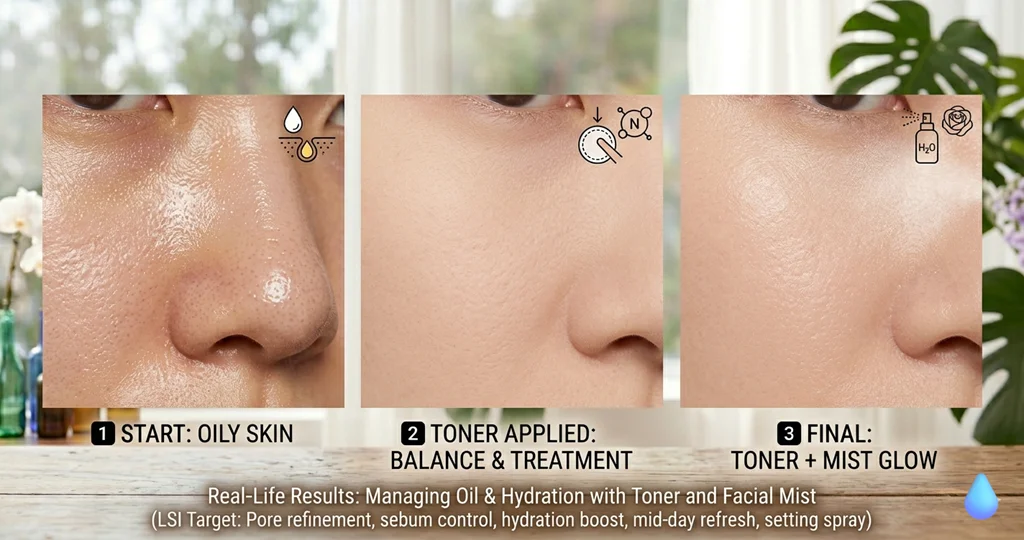
If you’re comparing face mist vs toner, toner is the better choice for controlling oil, unclogging pores, and improving skin over time. A facial mist only provides temporary hydration and refreshment.
Using a facial mist before moisturizer helps add hydration, while applying it after can refresh your skin. However, without moisturizer, the hydration may evaporate quickly.
A toner for oily skin helps balance pH, control oil, and clean pores. A facial mist only hydrates the surface and does not treat acne or excess oil.
A good toner for oily skin helps reduce shine, tighten the appearance of pores, and prevent breakouts, making it more effective than a facial mist.
However, if a face mist contains oils or heavy ingredients, it may not be ideal for acne-prone or oily skin.
Apply toner once or twice daily after cleansing. A facial mist can be used anytime for refreshment, but it’s not essential in your routine.
Thank you so much for reading this guide on facial mist vs toner! By now, you know the key differences, when to use each, and how to combine them effectively in your skincare routine—especially if you have oily or acne-prone skin.
Remember: toner is your treatment powerhouse, controlling oil and preparing your skin, while facial mist provides hydration and a refreshing boost throughout the day.
Using them strategically can give your skin the balance and glow it deserves.
If you found this guide helpful, don’t miss out on more expert skincare tips and product advice—subscribe to the Beauty Blurb newsletter today and get our latest insights delivered straight to your inbox. Your healthiest, most radiant skin journey starts here!

Akram Boulaid is a dedicated Skincare Researcher and Analyst with over 7 years of intensive focus on dermatology and cosmetic ingredient science. As a globally recognized expert, his insights have been featured in major international publications, including the New York Post and GB News. A verified expert on Qwoted, Akram connects with health journalists to provide evidence-based analysis. He founded Beauty Blurb to bridge the gap between complex clinical data and practical skincare routines, specializing exclusively in the needs of oily and acne-prone skin through rigorous analysis of peer-reviewed scientific literature.