
Are ceramides good for oily skin? Absolutely — and not just “good,” they can be a game-changer.
Ceramides help oily skin find that healthy balance between hydration and oil control by reinforcing the skin’s natural barrier.
When your barrier is strong, your skin doesn’t overproduce sebum to make up for lost moisture — meaning fewer clogged pores and less shine.
Unlike heavy creams, ceramides are lightweight, non-comedogenic lipids that keep your skin hydrated without feeling greasy. In other words, they teach oily skin how to stay balanced, calm, and clear.

In this guide on Ceramides for Oily Skin, you’ll learn exactly how these ingredients work, how to use them in your routine, and which products deliver real results.
We’ll also uncover common myths, dermatologist insights, and the best lightweight ceramide formulas that actually make oily skin look healthier — not shinier.
What Are Ceramides and How Do They Work
Ceramides are natural lipids — think of them as the “glue” that holds your skin cells together and keeps your barrier strong.
They make up nearly 50% of the skin’s outer layer (stratum corneum), playing a vital role in maintaining skin hydration, elasticity, and overall barrier function.
When your ceramide levels drop — whether from harsh cleansers, over-exfoliation, or pollution — your skin can lose water faster, become more sensitive, and even trigger excess oil production to compensate.
Here’s how ceramides work: they lock in moisture, protect against irritants, and help repair a damaged skin barrier.
For oily and acne-prone skin types, that means fewer breakouts and less dehydration underneath the oil.
In fact, studies show that restoring ceramide levels helps balance sebum production, reduce inflammation, and improve the skin’s protective barrier over time.
Unlike occlusive ingredients that just sit on top, ceramides actually blend with your skin’s natural lipids, helping it stay hydrated from within without clogging pores.
So, when you apply a ceramide moisturizer or ceramide serum, you’re not just adding hydration — you’re teaching your skin to rebuild its own strength.
That’s why dermatologists often call ceramides the foundation of a healthy skin barrier — especially for people with oily, acne-prone, or combination skin who need moisture without heaviness.
Ceramides Benefits for Oily Skin
When oily skin runs on overdrive—producing shine, clogging pores, breaking out—it’s often because the skin’s barrier is compromised and ends up over-compensating.
That’s where using a ceramide for oily skin routine comes in: ceramides rebuild the barrier without adding weight, so your skin stops running a “oil emergency mode” and instead moves back into balance and comfort.
discover Benefits of Ceramides for Oily Acne-Prone Skin:
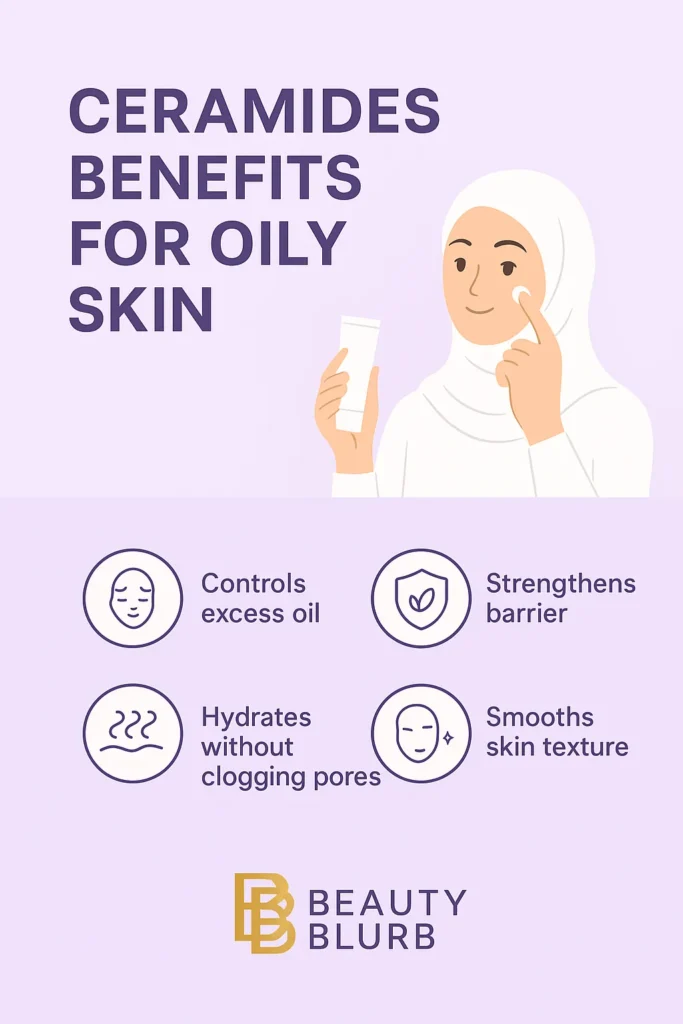
1. Balances Sebum (Oil) Production Naturally
When the skin barrier is weakened, your skin may increase oil output as a way to “patch up” moisture loss.
Ceramides help restore the barrier’s integrity, meaning the skin doesn’t feel the need to over-produce sebum.
By reinforcing that barrier, ceramide use for oily skin supports oil-control from the inside out, not just via blotting or mattifying layers.
In fact, a clinical study From Pubmed by Xia et al.
(2025) evaluated 44 participants with oily skin who used a ceramide-containing cleanser for 28 days:
- the sebum content decreased by about 79.18%, while transepidermal water loss (TEWL) dropped by 13.42% — clear evidence that improving the barrier can help reduce oil production. Source
2. Hydrates Without Clogging Pores (Non-Comedogenic Moisture)
Unlike heavy creams that may sit on the surface and risk clogging pores, a lightweight ceramide serum or gel for oily skin works by integrating with the skin’s natural lipids.
It locks in hydration while maintaining a non-comedogenic profile, so oily or acne-prone skin can stay moisturised without feeling greasy or seeing more breakouts.
Clinical Study:
- Reducing Water Loss (2025 Study): “You might be surprised to know that a recent study published in February 2025 has shed new light on how Ceramides work.
- It confirms that these lipids can slash your Transepidermal Water Loss (TEWL) by nearly 10%.
- What’s even more impressive is that they keep your skin hydrated and protected for up to 72 hours, acting as a powerful shield against environmental stressors like harsh cold and dry air (Source).
To put it simply: Think of Ceramides as the ‘mortar’ between your skin cell ‘bricks’; without them, the moisture inside your skin evaporates into the air like water escaping through cracks in a wall.
This study proves that Ceramides effectively seal those cracks, keeping your skin plump and hydrated even in tough weather.
3. Strengthens the Skin Barrier Against Irritants and Environment
Oily skin isn’t “immune” to barrier damage—especially if you’re using exfoliants, acids or treatments.
Ceramides support the “lipid mortar” of the outer skin layer, helping defend against external aggressors (pollution, bacteria, irritants) that can trigger more oil, redness, and inflammation.
Using ceramide products means you’re not just fighting oil—you’re building resilience.
4. Reduces Inflammation & Helps Prevent Post-Treatment Sensitivity
When oily/acne-prone skin is treated with strong actives (like salicylic acid or retinoids), the barrier can get compromised, leading to redness, flaking or more oil production.
- A 2023 double-blind study by Dr. Zoe Diana Draelos, MD et al.
- found that participants using a ceramide-containing cleanser and lotion during acne treatment.
- showed significantly lower transepidermal water loss (TEWL) and fewer inflammatory lesions compared to the control group. Source
This means ceramides don’t just moisturise—they help the skin heal and calm down.
5. Improves Skin Texture & Helps Reduce Mid-Day Shine
When your barrier is functioning well and your skin is hydrated at the right level, you’ll often see smoother texture, fewer rough patches, and less “oil-slick” shine by midday.
A 2025 review by TL Yong showed new insights into how ceramides support overall skin health, including improved barrier function and texture. Source
For a person with oily skin, this means the goal shifts: not just less oil, but healthier-looking, smoother skin.
So, what does ceramide do for oily skin? It rebuilds your skin’s barrier, calms excess oil production, hydrates without heaviness and supports smoother, healthier-looking skin.
Next, we’ll explore What to Look for when choosing the right formula—how to pick the best ceramide product for oily skin, what ingredients to prioritise (and avoid), and how to use it in your routine for maximum benefit.
What to Look for in a Ceramide Product for Oily Skin
You might be wondering what ingredients you should pay attention to when choosing ceramides for oily skin.
Not all ceramide products are created equal — some can feel heavy or greasy, while others are formulated perfectly for oily and acne-prone skin.
Here’s what to look for to make sure you’re picking the right one:
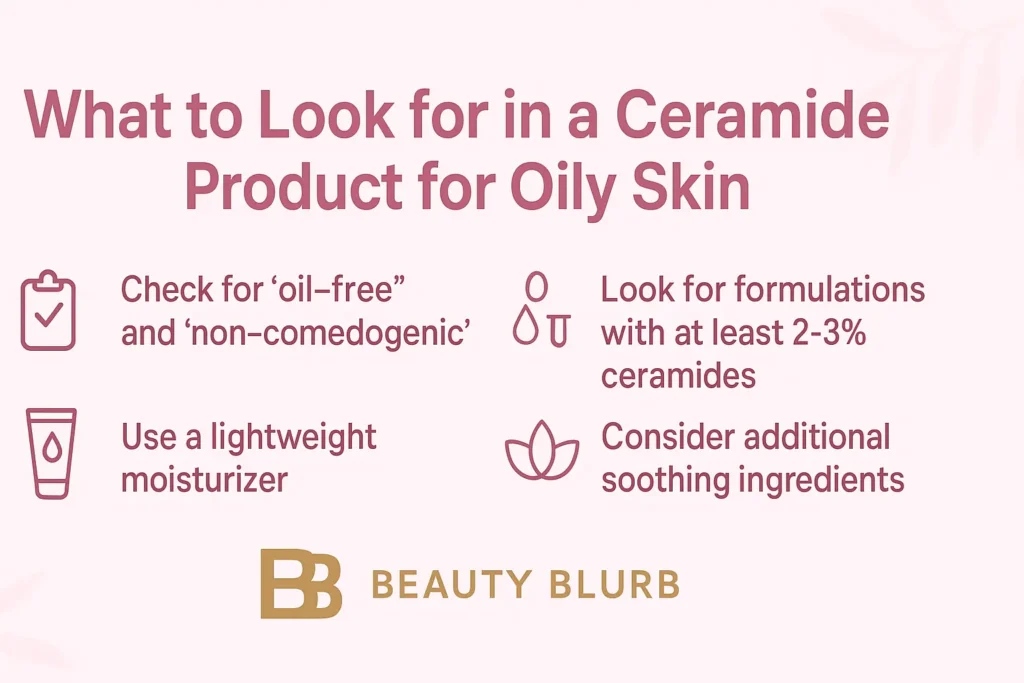
- Lightweight, Non-Comedogenic Formulas
Look for labels that say “non-comedogenic” or “oil-free.” These indicate that the product won’t clog pores or trigger breakouts.
The best ceramide moisturizer for oily skin feels breathable — hydrating without leaving a slick layer. - Ceramide Types + Supportive Ingredients
Choose formulas that combine Ceramide NP, Ceramide AP, and Ceramide EOP, as these mirror the natural ceramides in your skin barrier.
Bonus points if the product includes niacinamide or hyaluronic acid, since these ingredients help regulate sebum production and lock in moisture without heaviness. - Gel or Lotion-Based Textures
Instead of thick creams, go for gel-cream or light lotion textures.
They deliver the same barrier-repairing benefits of ceramide for oily and acne-prone skin but feel weightless and comfortable throughout the day. - pH-Balanced and Fragrance-Free
A pH between 4.5–6 helps keep your skin barrier balanced.
Fragrance-free formulas are less likely to irritate or cause redness, which is essential when dealing with oily, reactive, or breakout-prone skin. - Dermatologist-Tested or Clinically Proven Products
Look for products that have undergone clinical trials or dermatologist testing, especially those mentioning improved barrier function or reduced oil levels.
These tend to offer results you can trust — not just marketing claims.
💡 Final Thought
Knowing the right ingredients is only half the battle — understanding how to use & apply ceramides for oily skin is the real key.
The next section will walk you through the proper way to apply them so you get hydration, balance, and long-term skin health — without the shine.
How to Use Ceramides for Oily Skin (Dermatologist-Backed)
You might be wondering: What’s the correct way to include ceramides for oily skin into my routine so I actually see results?
It’s not just about slapping on a cream — it’s about smart timing, right texture, and layering with your other actives so that your skin barrier strengthens and your oil production begins to balance.

1. Cleanse First — Start With A Fresh Slate
Begin with a gentle, non-stripping cleanser designed for oily or acne-prone skin. This removes excess sebum, debris and old product build-up so your ceramide product can absorb properly.
Using a heavy or harsh cleanser can compromise your skin barrier and may trigger more oil production — the exact opposite of what you’re trying to achieve.
2. Apply Ceramide While Skin Is Slightly Damp
After cleansing (and optionally a mild toner), pat your face until it’s no longer dripping but still slightly damp. Then apply a lightweight ceramide moisturizer or gel formulated for oily skin.
This allows the ceramide for oily skin to integrate into the barrier repair process and lock in hydration without settling on the surface and feeling heavy. A nickel-sized amount is usually enough.
3. Layer Actives Intelligently
If you’re using other exfoliating or problem-targeting actives — for instance salicylic acid (BHA), niacinamide, or retinol — here’s how to layer:
- Use your main treatment actives (like acids or retinol) first (usually at night)
- Wait until skin is calm and absorbtion is done
- Then apply your ceramide product as the final leave-on step: this helps reduce irritation, supports the barrier and ensures the product is compatible with oily or breakout-prone skin.
In the morning, your final step after ceramide should always be a non-comedogenic, oil-free broad-spectrum sunscreen SPF 30+. This protects your newly strengthened barrier from UV-triggered oiliness and inflammation.
4. Texture & Frequency — Keep It Light & Consistent
For oily skin, choose gel-creams or lightweight lotions instead of heavy creams.
Use your ceramide product twice a day (morning and night) if your skin tolerates it — but if you’re layering many actives, just once at night may suffice initially.
The key is consistency. If your skin feels overloaded or you notice more oil, scale back other heavy products rather than skipping the ceramide step.
5. Monitor & Adjust for Seasonal or Treatment Changes
Oily skin doesn’t stay the same year-round. Humidity, heat, hormonal changes and treatments (like acne prescriptions) can alter your skin’s needs.
When you switch to stronger actives or your skin feels more reactive, increase your ceramide use slightly or swap to a thinner texture.
This flexibility ensures your ceramide routine for oily and acne-prone skin evolves with you and continues to support your barrier effectively.
✅ Final Thought
Knowledge of good ingredients is only half the battle — knowing how to use ceramides for oily skin is where the real difference is made.
Applied at the right time, in the right texture, and layered correctly with your other skincare steps, ceramides won’t just sit on your skin — they’ll help it rebuild, regulate excess oil and glow with health.
If you’re still figuring out how to build the perfect skincare routine for oily skin, don’t worry — I’ve got you covered.
Check out my guide Skincare Routine for Oily Skin (spoiler: it might just change the way your T-zone behaves). 😉
Are There Any Side Effects of Using Ceramides for Oily Skin?
For most people, ceramides are one of the safest and most skin-friendly ingredients you can use — even if you have oily or acne-prone skin.
Because ceramides are lipids that already exist naturally in your skin barrier, your body recognizes them instantly, which means true “side effects” are extremely rare.
However, there are a few important points to keep in mind when using a ceramide cream for oily skin, especially if your skin is sensitive or acne-prone.
- Mild Purging (Temporary) – When the skin barrier starts healing, you might see tiny bumps or mild congestion. This is temporary and not actual acne — your skin is just rebalancing sebum levels.
- Heavy or Greasy Feel – If your skin feels oily after use, switch to a lightweight, gel-based, non-comedogenic formula. The issue is texture, not the ceramide itself.
- Sensitivity with Actives – Layering ceramides too close to actives like retinol or acids can cause redness. Apply actives first, then your ceramide moisturizer.
- Fragrance or Preservative Reaction (Rare) – Some users may react to added ingredients, not the ceramide. Choose fragrance-free options and patch test first.
- Over-Moisturizing – Too many layers can trap oil and cause shine. Use a pea-sized amount once or twice daily.
✅ Bottom Line:
Ceramides are non-comedogenic, barrier-repairing ingredients that usually calm and balance oily skin — not irritate it. Just pick the right texture and use it consistently, and your skin will thank you.
By following the tips I’ve shared — based on both my personal experience and dermatologist-backed advice — you can easily avoid any irritation or unwanted reactions.
With the right ceramides for oily skin and proper layering, there’s no risk of serious side effects, only healthier, balanced, and calmer skin over time.
What are the Best Ceramides for Oily Skin
When your oily skin demands both oil-control and barrier repair, picking a ceramide formula can feel tricky.
The right “ceramide moisturizer for oily skin” needs to strengthen your skin’s protective layer without adding weight or grease.
Below you’ll find five top-rated options that deliver barrier support, lightweight texture, and mattified finish — perfect for oily or acne-prone skin types.
📋 Top 5 Ceramide Products for Oily Skin
| # | Product Name | Why It’s Great for Oily Skin | Key Ingredients & Texture | Rating |
|---|---|---|---|---|
| 1 | La Roche-Posay Toleriane Double Repair Matte Face Moisturizer | Lightweight, oil-free, reduces shine & improves skin barrier. | Ceramide-3 + Niacinamide + Glycerin; matte gel texture | ⭐⭐⭐⭐⭐ |
| 2 | The Derma Co 5% Nia-Ceramide Mattifying Moisturizer | Affordable, lightweight, helps control oil and strengthen barrier. | Ceramide + Niacinamide + Zinc PCA; oil-free cream | ⭐⭐⭐⭐½ |
| 3 | Mamonde Ceramide Light Cream | Light yet deeply hydrating; suitable for humid climates. | Ceramide + Hibiscus extract; light cream texture | ⭐⭐⭐⭐ |
| 4 | The Inkey List Bio-Active Ceramide Moisturiser | Strengthens barrier without heaviness; good for combo-oily skin. | Ceramide blend + Humectants; light lotion | ⭐⭐⭐⭐ |
| 5 | Dot & Key Cica + 5% Niacinamide Oil-Free Day Gel | Gel-based, calming formula; ideal for oily/acne-prone skin. | Ceramide 1/2/3/4/6II + Niacinamide; oil-free gel | ⭐⭐⭐⭐½ |
If I were to pick one best ceramide moisturizer for oily skin based on user experience and formula fit, I’d suggest the La Roche-Posay Toleriane Double Repair Matte Face Moisturizer.
Why? Because it checks all the boxes for oily/acne-prone skin: non-comedogenic, matte finish, ceramide-rich, and trusted by dermatologists. Start with it if you’re unsure — you can always branch out later if your skin’s needs change.
Which is better for oily skin, ceramide or hyaluronic acid?
Short answer: Neither is strictly “better” — they do different jobs and work best together.
- Hyaluronic acid (HA) is a humectant: it attracts and holds water at the skin surface, giving lightweight hydration that doesn’t add oiliness — ideal as a primary hydrator for oily skin.
- Ceramides are skin lipids that rebuild and seal the barrier; by repairing the barrier they can reduce compensatory sebum production and inflammation — which helps oily, acne-prone skin long term. A recent clinical study showed a ceramide product reduced sebum output and improved barrier markers in oily skin.
So for oily skin: use HA to attract moisture, and ceramides to seal and repair — that combo gives lightweight hydration without triggering more oil. Multiple reviews and brands recommend pairing them for best results.
💧 Ceramide or Hyaluronic Acid For oily skin
| Feature / Question | Hyaluronic Acid (HA) | Ceramides |
|---|---|---|
| Primary Function | Attracts and holds water for lightweight hydration. | Restores and seals the lipid barrier to lock in moisture. |
| Best Texture for Oily Skin | Light serums or gels — non-greasy, absorbs quickly. | Gel-creams or light lotions — non-comedogenic formulas. |
| Effect on Sebum Production | Balances oil by hydrating without clogging pores. | Repairs barrier, reducing overproduction of oil over time. |
| Best Role in Routine | Use first on damp skin — boosts hydration instantly. | Use afterward — seals in moisture and supports barrier repair. |
| When to Use Alone | If your skin feels dehydrated or dull but not damaged. | If your skin barrier is compromised or you use actives. |
| Can You Combine Both? | ✅ Yes — apply hyaluronic acid first, then ceramide cream to lock it in! | |
🌿 Final Takeaway
If you have oily skin, don’t choose — layer them! Use a hyaluronic acid serum to hydrate, then finish with a ceramide cream for oily skin to lock everything in. This combo balances oil, prevents dehydration, and keeps your skin barrier strong and calm all day.
FAQ About ceramide for oily skin
Ceramides help restore your skin barrier and control oil, while peptides focus more on skin repair and anti-aging. For oily skin, ceramides are generally more beneficial for balancing sebum and maintaining hydration without clogging pores. However, combining both can enhance texture and resilience over time.
Both are excellent, but niacinamide is better for controlling shine and reducing enlarged pores, while ceramides repair and strengthen the barrier. For the best results, use both: niacinamide in the morning to regulate oil and ceramide cream for oily skin at night to lock in hydration.
No, ceramides do not clog pores. They are naturally found in your skin barrier and are non-comedogenic when used in lightweight, oil-free formulas. In fact, they help reduce excess oil by keeping the skin hydrated and balanced.
Yes! Daily use of ceramides helps maintain a healthy barrier and prevent dehydration, which can actually reduce oil production. Choose a light gel-cream texture if you’re prone to shine.
Yes, they can. Strengthening the barrier with ceramides reduces irritation and helps balance oil — both key in minimizing acne flare-ups. Pairing ceramides with salicylic acid or niacinamide can enhance clarity.
Absolutely. Opt for a lightweight ceramide cream for oily skin that absorbs quickly and contains ingredients like hyaluronic acid or green tea. It keeps your barrier strong even in hot, humid weather.
No, ceramides themselves don’t add oil. If your skin feels greasy, it’s likely from the formula base, not the ceramide. Look for non-comedogenic, oil-free, or gel-based moisturizers instead.
Yes — by strengthening your skin barrier and preventing water loss, ceramides help regulate sebum production naturally. Balanced hydration tells your skin it doesn’t need to overproduce oil.
Yes, and it’s actually recommended. Applying ceramides after actives like retinol or exfoliating acids soothes irritation and restores the skin barrier, preventing dryness and redness.
Yes, ceramides are one of the most skin-friendly ingredients. They mimic your skin’s natural lipids, making them safe even for sensitive, oily, or combination skin types. Always patch test when trying a new product.
Thank you so much for taking the time to read this guide! 🌸
If you’ve made it this far, you now understand how ceramides for oily skin can completely transform your skincare routine — balancing oil, calming breakouts, and restoring that smooth, healthy glow.
I’d love to hear from you! 💬 Have you tried ceramide products before? How did they work for your skin?
Share your experience in the comments — your story might inspire someone else on their journey to healthier, happier skin.
And don’t forget to subscribe to our newsletter for more expert skincare tips, product reviews, and real-life beauty insights delivered straight to your inbox. 🌷
Because glowing skin isn’t luck — it’s science, consistency, and a little bit of self-love. ✨

Akram Boulaid is a dedicated Skincare Researcher and Analyst with over 7 years of intensive focus on dermatology and cosmetic ingredient science. As a globally recognized expert, his insights have been featured in major international publications, including the New York Post and GB News. A verified expert on Qwoted, Akram connects with health journalists to provide evidence-based analysis. He founded Beauty Blurb to bridge the gap between complex clinical data and practical skincare routines, specializing exclusively in the needs of oily and acne-prone skin through rigorous analysis of peer-reviewed scientific literature.