Many people wonder, does hyaluronic acid cause acne? The short answer is no—hyaluronic acid itself is considered non-comedogenic, meaning it doesn’t clog pores or directly trigger breakouts.
Instead, it acts as a humectant that pulls water into the skin, supporting hydration and barrier health.
If pimples appear after starting a hyaluronic acid product, they’re usually linked to other ingredients in the formula or the way the product is used, not the hyaluronic acid molecule itself.
That brings us to another common concern: can hyaluronic acid cause breakouts in certain situations?
In this article, we’ll break down the real reasons someone might notice blemishes after using it, how to tell whether it’s the product or something else in your routine, and simple, dermatologist-backed steps to prevent future flare-ups.
Does Hyaluronic Acid Cause Acne? Here’s What You Need to Know
Let’s be honest—when someone asks can hyaluronic acid cause breakouts, they’re often anxious, thinking, “Did that shiny new serum backfire?” The simple truth? No, hyaluronic acid (HA) isn’t acne’s culprit.
It’s non-comedogenic, meaning it doesn’t clog pores. In fact, for people with acne-prone skin, HA can be a secret ally—hydrating your skin and reinforcing the skin barrier without adding any oily or pore-blocking residue.
So why do some people wonder why does hyaluronic acid cause acne after using it? Let’s break it down in real-world terms:
- Heavy or oil-rich formulations packed with silicones or emollients alongside HA can suffocate your skin.
- Over-layering—for instance, HA + thick moisturizer + non-comedogenic sunscreen—can tip the balance.
- Personal sensitivity: sometimes, the fragrance or preservative, not the HA, causes irritation or breakouts.
- Introducing strong actives (like retinoids or acids) at the same time may cause purging, which often gets incorrectly blamed on HA.
Clinical Evidence: Safety Plus Results
To ground this in science, here’s a double-blind, randomized clinical trial (2023) you can rely on:
- Researchers: Gao Y-R and Wang R-P et al. (Skin Research and Technology)
- Participants: 129 women (young and elderly, various skin types)
- Duration: 12 weeks of daily oral HA supplementation (100 or 200 mg)
- Results: Significant improvements in skin hydration, brightness, and epidermal thickness—all achieved without any acne flare-ups or adverse skin reactions PMC.
This puts to rest any worry: HA didn’t trigger breakouts—instead, it actively supported healthier, more resilient skin.
In Summary: “HA works as a gentle humectant to hydrate acne-prone skin and reinforce your skin barrier, without risking pore clogging. To truly prevent breakouts naturally, be sure to apply on damp skin and layer with a non-comedogenic moisturizer.”
hyaluronic acid helps my acne?
So, hyaluronic acid helps my acne—at least that’s what you keep hearing, right? And it’s true: HA is one of the most skin-friendly hydrators out there.
But if you’ve ever applied a serum and noticed more pimples, don’t panic. The issue usually isn’t the hyaluronic acid itself—it’s how you use it, or what other ingredients are hiding in the formula.
Here’s a step-by-step guide to get the benefits of HA without breakouts:
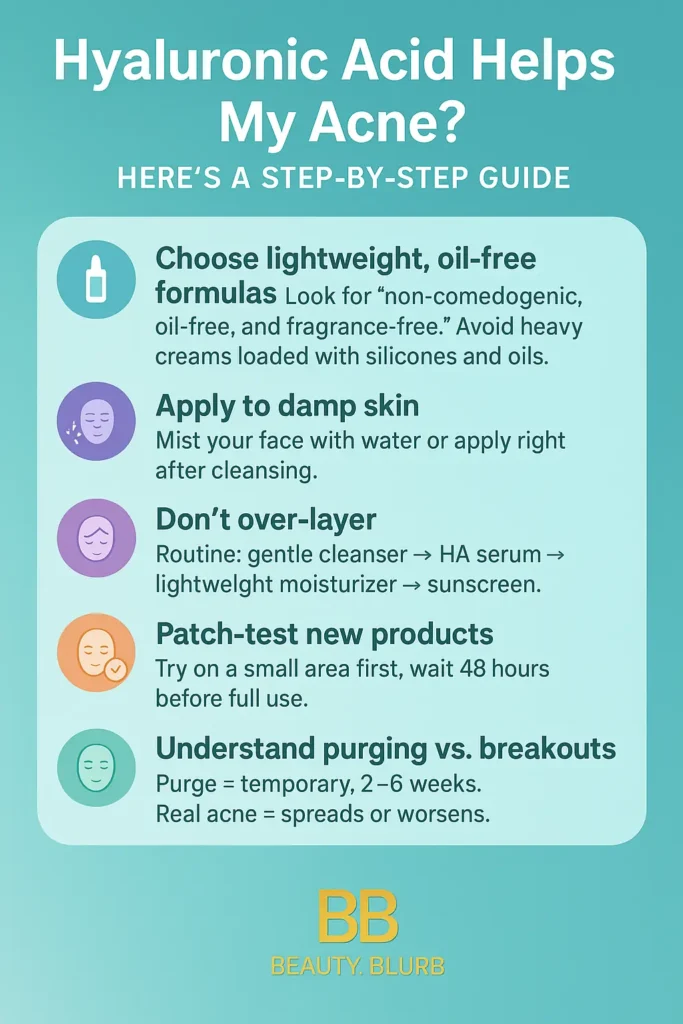
- Choose lightweight, oil-free formulas
Look for words like “non-comedogenic, oil-free, and fragrance-free. Thick creams or serums loaded with silicones and heavy oils can trap sebum, leading to clogged pores. - Apply to damp skin
Hyaluronic acid pulls water into your skin. If you apply it to dry skin, it may actually draw moisture out, leaving irritation that acne-prone skin doesn’t need. Always mist your face with water or apply right after cleansing. - Don’t over-layer
Pairing HA with a heavy moisturizer + sunscreen + makeup can suffocate acne-prone skin. Stick with a simple routine: gentle cleanser → HA serum → lightweight moisturizer → sunscreen. - Patch-test new products
Even if a product looks perfect on paper, your skin is unique. Apply HA on a small area of your cheek or jawline first. Wait 48 hours before using it on your whole face. - Understand skin purging vs. real breakouts
Sometimes, starting a new HA product alongside actives like retinoids or exfoliating acids may trigger temporary purging. This isn’t the same as acne—it’s your skin adjusting. A purge usually clears within 2–6 weeks, while true acne keeps spreading or worsening.
💡 Clinical insight: Clinical evidence shows that both cross-linked and non–cross-linked topical hyaluronic acid effectively reduced acne severity and minimized pore appearance—without adverse effects—so HA remains a safe and hydrating option even for acne-prone skin. Source.
That’s why dermatologists often recommend HA as a “base hydrator” in acne routines.
👉 Bottom line: Can hyaluronic acid cause breakouts? Not on its own. But the right formula + proper application makes the difference between glowing skin and frustrating flare-ups.
Pro Tip: Want a clearer picture of how hyaluronic acid really interacts with acne-prone skin? I’ve put together a detailed guide that brings in dermatologist insights and science-backed advice. You can check it out here: Is Hyaluronic Acid Good for Acne – The Truth Dermatologists Share.
Best Types of Hyaluronic Acid for Acne-Prone Skin
If you’re wondering what’s the best hyaluronic acid for acne-prone skin, the answer lies in the molecular weight. Not all HA molecules are created equal, and choosing the right type can make the difference between smooth, hydrated skin and unexpected breakouts.
🔹 High Molecular Weight HA (HMW-HA)
- Large molecules that sit on top of the skin.
- Create a light, breathable film that locks in hydration.
- Perfect for sensitive and acne-prone skin because they don’t penetrate deeply, reducing the risk of irritation.
🔹 Low Molecular Weight HA (LMW-HA)
- Smaller molecules that can penetrate into deeper skin layers.
- Provide intense hydration and may help with repairing the skin barrier.
- However, some dermatologists note that LMW-HA can occasionally cause redness or sensitivity in people with inflamed acne, because it’s more “active” at a cellular level.
💡 Clinical note:
A comprehensive Cochrane review including 49 randomized clinical trials (nearly 3880 participants) suggests that topical treatments like nicotinamide (niacinamide) and zinc may benefit acne-prone skin, although the evidence quality is moderate at best.
Topical niacinamide also reduces sebum production and supports skin barrier function—factors critical for managing acne-prone skin. Source
👉 Pro tip: If you’re acne-prone, start with a serum that lists “sodium hyaluronate” or “high molecular weight hyaluronic acid”. Once your skin adjusts, you can try blended formulas for deeper hydration.
Bottom line: The best hyaluronic acid for acne-prone skin is usually a lightweight, oil-free serum with high molecular weight HA—gentle enough to hydrate without clogging pores or triggering irritation.
Side Effects of Hyaluronic Acid for Acne
By now, we’ve already cleared the big question: does using hyaluronic acid cause acne? The short answer is no. But like any skincare ingredient, HA isn’t completely free of risks—and knowing the possible side effects helps you use it smartly, not fearfully.
Most people tolerate hyaluronic acid extremely well, since it’s a molecule naturally found in your own skin. Still, here are a few situations where you might notice unwanted reactions:
- Irritation or redness
Rare, but it can happen—usually not from HA itself, but from fragrances, preservatives, or alcohols blended into the formula. If your skin feels itchy or tight after applying a product, it’s likely the extras, not the hyaluronic acid. - Breakouts linked to heavy formulas
HA is non-comedogenic, but if it’s delivered in a thick, oily cream, the emollients might trap sweat and sebum, leading to clogged pores. Switching to lightweight, oil-free serums often solves the issue. - Purging when paired with actives
Introducing hyaluronic acid at the same time as retinoids or exfoliating acids can sometimes kick-start cell turnover. This “purge” may look like new pimples, but it’s usually temporary and a sign your skin is adjusting. - Sensitivity in compromised skin
If your skin barrier is already damaged (from over-exfoliation or harsh acne treatments), even a gentle hydrator can sting at first. Dermatologists suggest layering HA under a simple, fragrance-free moisturizer to buffer the effect.
🧴 Quick Tips: How to Avoid Side Effects of Hyaluronic Acid
| Tip 💡 | Why It Matters 🧴 |
|---|---|
| Choose lightweight formulas | Oil-free & non-comedogenic products reduce pore-clogging risks. |
| Patch test first | Helps you catch irritation or breakouts early before applying everywhere. |
| Layer smartly | Applying HA on damp skin then sealing it locks in hydration effectively. |
| Don’t overload actives | Combining HA with too many strong ingredients (retinoids, acids) can irritate skin. |
| Listen to your skin | Persistent redness, stinging, or breakouts mean it’s time to stop and seek advice. |
At the end of the day, hyaluronic acid isn’t the “villain” behind breakouts—it’s usually the supporting cast (heavy creams, hidden fragrances, or layering gone wrong).
Think of HA as a helpful team player: powerful when used right, but a little tricky if you throw it into the wrong mix. The secret is balance—keep your formulas clean, patch test before committing, and let your skin guide the way. When treated wisely, HA rarely bites back.
Best Way to Use Hyaluronic Acid for Acne-Prone Skin
If you’ve already figured out that hyaluronic acid itself isn’t the enemy, the next question is simple: how do you actually fit it into your daily acne routine without messing things up? Here’s a dermatologist-approved flow you can follow:
| Time | Step | What to Use | Why It Matters |
|---|---|---|---|
Morning | Cleanser | Gentle, sulfate-free | Removes oil without stripping the barrier. |
| Hyaluronic Acid | 2–3 drops on damp skin | Binds water for immediate hydration. | |
| Moisturizer | Lightweight, oil-free | Seals hydration without blocking pores. | |
| Sunscreen | SPF 30+ | Prevents acne scarring & hyperpigmentation. | |
Evening | Cleanser | Gentle cleanser | Removes sunscreen and daily grime. |
| Acne Treatment | Retinoid or BHA | Targets acne directly—use as advised. | |
| Hyaluronic Acid | On damp skin | Reduces dryness caused by treatments. | |
| Moisturizer | Gel-cream | Locks in hydration overnight. |
💡 Pro Tip: If you struggle with oily or acne-prone skin, hydration with hyaluronic acid is only one piece of the puzzle.
To get the best long-term results, it’s worth following a dermatologist-approved routine that balances cleansing, treatment, and protection.
We’ve put together a full dermatologist recommended skin care routine for oily skin that can help you control shine, prevent breakouts, and maintain healthy-looking skin.
FAQ Of Hyaluronic Acid Cause Acne
Thank you so much for taking the time to read through this guide, beautiful 💕. By now, you have a clearer answer to Does Hyaluronic Acid Cause Acne and how it can actually become a game-changing step in your skincare journey when used correctly.
Remember—healthy, glowing skin is all about listening to your skin and giving it the right care it deserves. So, don’t be afraid to try this routine and see how your skin responds. Every skin tells its own story, and yours is truly unique .
💬 I’d love to hear from you in the comments—have you tried hyaluronic acid before? Did it make a difference in your acne journey? Your experience might inspire someone else who’s searching for the same answers.

Akram Boulaid is a dedicated Skincare Researcher and Analyst with over 7 years of intensive focus on dermatology and cosmetic ingredient science. As a globally recognized expert, his insights have been featured in major international publications, including the New York Post and GB News. A verified expert on Qwoted, Akram connects with health journalists to provide evidence-based analysis. He founded Beauty Blurb to bridge the gap between complex clinical data and practical skincare routines, specializing exclusively in the needs of oily and acne-prone skin through rigorous analysis of peer-reviewed scientific literature.