Quick Answer
If you’re wondering Is Hyaluronic Acid Good for Acne? the short answer is definitely— it can be a helpful addition to your routine.
While it doesn’t directly treat pimples like benzoyl peroxide or salicylic acid, hyaluronic acid keeps your skin hydrated, soothes irritation, and supports healing. That means less dryness, less redness, and a healthier skin barrier, which all matter when you’re fighting breakouts.
Golden Tip: Pair hyaluronic acid with a lightweight, non‑comedogenic moisturizer to lock in hydration. Apply it on slightly damp skin right after cleansing — this boosts absorption and helps calm irritation while keeping your barrier strong.
You might also be asking, is hyaluronic acid good for acne-prone skin? In this article, we’ll walk through the science behind how it works, clear up common myths, show you exactly how to use it with acne treatments, and even share some of the best product options for acne-prone skin.
Let’s dive in together and make it simple.
what is Hyaluronic acid
Hyaluronic acid (HA) is a naturally occurring molecule in your body—found in your skin and joints—with one primary mission: moisture retention. Known as a “moisture magnet,” a single gram can hold up to a liter of water.
But for someone struggling with acne, HA is more than just a hydrator—it’s a protective buffer.
- The Weight Matters: Most acne-prone skin benefits from a mix of molecular weights. While High Molecular Weight HA creates a soothing shield on the surface to calm redness, Low Molecular Weight HA dives deeper to support the skin’s natural repair process.
- The Barrier Savior: Active acne treatments (like Salicylic Acid or Retinoids) often strip the skin, leaving it “angry” and flaky. HA steps in to lock water into the outer layer, ensuring your barrier stays strong enough to handle those tough treatments.
By keeping the skin surface balanced and resilient, Hyaluronic Acid ensures your journey to clear skin isn’t ruined by constant irritation and dryness.
Why Is Hyaluronic Acid Good for Acne
When talking about acne, we usually focus on treatments that dry out pimples — but there’s more to the story. In this section, we’ll explore how hyaluronic acid benefits go beyond hydration and why this gentle ingredient can still make a big difference for acne-prone skin.
1: Locks in Moisture Without Clogging Pores
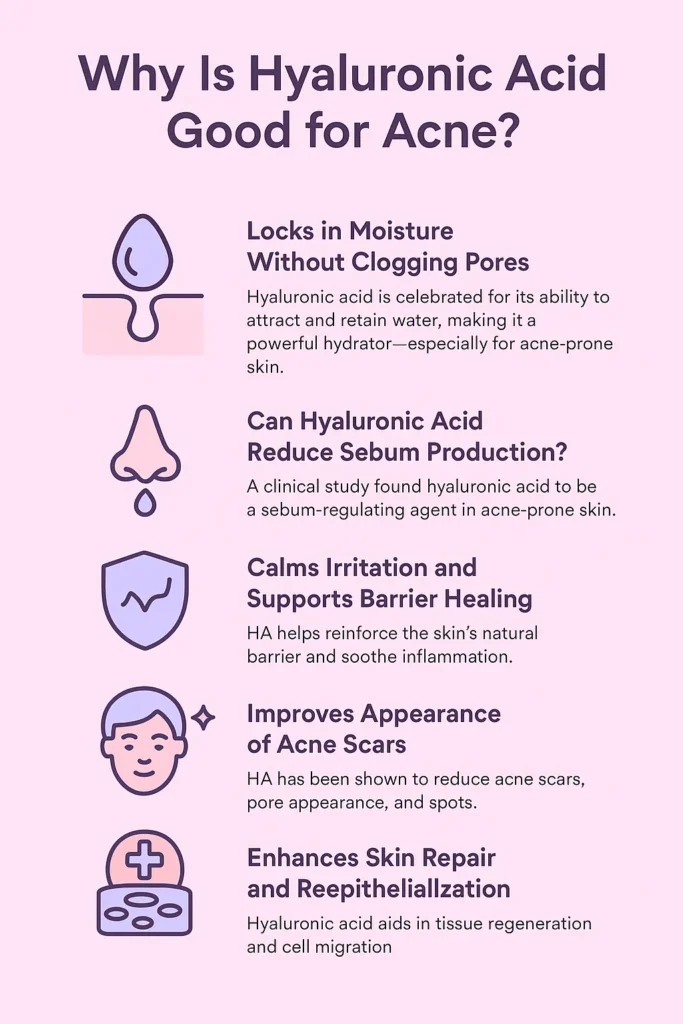
Hyaluronic acid is celebrated for its ability to attract and retain water, making it a powerful hydrator—especially for acne-prone skin. Unlike heavy oils or occlusives, HA delivers moisture without clogging pores, which helps maintain hydration while minimizing the risk of breakouts.
This hydration-supporting role lays the foundation for all other hyaluronic acid benefits in acne care.
2: Calms Irritation and Supports Barrier Healing
Acne treatments like benzoyl peroxide or retinoids often cause dryness and irritation. HA helps by reinforcing the skin’s natural barrier and soothing inflammation.
Its humectant properties attract moisture and reduce trans-epidermal water loss (TEWL), helping the skin tolerate acne treatments better and heal faster with less discomfort.
This vital role in supporting healing with hyaluronic acid complements the key notion of hyaluronic acid benefits in acne routines.
3: Improves Appearance of Acne Scars
Several studies highlight HA’s role in improving acne scars:
A dermal filler trial published in 2023 investigated both cross-linked and non–cross-linked HA treatments in participants (mean age ~32 years). Both forms led to significant reductions in acne severity and visible improvement in pores and spots.
Non–cross-linked HA showed better outcomes in reducing large pore appearance. Source.
A microinjection study involved 12 patients with moderate to severe atrophic acne scars who received a low-viscosity HA gel post-laser resurfacing. All exhibited immediate visual improvement in scar appearance, and the treatment was well tolerated. Source.
These findings serve as key hyaluronic acid for acne scars clinical studies, offering both cosmetic and therapeutic benefits for scar management.
4: Enhances Skin Repair and Reepithelialization
Hyaluronic acid plays a crucial role within the extracellular matrix, aiding tissue regeneration and cell migration.
Scientific sources describe how HA supports keratinocyte proliferation and wound repair—processes that are critical after inflammatory acne lesions disrupt the skin barrier. This foundational role in healing emphasizes yet another of HA’s essential hyaluronic acid benefits.
| Benefit | Supporting Evidence |
|---|---|
| Locks in moisture without clogging | Well-known humectant properties |
| Reduces sebum production | Clinical study (20 oily individuals, split-face, significant sebum reduction) |
| Soothes irritation, supports healing | Mechanism tied to hydration and barrier support |
| Improves acne scars | Filler trial & microinjection studies show visible improvement |
| Boosts skin repair | Role in epithelial healing and ECM support |
Conclusion: So, Is Hyaluronic Acid Good for Acne?
After looking at the research and real-world experiences, the answer is yes—hyaluronic acid can be good for acne.
While it doesn’t directly kill acne-causing bacteria, it helps in the ways your skin truly needs: keeping it hydrated without clogging pores, calming irritation from harsh treatments, supporting wound healing, and even improving the look of acne scars over time.
If you’re dealing with oily or acne-prone skin, adding hyaluronic acid could be the gentle yet powerful step that makes your skincare routine more effective and balanced.
Can Hyaluronic Acid Cause Acne?
Many people wonder, “does hyaluronic acid cause acne?” The good news is that, on its own, hyaluronic acid is a non-comedogenic ingredient. This means it does not clog pores or trigger breakouts directly. Instead, it simply works by pulling water into the skin to keep it hydrated.
So why do some people feel like they break out when using it? In most cases, the issue comes from the formulation of the product rather than the hyaluronic acid itself.
Some serums or creams may contain heavy oils, silicones, or added fragrances that can irritate acne-prone skin and lead to clogged pores.
Another reason could be a process called “skin purging.” If you’ve recently introduced new active ingredients (like retinoids or exfoliating acids) alongside hyaluronic acid, your skin may push out impurities, which looks like new pimples but usually calms down after a few weeks.
In short, hyaluronic acid itself does not cause acne. However, choosing the right formula—lightweight, oil-free, and fragrance-free—is essential to make sure you enjoy all its benefits without any unwanted side effects.
To avoid breakouts, simply go for formulas that are oil-free, lightweight, and non-comedogenic. Choosing fragrance-free products tested by dermatologists will also lower the risk of irritation and keep your skin clear.
How to Use Hyaluronic Acid for Acne-Prone Skin Safely
Now that we’ve answered the big question — Is Hyaluronic Acid Good for Acne? — let’s see how you can add it into your skincare routine the right way. Here’s a simple step-by-step routine you can follow:
🌙 Evening Routine (PM)
- Oil cleanser → Removes makeup, sunscreen, and excess sebum.
- Gentle foaming cleanser → Cleans away dirt without stripping the skin.
- Alcohol-free toner → Preps and balances your skin for better absorption.
- Hyaluronic acid serum (on damp skin) → Locks in hydration and soothes irritation.
- Targeted acne treatment → Apply benzoyl peroxide, salicylic acid, or retinoids if prescribed.
- Lightweight, non-comedogenic moisturizer → Seals in hydration and protects the skin barrier.
☀️ Morning Routine (AM)
- Gentle cleanser → Refreshes skin from overnight buildup.
- Alcohol-free toner → Keeps skin balanced and ready for hydration.
- Hyaluronic acid serum (on damp skin) → Provides all-day hydration.
- Light moisturizer → Maintains barrier function without heaviness.
- Broad-spectrum sunscreen (SPF 30+) → Shields skin from UV rays and prevents acne scars from darkening.
✨ Encouragement: Stick to this simple, structured routine and observe how your skin responds. If you see positive changes, share your experience in the comments — your story could help someone else with acne-prone skin.
🔎 Note for You: Want to build a more advanced plan? Check out our full guide on a [dermatologist recommended skin care routine for oily skin] — it ties perfectly with what you’ve just learned here.
💡 Transition Thought: Still, one question remains: if hyaluronic acid doesn’t directly target acne bacteria, where exactly does it fit in acne treatment? That’s what we’ll explore next.
Where Does Hyaluronic Acid Fit in Acne Treatment?
I know you’re wondering: “Does hyaluronic acid go before or after acne treatment?” Great question — and the answer depends on how your acne is being treated. Let’s break it down together in a simple way so you’ll know exactly where HA belongs in your routine.
Retinoids (Adapalene, Tretinoin, Isotretinoin)
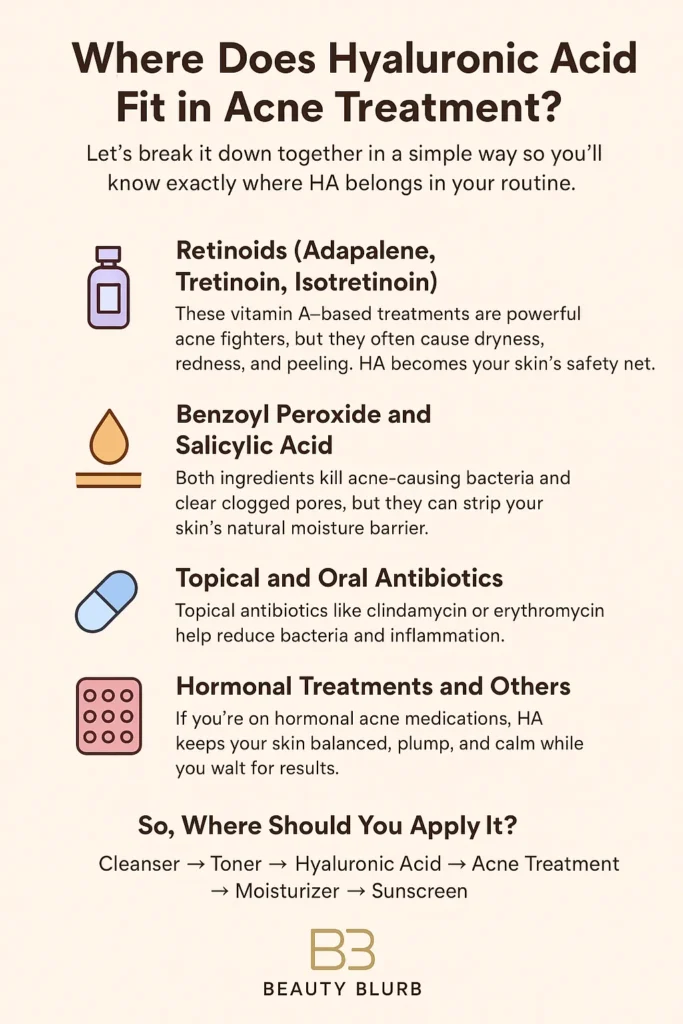
These vitamin A–based treatments are powerful acne fighters, but they often cause dryness, redness, and peeling. This is where hyaluronic acid becomes your skin’s safety net.
Applying HA right after cleansing — and before retinoids — helps cushion your skin, lock in hydration, and reduce irritation. Even if you’re on oral isotretinoin (Accutane), HA-based serums or even eye drops can help with dryness.
Benzoyl Peroxide or Salicylic Acid & hyaluronic acid
Both ingredients kill acne-causing bacteria and clear clogged pores, but they can strip your skin’s natural moisture barrier.
Using hyaluronic acid serum before these treatments hydrates and strengthens your skin, making it less likely to flake, sting, or feel tight.
By keeping your barrier intact, HA allows these treatments to work effectively without leaving you uncomfortable.
Topical and Oral Antibiotics
Topical antibiotics like clindamycin or erythromycin reduce bacteria and inflammation. Interestingly, clinical studies show that modified hyaluronic acid molecules can improve antibiotic penetration into oily skin.
In other words, pairing HA with topical antibiotics may make them work even better. For oral antibiotics, HA won’t interact directly, but it helps counter the dryness and sensitivity they often cause.
Hormonal Treatments and Others
If you’re on hormonal acne medications (like birth control pills or spironolactone), HA isn’t directly involved in the treatment process. But since these therapies often take time to show results, HA keeps your skin balanced, plump, and calm during the wait.
So, Where Should You Apply It?
Here’s the simple order most dermatologists recommend:
Cleanser → Toner → Hyaluronic Acid → Acne Treatment (retinoid, benzoyl peroxide, etc.) → Moisturizer → Sunscreen (AM only)
This way, HA hydrates and protects first, while still letting the acne medication do its job effectively.
✨ Key Takeaway: Hyaluronic acid won’t fight acne the way retinoids or benzoyl peroxide do. But as your skin’s loyal bodyguard, it ensures your acne treatments work better and feel gentler.
Is Hyaluronic Acid Good for Acne Scars On Face?
Acne scars are often more frustrating than pimples themselves—they linger long after breakouts heal. Many people wonder if hyaluronic acid can help fade these marks.

While it’s not a magic eraser, research shows that hyaluronic acid plays a supportive role in scar improvement, mainly by keeping skin hydrated and boosting its natural repair processes.
When skin is well-hydrated, it becomes more supple and resilient. This helps shallow scars appear less noticeable and prevents new irritation that could make post-acne marks worse.
One of the lesser-known hyaluronic acid benefits for oily skin is that it restores balance: it locks in water without adding extra oil, making it suitable even for acne-prone complexions that struggle with greasy texture.
Clinical studies also suggest that when hyaluronic acid is combined with treatments like microneedling or laser therapy, the results for acne scars improve significantly. This is because HA enhances collagen formation, which is key to smoothing indented scars over time.
Some dermatologists even use hyaluronic acid–based fillers to temporarily lift deep scars and give the skin a more even surface.
So, while hyaluronic acid may not remove scars on its own, it creates the perfect environment for your skin to heal and maximizes the effects of professional acne-scar treatments.
Can You Use Hyaluronic Acid on Hormonal Acne?
Hormonal acne often appears during puberty, pregnancy, menopause, or in conditions like polycystic ovarian syndrome (PCOS). These breakouts are linked to fluctuations in hormones such as androgens, which increase oil production and clog pores.

Managing hormonal acne requires a careful balance between effective acne treatments and hydrating, non-irritating skincare.
Hyaluronic acid can play a key role in this routine. Hyaluronic acid for hormonal acne works by hydrating the skin without adding oil, supporting the skin barrier, and reducing irritation from acne treatments like benzoyl peroxide, adapalene, or topical antibiotics.
Because hormonal acne skin tends to be sensitive and inflammation-prone, adding a hydrating serum with hyaluronic acid helps prevent dryness and maintain comfort.
Research and clinical experience show that using hyaluronic acid for acne-prone skin—even during hormonal breakouts—does not worsen acne. On the contrary, it supports healing and overall skin health while complementing acne medications.
For instance, applying HA after cleansing but before heavier treatments can improve absorption and reduce treatment-related irritation.
Tips for using HA on hormonal acne:
- Always apply on clean skin to avoid trapping bacteria.
- Use non-comedogenic serums to prevent clogged pores.
- Layer HA before medicated acne treatments for best results.
- Pair with gentle moisturizers or sunscreen to protect sensitive skin.
By following these steps, you can safely integrate hyaluronic acid for hormonal acne into your routine, helping your skin stay hydrated, calm, and balanced while treatments target the root causes of breakouts.
Possible Side Effects of Hyaluronic Acid for Acne
Hyaluronic acid is generally considered one of the safest skincare ingredients—even for acne-prone skin. Since it is naturally found in the body, most people tolerate it very well.
Still, like any product, it may have some side effects, especially if used incorrectly or if the formula doesn’t suit your skin. Here are the most common ones to be aware of:
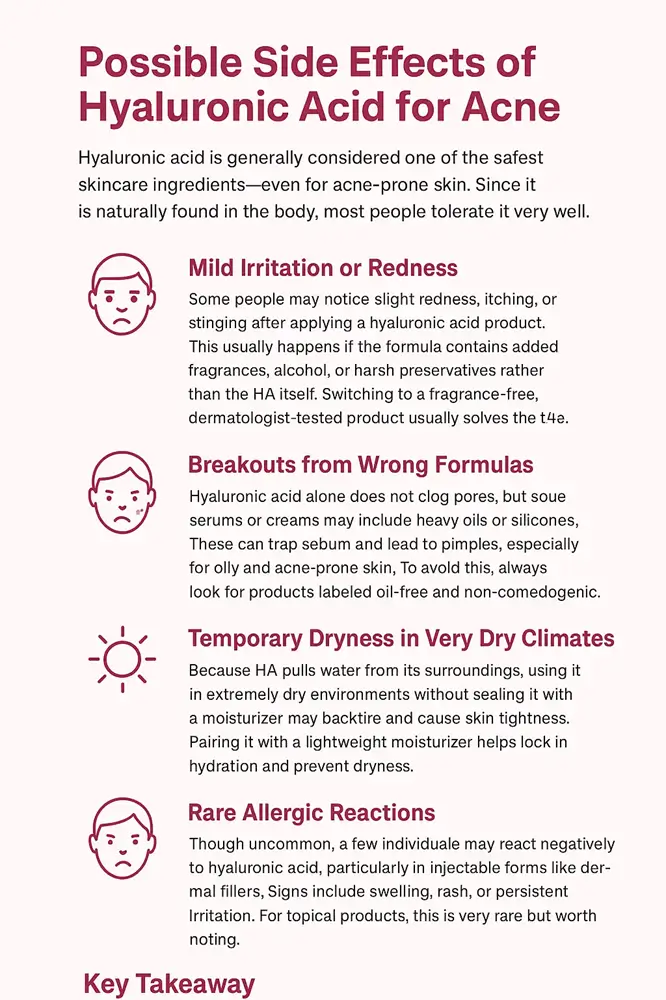
1. Mild Irritation or Redness
Some people may notice slight redness, itching, or stinging after applying a hyaluronic acid product. This usually happens if the formula contains added fragrances, alcohol, or harsh preservatives rather than the HA itself. Switching to a fragrance-free, dermatologist-tested product usually solves the issue.
2. Breakouts from Wrong Formulas
Hyaluronic acid alone does not clog pores, but some serums or creams may include heavy oils or silicones. These can trap sebum and lead to pimples, especially for oily and acne-prone skin. To avoid this, always look for products labeled oil-free and non-comedogenic.
3. Temporary Dryness in Very Dry Climates
Because HA pulls water from its surroundings, using it in extremely dry environments without sealing it with a moisturizer may backfire and cause skin tightness. Pairing it with a lightweight moisturizer helps lock in hydration and prevent dryness.
4. Rare Allergic Reactions
Though uncommon, a few individuals may react negatively to hyaluronic acid, particularly in injectable forms like dermal fillers. Signs include swelling, rash, or persistent irritation. For topical products, this is very rare but worth noting.
🔹 Key Takeaway: Hyaluronic acid is safe for most people with acne, but results depend on choosing the right formula and applying it correctly. If you notice unusual irritation or breakouts, discontinue use and consult a dermatologist.
Side Effects Of Hyaluronic Acid for Acne from Injections
When hyaluronic acid is injected as a dermal filler, side effects depend heavily on the provider’s skill and technique. While most reactions are temporary and mild, more serious complications can occur if performed incorrectly. Here are the possible issues:
- Mild reactions: Redness, swelling, tenderness, or bruising around the injection site—these usually resolve within days.
- Allergic responses: Rare but possible, especially if the filler contains preservatives.
- Inflammatory nodules (skin lumps): Small, firm bumps can develop under the skin due to the body’s reaction.
- Infections: If strict hygiene is not followed, bacterial infections may occur.
- Cold sore reactivation: People with a history of herpes simplex may notice flare-ups after injections.
- Filler migration: The injected HA may shift from the original site, causing uneven cosmetic results.
- Skin discoloration: A bluish tint (Tyndall effect) may appear if the filler is placed too close to the skin surface; post-treatment hyperpigmentation or hypopigmentation can also occur.
- Scarring at the injection site: Rare, but possible if healing is disrupted.
- Accidental injection into a blood vessel: The most serious risk, which can block blood flow and cause tissue damage, skin ulceration, vision loss, or even stroke.
👉 These risks underline why injectable HA should only be done by board-certified dermatologists or licensed specialists.
Is Hyaluronic Acid or Niacinamide Good for Acne?
Many readers ask: is hyaluronic acid or niacinamide better for acne? Both ingredients are highly popular in acne-prone skincare, but they work differently and offer unique benefits. The following table breaks down their effects, strengths, and best use cases for acne-prone and oily skin:
| Feature | Hyaluronic Acid | Niacinamide |
|---|---|---|
| Primary Function | Hydration & skin barrier support | Anti-inflammatory, oil regulation, brightening |
| Acne Benefits | Reduces dryness & irritation from acne treatments | Reduces sebum production, calms inflammation, fades acne marks |
| Suitable for | All skin types, especially dry or sensitive acne-prone skin | Oily, combination, and sensitive acne-prone skin |
| Application | Apply after cleansing, before moisturizer and sunscreen | Apply after cleansing or as part of serum layer, can combine with HA |
| Clinical Insights | Supports skin healing during treatment, enhances tolerance to active ingredients | Clinical studies show reduction in breakouts & post-inflammatory hyperpigmentation |
| Side Effects | Rare, mostly mild irritation if combined with irritants | Rare, slight redness or tingling possible if concentration >10% |
Conclusion:
Both hyaluronic acid and niacinamide are valuable in acne care, but their roles differ. Hyaluronic acid primarily restores hydration and reduces irritation, while niacinamide targets oil production, inflammation, and discoloration. Using them together can provide comprehensive care for acne-prone skin, balancing hydration and active treatment benefits.
Note: To explore niacinamide’s benefits in oily acne-prone skin, check out our full guide here: [Is Niacinamide Good for Oily Acne-Prone Skin].
What Medications Should Not Be Taken With Hyaluronic Acid?
I know you’re wondering, What should I never mix with hyaluronic acid? Let’s simplify this so you can safely incorporate hyaluronic acid into your skincare or supplement routine without any unwanted interactions.
Hyaluronic acid is generally very safe and well-tolerated, whether applied topically or taken as a supplement. However, certain medications and treatments can potentially interact or reduce its effectiveness:
- Blood Thinners (Anticoagulants like Warfarin or Heparin): Hyaluronic acid injections in the joints or skin may increase the risk of minor bleeding or bruising.
- Immune-Suppressing Medications: While rare, combining injectable hyaluronic acid with immunosuppressants might increase the risk of mild infection at the injection site.
- High-Dose Retinoids (e.g., Oral Isotretinoin): Using topical or injectable hyaluronic acid during intense retinoid therapy is usually safe, but the skin may be more sensitive. A dermatologist may adjust timing to prevent irritation.
- Other Injectable Fillers: Mixing multiple injectable dermal fillers at the same session can lead to uneven results or swelling. Always consult your provider.
💡 Pro Tip: Topical hyaluronic acid serums are generally safe with almost all medications. Most potential interactions appear only with injectable forms, so proper guidance from a certified dermatologist or healthcare professional is essential.
Best Hyaluronic Acid Products for Acne-Prone Skin
After extensive research, I’ve compiled a list of the best hyaluronic acid products from top brands that dermatologists actually recommend. These options are carefully selected to hydrate your skin without aggravating acne.
| Brand | Product | Price | Key Feature |
|---|---|---|---|
| The Ordinary | Hyaluronic Acid 2% + B5 | $12 | Lightweight hydration, suitable for oily skin |
| La Roche-Posay | Hyalu B5 Serum | $29 | Supports skin barrier, enriched with vitamin B5 |
| Neutrogena | Hydro Boost Water Gel | $19 | Oil-free hydration, absorbs quickly |
| Vichy | Minéral 89 Hyaluronic Acid Booster | $22 | Strengthens skin barrier, gentle for sensitive skin |
If you’re interested in a detailed review of any of these products, just let me know in the comments—I’d be happy to do it for you and guide you step by step!
My Experience with Hyaluronic Acid for Acne-Prone Skin
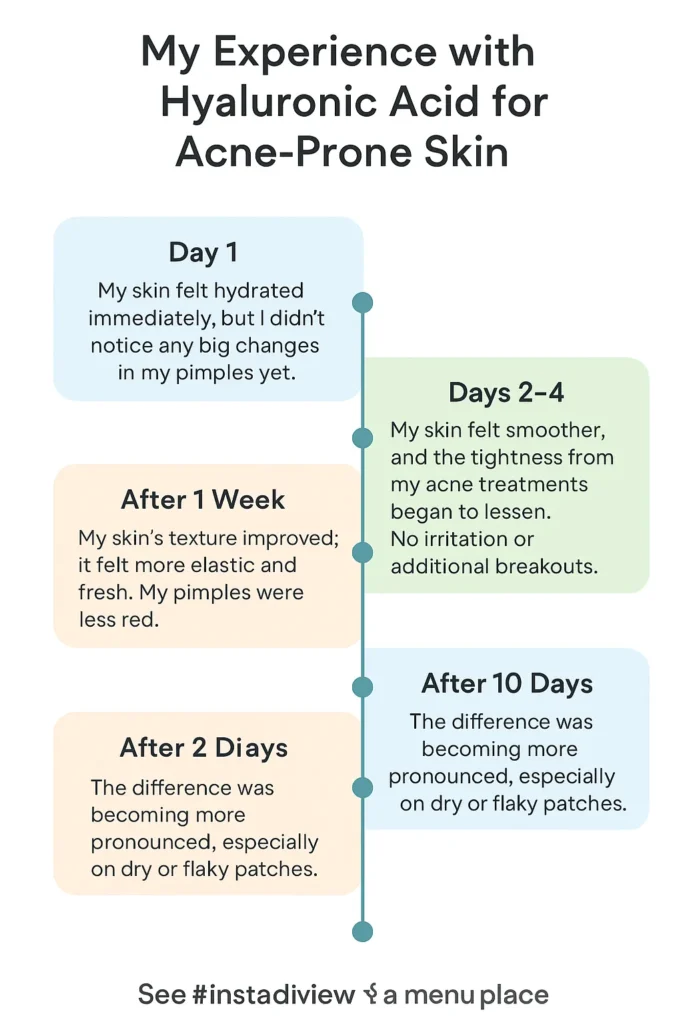
Day 1
I could already feel my skin needing some serious hydration after cleansing. I applied a hyaluronic acid serum right after washing my face, before any moisturizer.
My skin felt instantly soft and plump, but honestly, I didn’t notice any big changes in my pimples yet.
Days 2–4
I kept up the same routine morning and night. My skin started feeling smoother, and the tight, dry feeling from my acne treatments began to ease up. No irritation or extra breakouts, which was a huge relief!
After 1 Week
I noticed my skin’s texture improving. It felt more elastic and fresh. My pimples weren’t smaller yet, but the redness seemed to calm down a bit.
After 10 Days
The difference was becoming more obvious, especially on dry or flaky patches. My skin tolerated other acne treatments better too—less stinging from retinoids or benzoyl peroxide, which was amazing.
After 1 Month
My skin felt balanced, hydrated, and calmer overall. Breakouts appeared less inflamed, and my skin texture was super smooth. Even my usual acne treatments didn’t dry me out like before.
Note: This is just my personal experience! Everyone’s skin is different, so your results might not be exactly the same.
Hyaluronic Acid & Acne – Frequently Asked Questions
Clear, dermatologist-informed answers for acne-prone and sensitive skin.
Is hyaluronic acid serum good for acne?
Yes—hyaluronic acid (HA) is non-comedogenic and boosts hydration, which helps your skin tolerate acne treatments (like retinoids or benzoyl peroxide) better. It supports the barrier but isn’t an acne medication by itself.
Is hyaluronic acid good for fungal acne?
Generally yes. Pure HA is a sugar-based humectant and doesn’t feed Malassezia. The issue is usually the formula—avoid products heavy in esters, polysorbates, and certain plant oils if you’re reactive. Choose simple, “fungal-acne-safe” formulas.
Is hyaluronic acid good for cystic acne?
HA helps with comfort and barrier repair but won’t treat cystic (deep, inflamed) acne. For cysts, see a dermatologist and use proven actives (e.g., retinoids, benzoyl peroxide, azelaic acid). Intralesional steroids may help large lesions.
Which is better for acne: salicylic acid or hyaluronic acid?
For clearing acne, salicylic acid (BHA) is better—it penetrates pores, reduces oil, and helps unclog comedones. Hyaluronic acid is for hydration and barrier support. Many routines use both: BHA to treat, HA to hydrate.
What is a patch test—and do you need it before using a hyaluronic acid product?
A patch test checks for delayed skin reactions (contact dermatitis). Yes, it’s smart when trying a new serum. Apply a small amount behind the ear or on the inner arm once daily for 2–3 days. If you see redness, burning, or itch, don’t use it on your face.
Should people with acne use hyaluronic acid?
Absolutely. Acne regimens often dry the skin; HA adds water without clogging pores, improving comfort and adherence to treatment. Look for “non-comedogenic” gels or serums and layer under your moisturizer.
Can you overuse hyaluronic acid?
You can. In very dry air or when layered too many times without sealing moisture, HA may pull water out of your skin and leave it tight or irritated. Use 1–2 HA products max, apply to damp skin, and seal with a moisturizer.
Can hyaluronic acid serum trigger acne in acne-prone skin?
It’s uncommon. HA itself doesn’t clog pores. If you break out after a new HA serum, the culprits are usually other comedogenic ingredients, fragrance, heavy occlusives, or simply irritation. Patch test and choose simpler formulas.
Sources: GoodRx (non-comedogenic & adherence benefits); Cleveland Clinic (what a patch test is); AAD & JAAD guidelines (salicylic acid treats acne; HA isn’t an acne drug); BH Skin (breakouts usually from other ingredients); SimpleSkincareScience/FA resources (Malassezia-safe approach); Hudson Dermatology & Vogue (don’t over-layer HA in dry climates).
Thank you so much for reading! Skincare is always a personal journey, and if you’ve ever wondered Is Hyaluronic Acid Good for Acne?—the answer is that while it won’t treat breakouts directly, it can be a gentle game-changer for keeping your skin hydrated, calm, and more resilient.
I’d love to hear from you—have you tried hyaluronic acid in your routine? Did it help your skin feel better while managing acne? 🌿 Share your experience in the comments below so we can all learn from each other’s journey. Your story might inspire someone else who’s just starting out! 💖

Akram Boulaid is a dedicated Skincare Researcher and Analyst with over 7 years of intensive focus on dermatology and cosmetic ingredient science. As a globally recognized expert, his insights have been featured in major international publications, including the New York Post and GB News. A verified expert on Qwoted, Akram connects with health journalists to provide evidence-based analysis. He founded Beauty Blurb to bridge the gap between complex clinical data and practical skincare routines, specializing exclusively in the needs of oily and acne-prone skin through rigorous analysis of peer-reviewed scientific literature.