
Can I Use Salicylic Acid and Niacinamide Together? Yes — you absolutely can, and when used the right way they make an excellent team for oily and acne-prone skin.
Salicylic acid works deep inside the pores to clear out excess oil and prevent breakouts, while niacinamide helps calm irritation, strengthen the skin barrier, and keep your skin balanced.
The key is not just whether you can use them together, but how you apply them:
start with your salicylic acid product, then follow with niacinamide or use them in separate routines (AM vs PM) to maximize their benefits without causing unnecessary irritation.

In this guide, we’ll break down everything you need to know about using niacinamide and salicylic acid together.
You’ll discover their individual benefits, how they work in synergy, the right order to apply them, common mistakes to avoid, and dermatologist-backed routines tailored especially for oily skin.
By the end, you’ll have a clear, step-by-step plan to safely combine these two powerhouse ingredients in your skincare routine.
What is Salicylic Acid and How Does It Work?
Salicylic acid is a type of beta hydroxy acid (BHA) that’s widely used in skincare, especially for people struggling with oily or acne-prone skin.
Unlike water-based acids, salicylic acid is oil-soluble, which means it can penetrate deep into pores and dissolve the buildup of excess sebum, dead skin cells, and debris.
This unique property makes it one of the most effective ingredients for clearing clogged pores and reducing breakouts.
When applied regularly, salicylic acid gently exfoliates the skin’s surface while also working inside the pores to prevent congestion.
It helps to minimize blackheads, control shine, and reduce the chances of new pimples forming. That’s why many dermatologists recommend salicylic acid for oily skin as a first-line treatment — it directly targets the root causes of acne and excess oil production.
In addition to its exfoliating power, salicylic acid has mild anti-inflammatory properties. This makes it especially helpful for calming redness and irritation often associated with acne.
Overall, it’s a multi-tasking ingredient that not only unclogs pores but also refines skin texture and supports a clearer, smoother complexion.
What is Niacinamide and How Does It Work?
Niacinamide, also known as vitamin B3, is a water-soluble ingredient that has become one of the most popular choices in modern skincare.
Unlike exfoliating acids, niacinamide doesn’t strip the skin — instead, it supports and strengthens your skin barrier. This makes it gentle enough for daily use while still delivering powerful results.
One of the key niacinamide benefits is oil regulation. It helps reduce excess sebum production, which is why many dermatologists recommend niacinamide for oily skin.
By controlling shine and minimizing enlarged pores, it creates a smoother, more balanced complexion. At the same time, it soothes redness and calms irritation, making it ideal for acne-prone and sensitive skin types.
But that’s not all. Niacinamide also boosts hydration, supports collagen production, and evens out skin tone. When you’re searching for the Best Ingredients for Oily Skin,
niacinamide always makes the list because it works in harmony with other active ingredients like salicylic acid. Instead of competing, it complements them — helping your skin stay clear, calm, and resilient.
Can I Use Salicylic Acid and Niacinamide Together?
Can I use salicylic acid and niacinamide together everyday? Yes — in many cases you can use salicylic acid and niacinamide together daily, but with caution and gradual buildup.
While niacinamide is gentle and works to soothe and regulate oil, salicylic acid is more potent and can irritate skin if overused.
The smartest strategy is to start with alternating days or use niacinamide in the morning and salicylic acid in the evening. Always monitor how your skin responds — if you notice dryness or irritation, scale back.
Benefits of Using niacinamide and salicylic acid together
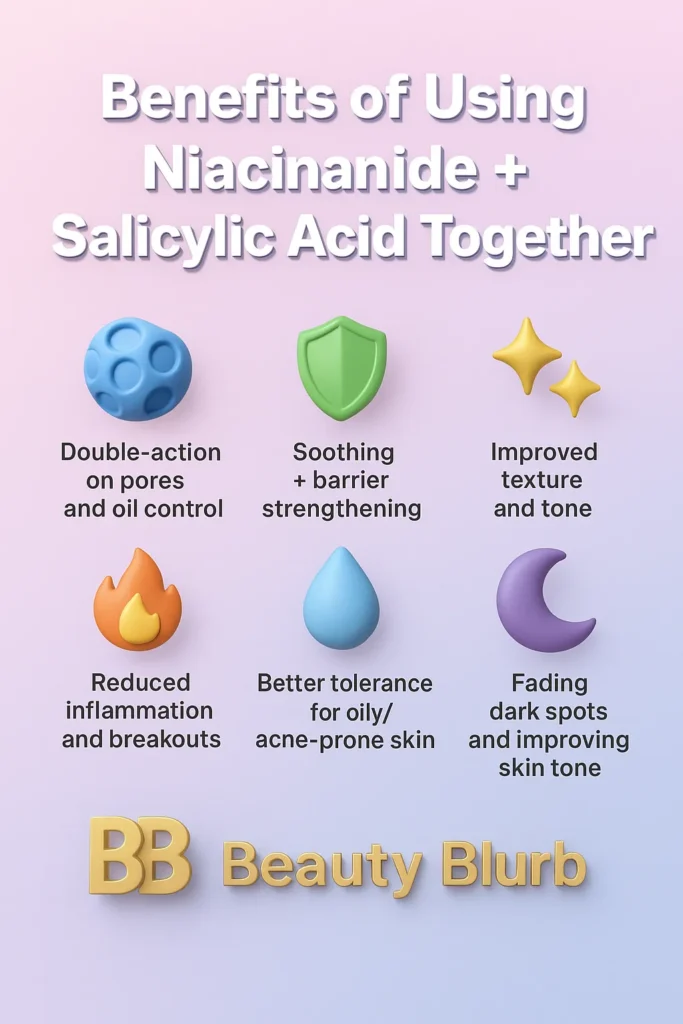
- Double-action on pores and oil control: Salicylic acid exfoliates inside pores to remove buildup, while niacinamide reduces sebum production, leading to less shine and clogged pores.
- Soothing + barrier strengthening: Niacinamide helps repair and calm the skin barrier, reducing the irritation salicylic acid may cause.
- Improved texture and tone: Together they can smooth rough skin, fade post-acne marks, and help with even tone.
- Reduced inflammation and breakouts: Salicylic acid’s anti-comedonal effect combined with niacinamide’s anti-inflammatory action helps tackle acne and reduces redness.
- Better tolerance for oily/acne-prone skin: Using them together (or in split routines) can let you get the benefits of both without overwhelming your skin.
- Fading Dark Spots and Improving Skin Tone: Together, salicylic acid exfoliates away pigmented dead cells while niacinamide brightens the complexion, helping fade acne marks and dark spots for a more even skin tone.
- Supporting Anti-Aging Efforts: This duo not only keeps pores clear and skin calm but also boosts collagen production and smooths fine lines, making it a smart choice for long-term anti-aging skincare.
Clinical study:
Supramolecular Salicylic Acid Combined with Niacinamide in Chloasma: A Randomized Controlled Trial:
- Authors: Ying Xiong et al.
- Source: Clinical and Experimental Dermatology (Oxford University Press).
- Participants: 300 people total — 150 in the treatment group (30% supramolecular salicylic acid + 10% niacinamide) and 150 in the placebo group.
- Duration: 16 weeks.
- Results: Participants who used 30% SSA + 10% niacinamide showed significant reduction in mMASI score (modified Melasma Area and Severity Index) compared to placebo (P < 0.001). The treatment was found to be effective and safe with good tolerability, few adverse events. Source.
Another Clinical study:
Efficacy & Safety of 30% Salicylic Acid + 10% Nicotinamide Combined Therapy in Melasma:
- Registry: ClinicalTrials.gov .
- Participants: 56 patients with moderate-to-severe melasma, divided into four groups:
- Placebo control
- SA peels alone (30% SA every 2 weeks, 8 sessions)
- NAM cream alone (10% nicotinamide, twice daily for 16 weeks)
- Combination of SA + NAM .
- Duration: 16 weeks treatment period (peeling and topical) with assessments at multiple intervals.
- Outcomes: The combination therapy group showed better improvement in melasma severity (mMASI), pigmentation indices, compared to either treatment alone or placebo. Side-effects were mild and tolerable. Source.
So, is it okay to use salicylic acid and niacinamide together? Absolutely. When combined thoughtfully, they work in harmony.
salicylic acid purifies deep within the pores, while niacinamide restores balance, resilience, and clarity to the skin.
This pairing doesn’t just manage oil and breakouts; it helps refine texture, support the barrier, and promote an overall healthier complexion.
Evidence from clinical research reinforces that the duo is both safe and effective, provided you introduce them gradually and respect your skin’s tolerance.
With the right approach, salicylic acid and niacinamide together can shift your routine from basic care to a results-driven strategy for long-term skin health.
How to Use Salicylic Acid and Niacinamide Together
Many people wonder: Can I mix salicylic acid with niacinamide? Yes, but it’s best not to apply them at the exact same time because of their different pH levels.
A smarter approach is to separate them — salicylic acid in the evening and niacinamide in the morning. This way, each ingredient works at its optimal environment without interfering with the other.

Step-by-Step skincare Routine with salicylic acid and niacinamide
Here’s a minimalist, easy-to-follow guide on how to use salicylic acid and niacinamide together minimalist:
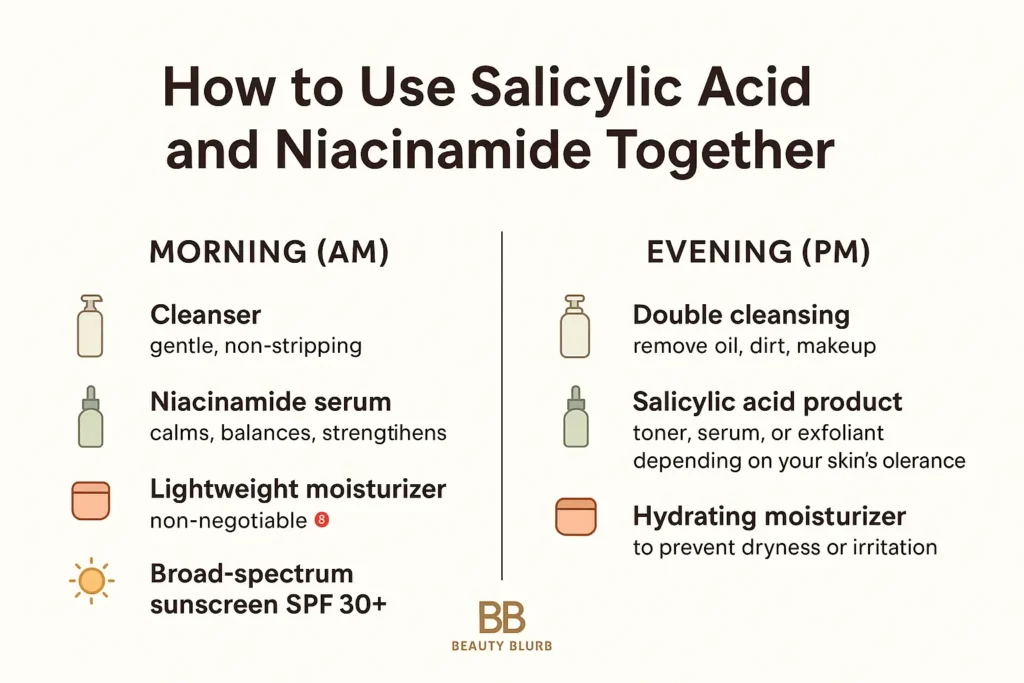
- Morning (AM)
- Cleanser (gentle, non-stripping)
- Niacinamide serum (calms, balances, strengthens)
- Lightweight moisturizer
- Broad-spectrum sunscreen SPF 30+ (non-negotiable 🚨)
- Evening (PM)
- double cleansing (remove oil, dirt, makeup)
- Salicylic acid product (toner, serum, or exfoliant depending on your skin’s tolerance)
- Hydrating moisturizer (to prevent dryness or irritation)
Pro Tips for Best Results
- Start slow: Use salicylic acid 2–3 nights per week at first, then increase if your skin tolerates it.
- Patch test: Always test new products on a small area before applying to your whole face.
- Moisturize generously: Both actives need barrier support to prevent dryness.
- Sun protection is non-negotiable: Salicylic acid increases sensitivity to UV rays — sunscreen is your best friend.
- Listen to your skin: If irritation occurs, reduce frequency or concentration.
So, if you’ve been debating whether to try them, the answer is: absolutely — give it a go! With the right routine, salicylic acid and niacinamide together can make a real difference for oily and acne-prone skin.
Try this step-by-step guide for a few weeks, and don’t forget to share your personal experience in the comments — your journey might inspire someone else.
Pro Note (with a wink 😉):
Think of salicylic acid and niacinamide like a legendary skincare duo: Batman works best at night, and Robin shines in the morning.
But hey, if you’re looking for the whole Justice League of skin heroes, don’t miss my guide on the dermatologist recommended skin care routine for oily skin — that’s where all the superheroes assemble!
Risks & Common Mistakes When Using Niacinamide and Salicylic Acid Together
Do you use salicylic acid before or after niacinamide? Great question — and one many people ask! The short answer is: apply salicylic acid first, then follow with niacinamide.
Why? Because salicylic acid has a lower pH and needs to penetrate the pores effectively, while niacinamide works best afterward to calm, balance, and strengthen your skin.
If you mix them in the wrong order or use too much at once, you might not only reduce their effectiveness but also increase the risk of irritation.
For example, you could use a The ordinary 2% salicylic acid serum at night to clear out excess oil and unclog pores, then apply a 5–10% niacinamide serum the next morning to reduce redness, control sebum, and reinforce your skin barrier.
This way, you’re still combining their benefits without overwhelming your skin — and keeping irritation to a minimum.
Potential Risks of Niacinamide and Salicylic Acid Together
- Over-exfoliation: Using salicylic acid too frequently, especially with high-strength products, can lead to dryness, peeling, or redness.
- Skin irritation: Sensitive skin types may react if both actives are layered too aggressively in one routine.
- pH conflict: Applying them incorrectly (niacinamide first) can neutralize the acidic environment that salicylic acid needs to work.
- Increased sun sensitivity: Salicylic acid can make skin more vulnerable to UV damage, which means daily sunscreen is a must.
Common Mistakes to Avoid
- Layering too many actives: Combining niacinamide and salicylic acid with other strong ingredients (like retinol or high-strength vitamin C) can overwhelm the skin barrier.
- Skipping moisturizer: Both actives need hydration support to avoid dryness or irritation.
- Forgetting sunscreen: One of the biggest mistakes — salicylic acid without SPF protection increases the risk of sunspots and post-acne marks.
- Starting too strong: Jumping straight into daily use instead of building tolerance gradually.
- Ignoring patch testing: Not testing new products first can lead to unexpected breakouts or allergic reactions.
By avoiding these mistakes and using a mindful approach, you’ll get the most out of niacinamide and salicylic acid together. Think of it as creating balance:
let salicylic acid do the deep cleaning, and let niacinamide rebuild and protect.
When used correctly, this duo can become one of the best skincare routines for oily skin — safe, effective, and dermatologist-approved.
What not to mix with niacinamide and salicylic acid?
While both are powerhouse ingredients, pairing them with the wrong actives can backfire, causing irritation, flushing, or reduced effectiveness.”
Here’s a quick reference table showing ingredients that may clash with niacinamide or salicylic acid, and why you should avoid mixing them in the same routine.
| Ingredient | Do Not Mix With Niacinamide | Do Not Mix With Salicylic Acid | Reason |
|---|---|---|---|
| Vitamin C (Ascorbic Acid) | ✔️ High concentrations — pH conflict | ⚠️ Generally safe, but too many actives can irritate | pH differences may reduce effectiveness and cause flushing. |
| Strong AHAs (Glycolic, Lactic) | ⚠️ Caution — barrier stress | ❌ Avoid stacking with BHA | Too much exfoliation causes dryness and barrier damage. |
| Retinoids (Retinol, Tretinoin) | ⚠️ Possible irritation | ❌ Not recommended in same routine | Combining can lead to peeling, dryness, and sensitivity. |
| Benzoyl Peroxide | ✅ Safe with niacinamide | ⚠️ Use cautiously | Overly drying when paired with BHA — moisturize well. |
| Multiple Strong Actives | ⚠️ Avoid overloading | ⚠️ Avoid overloading | Too many actives overwhelm skin — keep it minimalist. |
“So, when thinking about What should I not use with niacinamide and salicylic acid, the key is balance. Keep your routines simple, avoid doubling up on strong actives, and let each ingredient shine.
If you’re unsure, alternate days or ask your dermatologist for a personalized plan.”
what are Best Products with Salicylic Acid and Niacinamide?
If you’re wondering which products combine salicylic acid and niacinamide together in the most effective way, you’re in the right place.
The skincare market is filled with options, but not all are created equal. To save you the trial-and-error, we’ve handpicked dermatologist-loved products that balance these powerhouse ingredients for oily and acne-prone skin.
Best Products of Salicylic Acid
Top picks for oily & acne-prone skin — easy-to-use exfoliants that unclog pores and reduce blackheads.
| Product | Main Benefits | Form / Strength | Rating | Buy / Review |
|---|---|---|---|---|
PC | Clears pores, reduces blackheads, gentle daily use for many skin types. | Liquid / 2% Salicylic Acid | View / Review | |
TO | Affordable, beginner-friendly, spot-targets congested pores & whiteheads. | Solution / 2% Salicylic Acid | View / Buy | |
CV | Gentle daily exfoliation; supports barrier with ceramides and niacinamide. | Cleanser / contains SA (concentration not listed) | View / Buy | |
LP | Good for oily, acne-prone skin; reduces spots and calms redness. | Cream / contains SA derivatives and supportive actives | View / Buy |
✨ Lucky for you, we’ve already done an in-depth review of this cult favorite: The Ordinary Salicylic Acid Review. Don’t miss it if you’re curious about whether it’s worth the hype.
Best Products of Niacinamide
| Product | Key Benefits | Best For | Rating |
|---|---|---|---|
| The Ordinary Niacinamide 10% + Zinc 1% | Controls oil, reduces blemishes | Oily & acne-prone skin | ⭐⭐⭐⭐⭐ |
| Paula’s Choice 10% Niacinamide Booster | Minimizes pores, smooths texture | All skin types | ⭐⭐⭐⭐⭐ |
| CeraVe PM Facial Moisturizing Lotion | Hydration + skin barrier support | Sensitive & dry skin | ⭐⭐⭐⭐ |
| La Roche-Posay Mela B3 Serum | Brightens skin, reduces dark spots | Pigmentation & uneven tone | ⭐⭐⭐⭐⭐ |
🌸 These products not only deliver results but also complement salicylic acid beautifully. Try one of them in your routine.
don’t forget to share your experience in the comments — I’d love to hear which combo worked best for you!
FAQ Of salicylic acid and niacinamide together
Salicylic acid unclogs pores, niacinamide calms irritation, and hyaluronic acid restores hydration. Use salicylic acid first, then niacinamide, and seal with hyaluronic acid for moisture balance.
Apply salicylic acid first to clear pores, then follow with niacinamide to calm and strengthen your skin barrier overnight. Always moisturize and avoid overuse if you notice dryness.
Salicylic acid works best at a low pH, while Vitamin C (ascorbic acid) also prefers acidic conditions. Niacinamide pairs better in a separate routine (AM vs PM) to avoid irritation. A common approach: Vitamin C in the morning, salicylic acid + niacinamide at night.
Most people can safely use them 3–4 times a week. If your skin adapts well, you may use them daily. Start slow and always monitor for dryness or sensitivity.
Retinol can be irritating when combined with acids. A safe method is using niacinamide in the morning and retinol at night, or alternating retinol and salicylic acid on different nights. Always moisturize and wear SPF daily.
Salicylic acid clears active breakouts within days, while niacinamide brightens and strengthens over weeks. Consistency and daily SPF are key for lasting results.
Thank you so much for reading! We hope this guide on salicylic acid and niacinamide together has given you clear tips and confidence to include them in your skincare routine.
Every skin journey is unique, so don’t hesitate to experiment and find what works best for you.
Subscribe to stay updated with more expert skincare advice, and try incorporating these products into your daily routine. We’d love to hear about your experience — share your results, tips, and stories in the comments below!
Remember: patience and consistency are key, and enjoying your skincare journey makes all the difference.

Akram Boulaid is a dedicated Skincare Researcher and Analyst with over 7 years of intensive focus on dermatology and cosmetic ingredient science. As a globally recognized expert, his insights have been featured in major international publications, including the New York Post and GB News. A verified expert on Qwoted, Akram connects with health journalists to provide evidence-based analysis. He founded Beauty Blurb to bridge the gap between complex clinical data and practical skincare routines, specializing exclusively in the needs of oily and acne-prone skin through rigorous analysis of peer-reviewed scientific literature.