
The best ingredients for oily skin are those that balance excess sebum, unclog pores, and keep skin hydrated without heaviness.
Top choices include Salicylic Acid (a BHA that clears oil from deep inside pores), Niacinamide (controls shine and refines pores), Clay like kaolin or bentonite (absorbs excess oil), and Retinol (improves cell turnover and prevents breakouts).
For hydration, Hyaluronic Acid offers lightweight moisture without greasiness, while Vitamin C and Glycolic Acid help brighten and gently exfoliate oily skin for a smoother, more even look.
In this guide, we’ll explore the best skincare ingredients for oily skin in detail—how they work, how to use them safely, and which products contain them.
You’ll also learn which ingredients to avoid, how to layer actives correctly, and dermatologist-approved tips to keep oily skin clear, balanced, and healthy.
Why Choosing the Right Ingredients Matters for Oily Skin
Managing oily skin isn’t just about using any “oil-free” product—it’s about choosing the right ingredients that balance sebum production instead of stripping it away.
When the wrong ingredients are used (like harsh alcohols or heavy oils), the skin often reacts by producing even more oil, leading to clogged pores, breakouts, and an uneven texture.
The right skincare ingredients, on the other hand, work with your skin. They help regulate sebum, keep pores clear, provide lightweight hydration, and even target concerns like acne, dullness, or early aging.
In short, the ingredients you choose will determine whether your oily skin stays balanced and healthy—or stuck in a cycle of shine and breakouts.
Quick Summary of the Best Skincare Ingredients for Oily Skin
When it comes to managing oily skin, not all ingredients are created equal. Some can balance sebum and keep pores clear, while others provide lightweight hydration or target acne directly.
Here’s a quick overview of the best skincare ingredients for oily skin so you can see at a glance which ones truly make a difference.
| Ingredient | Main Benefit for Oily Skin | Bonus Effect |
|---|---|---|
| Salicylic Acid | Unclogs pores & reduces excess oil | Gentle exfoliation, acne control |
| Niacinamide | Regulates sebum & refines pores | Calms redness, strengthens barrier |
| Clay (Kaolin/Bentonite) | Absorbs excess oil, mattifies skin | Detoxes and deep cleans |
| Retinol | Boosts cell turnover, clears pores | Anti-aging benefits |
| Hyaluronic Acid | Hydrates without heaviness | Plumps and soothes skin |
| Vitamin C | Brightens skin tone | Antioxidant protection |
| Glycolic Acid (AHA) | Exfoliates surface, removes dead cells | Improves glow and smoothness |
| Benzoyl Peroxide | Kills acne-causing bacteria | Reduces inflammation |
| Tea Tree Oil | Natural antibacterial | Reduces redness and swelling |
| Aloe Vera | Lightweight hydration | Soothes irritation |
| Zinc | Regulates oil production | Helps heal acne |
Now that you’ve seen the full list of the top ingredients for oily skin, let’s break them down one by one.
In the next section, we’ll explain exactly how each ingredient works, the best ways to use it, and what makes it stand out compared to others.
This detailed guide will help you understand not just what to use, but why it works—so you can finally build the right routine for your oily skin.
what are the best ingredients for oily skin
If your oily skin feels like it’s running its own oil factory, you’re not alone. The good news? With the best ingredients for oily skin, you can turn that unwanted shine into a healthy glow.
From oil-absorbing heroes to pore-clearing acids and lightweight hydrators, this guide will walk you through the essentials you need to keep your skin balanced, clear, and shine-free.
1: Salicylic Acid for Oily Skin
When it comes to controlling excess oil, breakouts, and clogged pores, few ingredients perform as reliably as salicylic acid for oily skin.
This beta-hydroxy acid (BHA) is oil-soluble, which means it can travel deep into pores to dissolve sebum, clear out dead skin cells, and reduce the greasy shine many people struggle with daily.
How Salicylic Acid Works
Unlike surface-only exfoliants, salicylic acid penetrates the pore lining. By doing so, it prevents blackheads and whiteheads while gently exfoliating from within.
For oily and acne-prone skin, this makes it a true “must-have” ingredient in any routine.

Clinical Evidence:
The benefits of salicylic acid aren’t just marketing hype.
- A clinical trial conducted by Dr. Kligman and Dr. Mills (University of Pennsylvania, 1992) tested a 2% salicylic acid lotion on 30 patients with oily and acne-prone skin over 12 weeks.
- The results showed a 47% reduction in comedones and significant improvement in skin smoothness compared to placebo.
- Another study published in the Journal of Clinical and Aesthetic Dermatology (2009) confirmed that salicylic acid peels reduced both oiliness and inflammatory lesions after 6 weekly sessions.
Best Way to Use Salicylic Acid for Oily Skin
- Ideal formats: cleansers, toners, or serums.
- Safe concentration: 0.5%–2% for daily products; up to 30% only in professional peels.
- Frequency: start 2–3 times per week, then adjust as your skin tolerates.
Key Benefits Of salicylic acid for oily skin
- Deep cleans and unclogs pores
- Reduces oily shine throughout the day
- Prevents blackheads, whiteheads, and mild acne
- Improves skin texture and radiance
Pairing Tips
- ✅ Works well with niacinamide (oil control + barrier support) and hyaluronic acid (hydration).
- ❌ Avoid layering with high-strength AHAs or retinoids in the same routine to minimize irritation.
Pro Tip: Always patch-test before applying. Follow with an oil-free moisturizer to avoid rebound dryness—a common mistake when people overuse exfoliating acids.
2: Niacinamide For oily skin
Niacinamide is one of the best ingredients for oily skin moisturizer because it balances sebum, refines enlarged pores, and hydrates without feeling heavy or greasy. If you’re looking for a moisturizer or serum that calms the shine and improves skin texture, niacinamide deserves a top spot in your routine.
Clinical Evidence & Studies:
- “Evaluation of the effectiveness of niacinamide-based cosmetic preparations in reducing facial skin sebum levels” (University of Tuzla, Bosnia, 2024):
- Volunteers used foams and tonics with niacinamide over one month.
- The study measured sebum levels before and after using the products.
- Most participants saw 40-80% reduction in sebum immediately after application and maintained a lower sebum level one month in. Source.
How to Use Niacinamide for Oily Skin
- Formulations: Look for serums, moisturizers, or lotions labeled with niacinamide.
- Concentration: 2% is great for balancing oil and reducing shine; up to 5%-10% if skin tolerates it and you also want pore refinement or mild brightening.
- Frequency: Start once per day (often in the morning under sunscreen) or at night; you can increase use gradually to twice daily if there’s no irritation.
Key Benefits Of Niacinamide For Oily Skin
- Reduces oily shine and regulates sebum production.
- Minimizes the appearance of large pores.
- Strengthens the skin barrier, reducing irritation and sensitivity.
- Lightweight hydration without clogging pores.
- Anti-inflammatory and antioxidant effects help reduce breakouts.
Pairing Tips & What to Avoid
- ✅ Works well with: hyaluronic acid (for hydration), niacinamide + zinc (for oil & acne control), niacinamide + vitamin C (for brightening + balancing)
- ❌ Avoid mixing with too many strong actives at once (strong acids, high-strength retinol) to prevent irritation or “sensory overload.”
Caution:
Patch test any niacinamide product first—especially if you have sensitive skin.
Even though niacinamide is usually well tolerated, higher concentrations might tingle or cause slight flushing. Always follow up with an oil-free moisturizer and daily sunscreen when using actives.
Give niacinamide a try—start with a 2-5% formula that works as your best skincare ingredients for oily skin moisturizer. Use it for 3-4 weeks, observe how your skin responds (shine, pores, texture).
If it works for you, I’d love to hear in the comments how it goes—your experience could help others choose smarter too!
3: Clay For Oily Skin
Clay is one of the most praised natural ingredients when you want to tackle oiliness without harsh chemicals.
Because it absorbs sebum, reduces shine, and calms the skin, clay is a staple in many clay masks for oily skin—especially if you’re looking for a gentle treatment that doesn’t strip or irritate.
Clinical Evidence from PubMed:
- A 2023 clinical trial by Xianghua Zhang et al., published in Skin Research and Technology , (PMID: 38009030), evaluated the efficacy and safety of a clay mask in 75 adults with oily or combination skin.
- Participants used the mask twice weekly for 4 weeks. Assessments included sebum content (via Sebumeter), skin hydration (Corneometer), and skin irritation.
- Results showed significant reduction in skin oiliness and acne lesions, with improved hydration and texture, and minimal irritation. PubMed
How to Use Clay Masks for Oily Skin
- Frequency: Once or twice per week is usually enough. Overuse can dry your skin out.
- Mask Duration: Leave on for 10-15 minutes; remove before it cracks completely dry to avoid excessive dehydration.
- Types: Green clay, bentonite, kaolin—each has different absorptive strength. Choose gentler clay like kaolin if you’re sensitive.
- Natural ingredient combo: Use clay masks in formulas with hydrating helpers like aloe vera or hyaluronic acid so skin doesn’t rebound with more oil.
Key Benefits Of Clay Mask For oily skin
- Absorbs excess oil and controls greasy shine early in the day.
- Helps clear up mild acne and reduces visible pores (remove surface congestion).
- Improves skin texture and smoothness, giving a natural matte but healthy finish.
- When formulated well, can provide hydration balance so skin stays calm and not over-stripped.
Pairing Tips & What to Avoid
- ✅ Pair with niacinamide or tea tree oil for extra anti-bacterial/anti-inflammatory boost.
- ✅ Include aloe vera or glycerin to prevent dryness.
- ❌ Avoid using clay masks more than 2 times/week or leaving them till completely dry, which may irritate and trigger more oil production.
Always test the mask in a small patch first—especially if you have sensitive skin.
My experience tip: Also, ensure the clay product is free from harsh additives or too much fragrance; sometimes “natural ingredient” is used as a buzzword but actual formulation matters.
4: Retinol for Acne Prone Skin
Retinol is one of the best skincare ingredients for acne prone skin, especially if you want something more potent than over-the-counter BHAs but less irritating than prescription retinoids.
It accelerates cell turnover, reduces plugs in pores, calms inflammation, and fades post-acne marks — making it a must-try natural element in your oily-skin toolkit.
Clinical Evidence & Studies:
- A systematic review “Topical Retinoids in Acne Vulgaris” (2018) looked at over 50 clinical trials involving adapalene, tretinoin, and tazarotene in participants aged >12 years with mild-to-moderate acne.
- They found that topical retinoids significantly reduced both inflammatory and non-inflammatory lesion counts, (e.g. comedones) between 24-34% better improvement vs placebo or control by week 12.
- with tolerable side effects (redness, peeling) depending heavily on strength, vehicle (serum vs cream), and frequency. Source.
How to Use Retinol Smartly with Acne Prone Skin
- Start low, go slow: Begin with low concentration retinol (~0.25%–0.3%) just 1-2 nights/week to build tolerance.
- Format choice: Lightweight serums, gels, or stabilized retinol formulations tend to be better tolerated by oily, acne-prone skin.
- Order in routine: At night → Cleanser → Retinol → Moisturizer. SPF the next morning is non-negotiable.
- Frequency: After ~4-6 weeks if skin tolerates well, increase to every other night then possibly nightly.
Key Benefits Of Retinol For oily acne-prone skin
- Clears clogged pores and reduces blackheads & whiteheads.
- Controls excess oil and shine across the day.
- Fades post-acne spots and improves skin texture and tone.
- Helps prevent future breakouts by normalizing skin-cell turnover.
Pairing Tips & What to Avoid
- ✅ Pair with niacinamide or hyaluronic acid to soothe irritation and support barrier repair.
- ✅ Use with moisturizers to buffer dryness.
- ❌ Avoid layering with strong AHAs/BHAs or benzoyl peroxide the same night unless advised.
- ❌ Don’t use retinol without sunscreen; leads to sensitivity and potential pigmentation in acne-prone skin.
Pro Tip + Caution:
Expect a purge phase (~1-3 weeks) as retinol kicks in — some breakouts, mild flaking or dryness are normal initially. If irritation is severe, reduce frequency or switch to every other night. Always patch-test first.
So, is retinol really worth adding if your skin is oily and acne-prone? Absolutely — when used correctly. It may take patience, but the payoff is clearer, smoother, less shiny skin.
Give a mild stabilized retinol a fair trial (say 8-12 weeks), and you’ll likely see improvements in breakouts, texture, and tone. Don’t forget to SPF and moisturize — your future glow will thank you.
5: Hyaluronic Acid For Oily Skin
Perhaps you’ve wondered: Can oily skin be dehydrated? Absolutely. Even oily skin can lack water, causing it to overproduce sebum and look greasy.
That’s where hyaluronic acid comes in — it’s one of the best skincare ingredients for oily skin to restore hydration without clogging pores or adding heaviness.
What did science say:
- “Efficacy Evaluation of a Topical Hyaluronic Acid Serum in Facial Photoaging” (Zoe Diana Draelos, Isabel Diaz, Jin Namkoong, Joanna Wu, Thomas Boyd; 2021; Dermatology and Therapy) — in 40 adult women (30-65 years, mixed Fitzpatrick types).
- using HA serum twice daily for 6 weeks alongside sunscreen, saw immediate hydration jump ~134% after first use, persistent increase of ~55% at week 6. Also improvements in skin smoothness, plumping, and tone, without irritation. Source.
How to Use Hyaluronic Acid for Oily or Acne-Prone Skin
- Format: Lightweight serums or gel formulations are ideal.
- Concentration & Molecular Weight: Ingredients labeled with low-molecular-weight HA penetrate better; high-MW HA sits more on top. Even moderate amounts give hydration and comfort.
- Order in Routine: Apply HA serum on damp skin → follow with a non-comedogenic, oil-free moisturizer → always use SPF in the morning.
- Frequency: Daily use (morning or night), depending on humidity and how your skin responds.
Key Benefits Of Hyaluronic Acid for Oily
- Hydrates skin deeply without adding oiliness or greasy feel.
- Helps reduce appearance of fine lines & improve skin texture.
- Supports skin barrier → less dryness → less compensation of oil production.
- Boosts radiance, gives smooth plumping effect.
Pairing Tips & What to Avoid
- ✅ Pairs well with niacinamide, vitamin C, or ceramide-rich moisturizers to seal hydration.
- ✅ For oily, acne-prone skin, look for oil-free / non-comedogenic formulas.
- ❌ Avoid using HA alone in very dry or arid climates without a “sealing” moisturizer, or applying on bone-dry skin — might pull moisture from deeper layers (hygroscopic behavior) and increase irritation.
Our EXprience: Apply hyaluronic acid while skin is still damp — this helps it draw moisture into the skin instead of just sitting on top.
Always follow up with moisturizer so the water it absorbs doesn’t evaporate too quickly.
Watch for signs of stickiness or blotting — if that happens, you might use too much product or the formula might have fillers/heavy thickeners.
6: Vitamin C For Oily skin
You may wonder: Can vitamin C help oily skin without making you unbearably greasy? Yes—and intelligently choosing the right form makes all the difference.
As one of the best ingredients for oily skin, vitamin C offers antioxidant protection, brightening, and helps even skin tone—all while supporting oil regulation when formulated properly.
Clinical Evidence from PubMed
- The review “Topical Vitamin C and the Skin: Mechanisms of Action and Clinical Applications” (2017) .
- discusses multiple trials showing that topical vitamin C (ascorbic acid and derivatives) not only protects against photoaging and pigmentation.
- but also helps reduce oxidative stress which can worsen acne and oiliness. PubMed
Another study:
- Another study, “The Roles of Vitamin C in Skin Health” (Pullar JM, Carr AC, Vissers MCM; 2017).
- shows that normal skin levels of vitamin C help with collagen synthesis, improving skin barrier, and defending against UV damage—all of which indirectly reduce oil overcompensation and inflammation. PubMed
How to Use Vitamin C for Oily or Acne-Prone Skin
- Formulation matters: Choose lightweight serums or gels; look for stable derivatives (e.g. sodium ascorbyl phosphate, ascorbic acid in air-sealed dropper bottles).
- Ideal concentration: 5-15% is often enough for daily use without irritation. If your skin tolerates well, you may try up to ~20%.
- Order and routine: Apply vitamin C in the morning (after cleansing, before moisturizer + SPF) to gain antioxidant + brightening benefits. If using at night, make sure it’s followed by a gentle moisturizer.
Key Benefits Of Vitamin C For Oily Skin
- Brightens dull skin and fades post-acne spots / hyperpigmentation.
- Protects from free radicals, pollution, and UV damage.
- Supports collagen production → smoother texture, fewer fine lines.
- Helps maintain healthier barrier → less irritation and less reactive oiliness.
Pairing Tips & What to Avoid
- ✅ Works well with ferulic acid, vitamin E, niacinamide for enhanced stability and extra antioxidant boost.
- ✅ Use with oil-free, non-comedogenic moisturizer to avoid heavy feel.
- ❌ Avoid mixing with benzoyl peroxide in the morning or combining strong acids the same time (unless formulations are compatible) to prevent irritation.
- ❌ Use stable packaging (dark bottle, airtight) because vitamin C degrades in light/air easily.
If you’re new to vitamin C, start with a low concentration serum (5-10%) and patch test behind jawline. You might feel a slight tingling—that’s normal if tolerable.
Always pair vitamin C in morning routines with SPF to protect skin and avoid oxidation damage.
7: Glycolic Acid For Oily Skin
Wondering how to gently exfoliate oily skin while keeping it smooth and clear? Glycolic acid is one of the best ingredients for oily skin.
Also helping to remove dead skin cells, unclog pores, reduce shine, and improve overall skin texture—without over-drying when used correctly.

How to Use Glycolic Acid for Oily Skin
- Concentration: Start with low concentrations (5‑10%) to minimize irritation.
- Application: Apply after cleansing, avoiding the eye area.
- Frequency: 2‑3 times per week; gradually increase based on tolerance.
- Sun Protection: Use broad-spectrum sunscreen daily, as glycolic acid increases sun sensitivity.
Glycolic Acid Benefits For Oily Skin
- Gentle exfoliation for brighter, smoother skin.
- Helps reduce pore size and unclog pores.
- Controls excess oil and shine.
- Improves post-acne marks and overall skin texture.
Pro Tip: Use glycolic acid consistently but avoid overuse. Pair with hydrating, oil-free moisturizers to prevent irritation.
Note: For a more in-depth review and practical tips, check out our The Ordinary Glycolic Acid Review, where we break down the product’s ingredients, effectiveness, and step-by-step usage tips for oily skin.
8: Benzoyl Peroxide — Acne-Fighting Powerhouse
Benzoyl Peroxide is a must-have ingredient for acne-prone oily skin, targeting bacteria that cause breakouts while reducing excess sebum. It’s highly effective for inflammatory acne and preventing new blemishes.
Used correctly, benzoyl peroxide for oily skin can clear pores without over-drying when paired with a gentle moisturizer. Start with lower concentrations (2.5–5%) to assess tolerance.
9: Tea Tree Oil — Natural Anti-Bacterial Solution
Tea Tree Oil is a natural ingredient widely recognized for its antibacterial and anti-inflammatory properties. It helps calm redness, reduce blemishes, and control oil, making it ideal in tea tree oil for oily skin treatments.
Incorporate it in diluted form or in oil-free formulations to prevent irritation. It pairs well with niacinamide or aloe vera to boost calming effects.
10: Aloe Vera — Soothing Hydration for Oily Skin
One Of Best natural ingredients for oily skin Is Aloe Vera.
Aloe is a gentle hydrating natural ingredient that soothes inflammation, redness, and irritation without adding grease.
Even oily skin can benefit from aloe vera for oily skin as it balances moisture and supports skin barrier health.
Apply as a gel or include in moisturizers after active treatments (like salicylic acid or glycolic acid) to calm the skin. Aloe vera also complements antioxidants like vitamin C.
11: Zinc — Oil Control and Anti-Inflammatory Mineral
Zinc is a mineral that regulates oil production and helps reduce inflammation, making it an essential ingredient for oily skin. Topical or oral zinc supports overall acne management and balances sebum.
In creams, serums, or masks, zinc can help reduce pore congestion and prevent new breakouts. Combine with niacinamide or benzoyl peroxide for enhanced results.
Which Skincare Ingredients Go Together?
Wondering which combinations give the best results for oily and combination skin? Let’s cut to the chase — using the right pairings can amplify benefits, reduce irritation, and help you get the glow you want.
Here are some of the top-performing combos:
Best Ingredient Pairings for Maximum Results
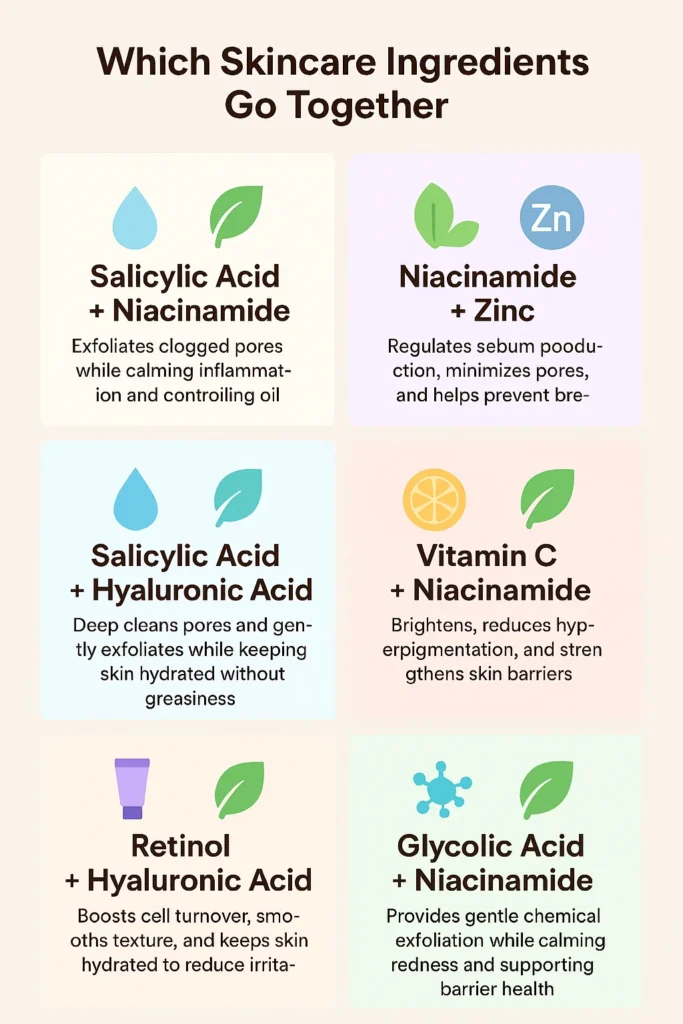
- Salicylic Acid + Niacinamide
Exfoliates clogged pores while calming inflammation and controlling oil. - Niacinamide + Zinc
Regulates sebum production, minimizes pores, and helps prevent breakouts. - Salicylic Acid + Hyaluronic Acid
Deep cleans pores and gently exfoliates while keeping skin hydrated without greasiness. - Vitamin C + Niacinamide
Brightens, reduces hyperpigmentation, and strengthens skin barrier for healthier skin. - Retinol + Hyaluronic Acid
Boosts cell turnover, smooths texture, and keeps skin hydrated to reduce irritation. - Glycolic Acid + Niacinamide
Provides gentle chemical exfoliation while calming redness and supporting barrier health.
Pro Tip:
These pairings represent some of the best ingredients for combination skin. Start slowly, patch-test new combos, and see how your skin responds.
Don’t forget to share your favorite pairings or results in the comments — your experience could help others create their perfect oily/combination skin routine!
What Are Worst ingredients for oily skin
I know you’re wondering: What ingredients should not be used for oily skin? So, Look When managing oily or combination skin, knowing what not to use is just as important as knowing the best ingredients.
Certain products can clog pores, strip your skin, or trigger more oil production, leading to breakouts and dullness. Here’s a breakdown of the worst offenders and why you should steer clear.
1. Comedogenic / Pore-Clogging Ingredients
- Mineral Oil, Petroleum, Paraffin: These heavy occlusive oils create a barrier that traps sebum, dead skin cells, and bacteria, leading to blackheads and acne.
- Coconut Oil: Despite being natural, it’s highly comedogenic for many people with oily skin and can trigger breakouts.
- Silicones (Dimethicone, Cyclopentasiloxane): Used for smooth finishes in primers and moisturizers, some silicones can trap impurities in pores over time.
- Lanolin: A hydrating wax derived from sheep’s wool that can block pores and worsen oiliness in acne-prone skin.
- Certain Vegetable Oils: Rosehip, soybean, and wheat germ oil may clog pores for oily skin types despite being “natural.”
- Artificial Dyes & Colorants: Often sourced from coal tar or petroleum, they can irritate skin and contribute to breakouts.
2. Stripping & Irritating Ingredients
- High-proof Alcohols (Denatured Alcohol, SD Alcohol 40): Can strip essential moisture, prompting the skin to overproduce oil to compensate.
- Sulfates (SLS / SLES): Strong detergents that damage the skin barrier, increase sensitivity, and cause rebound oiliness.
- Synthetic Fragrances & Parabens: Can trigger irritation, inflammation, and even worsen acne in sensitive oily skin.
- Harsh Physical Exfoliants: Scrubs with rough particles can damage the moisture barrier, leading to dryness and increased sebum production.
Quick Takeaway
For oily or acne-prone skin, avoid heavy oils, pore-clogging ingredients, harsh alcohols, sulfates, and synthetic irritants.
Focus instead on lightweight, non-comedogenic, and skin-calming formulas. Your skin will thank you with fewer breakouts, balanced oil, and smoother texture.
FAQ Of Best Ingredients for Oily Skin
Use gentle foaming cleansers twice daily, lightweight non-comedogenic moisturizers, and incorporate oil-controlling ingredients like niacinamide or salicylic acid. Always finish with sunscreen during the day to prevent overproduction of sebum.
It helps balance oil production, improves skin texture, and calms inflammation. Start slowly and pair with gentle hydration to avoid irritation.
Best options include foaming or gel-based cleansers with salicylic acid, glycolic acid, or niacinamide. Avoid harsh sulfates that strip and trigger more oil.
Use one in the morning and the other in the evening or on different days. This combination supports exfoliation and oil control without over-stripping skin.
Gel-based or water-based moisturizers with niacinamide, hyaluronic acid, or aloe vera provide hydration without clogging pores or adding shine.
Opt for lightweight, matte-finish, non-comedogenic sunscreens. Mineral or gel-based options work best. Avoid thick creams with oils that can increase shine or cause breakouts.
Use gentle chemical exfoliants like salicylic acid or glycolic acid. Avoid harsh scrubs that can strip the skin and trigger rebound oiliness. Adjust frequency based on your tolerance.
Thank you so much for spending time here and learning about the Best Ingredients for Oily Skin! 🌸 I hope you feel inspired to try some of these amazing ingredients and find the routine that works perfectly for your skin type.
Don’t forget to subscribe to stay updated with our latest tips, product reviews, and skincare guides.
And I’d love to hear from you — share your journey, your favorite ingredients, or any results you notice in the comments below. Your experience might inspire someone else to glow with confidence! ✨

Akram Boulaid is a dedicated Skincare Researcher and Analyst with over 7 years of intensive focus on dermatology and cosmetic ingredient science. As a globally recognized expert, his insights have been featured in major international publications, including the New York Post and GB News. A verified expert on Qwoted, Akram connects with health journalists to provide evidence-based analysis. He founded Beauty Blurb to bridge the gap between complex clinical data and practical skincare routines, specializing exclusively in the needs of oily and acne-prone skin through rigorous analysis of peer-reviewed scientific literature.