💡 Key Takeaways
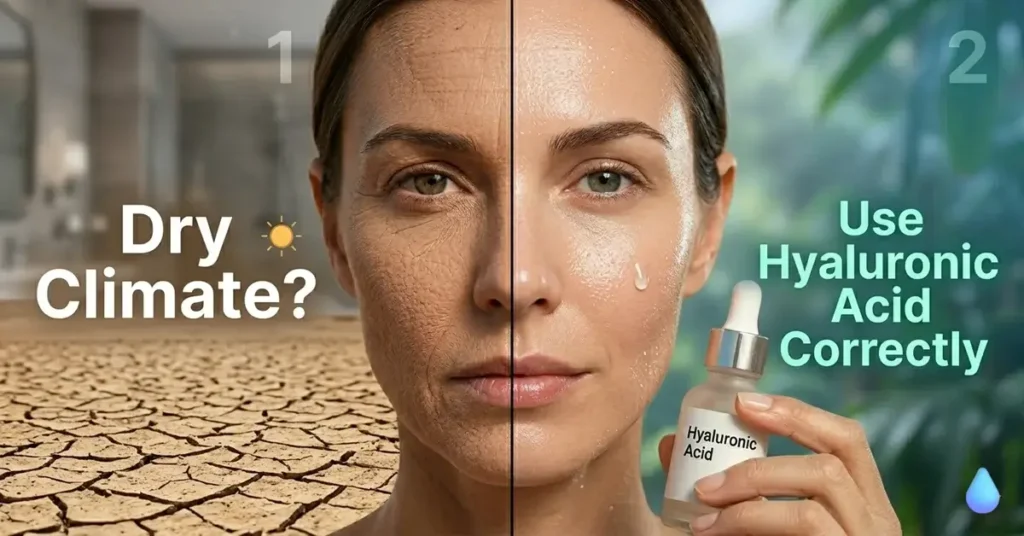
You might be wondering, can I use hyaluronic acid in a dry climate? Here is the honest answer:
Hyaluronic acid can work in dry climates—but only if you use it the right way. In low humidity, it doesn’t always hydrate your skin like you expect. Instead of pulling moisture from the air, it may draw water from your own skin, which can leave it feeling even drier or tighter.
The solution isn’t to stop using it, but to apply it correctly: always on slightly damp skin, then seal it immediately with a moisturizer to lock in hydration.
When used with the right routine, hyaluronic acid can still be effective—even in dry or desert-like conditions.
In this guide, we’ll break down everything you need to know about Hyaluronic acid and dry climates in a simple, practical way.
You’ll understand why it sometimes fails, how to use it properly step by step, the mistakes to avoid, and when it’s better to switch to other ingredients.
By the end, you’ll know exactly how to keep your skin hydrated—even in the driest environments.
What Happens to Hyaluronic Acid in Dry Climates?
🟡 How Hyaluronic Acid Works (Simple Explanation)
Hyaluronic acid is one of the most popular skincare ingredients—and for a good reason. It’s a humectant, which means it attracts and holds water to keep your skin hydrated, smooth, and plump.
In simple terms, hyaluronic acid works like a sponge. It pulls moisture and helps your skin retain it, which is why it’s commonly used in products for dry skin, dehydrated skin, oily skin, and combination skin.
Even if you have oily skin, hyaluronic acid can still be beneficial because it provides lightweight hydration without clogging pores or making your skin greasy.
When you apply hyaluronic acid serum, it can draw water from:
- the surrounding air (humidity).
- or the upper layers of your skin.
This is what makes it so effective for improving skin hydration, skin barrier function, and reducing dryness.
Why Low Humidity Changes Everything
Here’s where things get interesting—and where most people get confused.
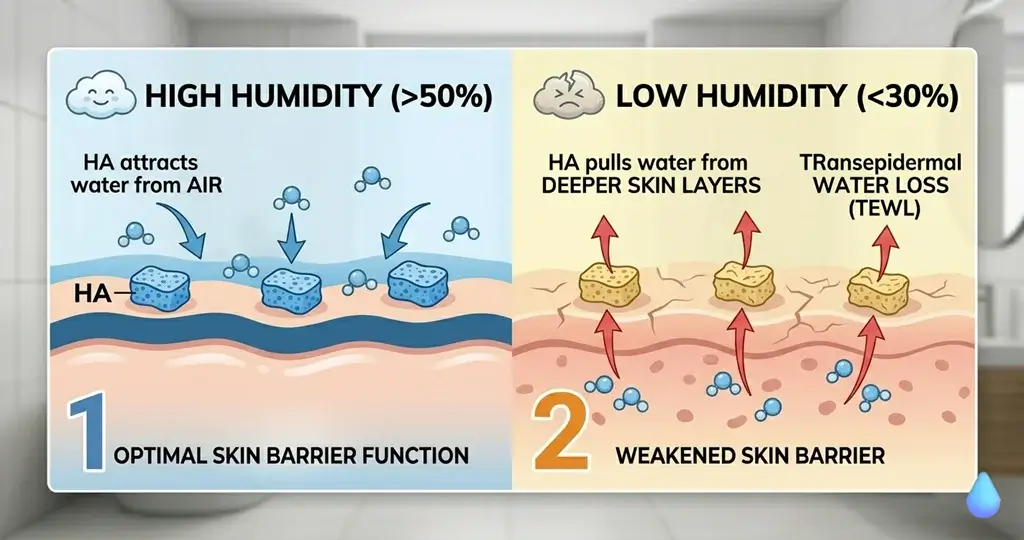
Because hyaluronic acid is a humectant, it depends on water availability. In environments with normal or high humidity, it pulls moisture from the air into your skin. But in dry climates or low humidity conditions (below ~40%), there simply isn’t enough moisture in the air.
So what happens?
👉 It may start pulling water from your own skin instead.
If that water isn’t sealed in with a moisturizer, it can evaporate—this process is called transepidermal water loss (TEWL).
This is why some people feel that:
- “hyaluronic acid is drying my skin”.
- or “hyaluronic acid not working in dry climate”.
💡 But the key point is: It’s not that hyaluronic acid is bad, it’s that low humidity changes how it behaves.
A recent study published in 2025 highlighted that skin water loss (TEWL) is strongly influenced by environmental factors like relative humidity, and that lower humidity levels can increase water evaporation from the skin surface (Source).
Another dermatological review From PMC, also found a negative relationship between relative humidity and TEWL, meaning:
👉 when humidity decreases, water loss from the skin tends to increase (Source).
Common Myths About Hyaluronic Acid in Dry Climates
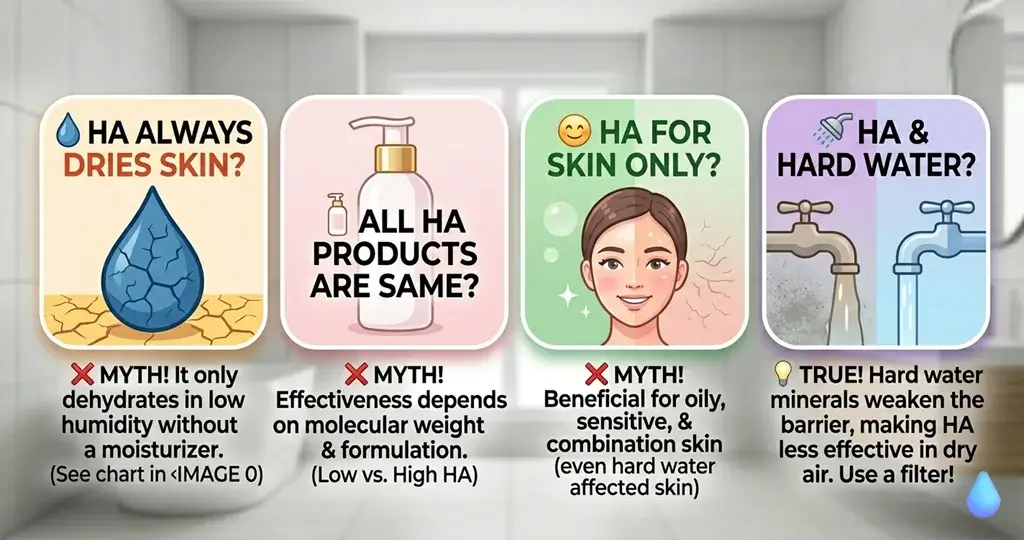
Myth 1: Hyaluronic Acid Always Dries Out Skin
Yes… but only in certain conditions.
This is one of the most common concerns people have, especially when using hyaluronic acid in dry climates.
The truth is: 👉 Hyaluronic acid doesn’t always dry out your skin—but it can if used incorrectly.
As a humectant, it needs water to work properly. In environments with low humidity, there isn’t enough moisture in the air. So instead of pulling water from the environment, it may pull it from your skin.
If you apply it on dry skin and don’t follow it with a moisturizer, that water can evaporate, leading to increased dryness and tightness.
💡 What actually matters:
- Humidity level (low vs high)
- How you apply it (damp skin vs dry skin)
- Whether you seal it with a moisturizer
✔️ Used correctly → hydrates your skin
❌ Used incorrectly → may contribute to dryness
👉 That’s why many people search:
“why hyaluronic acid is drying my skin” or “hyaluronic acid not working in dry climate”
Myth 2: All Hyaluronic Acid Products Work the Same
This is not true—and it’s a big reason why results vary so much.
Not all hyaluronic acid serums are created equal. Their effectiveness depends on:
- Molecular weight (how deeply it penetrates the skin)
- Formulation (what ingredients are combined with it)
- Concentration and layering
For example:
- High molecular weight HA sits on the surface and helps with immediate hydration
- Low molecular weight HA penetrates deeper into the skin
But in dry climates, this becomes even more important.
👉 A poorly formulated product (without supporting ingredients like glycerin or ceramides) may not provide lasting hydration—especially in low humidity conditions.
💡 What to look for instead:
- Multi-molecular weight formulas
- Products combined with glycerin, panthenol, or ceramides
- A formula that supports the skin barrier, not just hydration
Myth 3: Hyaluronic Acid Works Best for Dry Skin Only
This is another common misunderstanding.
While hyaluronic acid is often marketed for dry skin, it actually works for all skin types—including:
- Oily skin
- Combination skin
- Sensitive skin
Because it provides lightweight, oil-free hydration, it’s especially useful for oily skin types that need moisture without heaviness.
However, in dry climates, your skin type becomes less important than your environment.
👉 Even oily skin can become dehydrated in low humidity.
That’s why:
- Oily skin still needs hydration
- And hyaluronic acid can help—if used properly
💡 Key takeaway:
Hyaluronic acid isn’t just for dry skin…
👉 it’s for dehydrated skin, which can happen to anyone.
🟢 Does Hyaluronic Acid Work in Dry Climates?
Short answer:
Yes—but only under the right conditions.
Hyaluronic acid can work in dry climates, but it doesn’t behave the same way it does in humid environments. If used incorrectly, it may leave your skin feeling tighter or even more dehydrated.
The key is not just using hyaluronic acid…
👉 but understanding how it behaves in low humidity and adjusting your routine accordingly.
The “Reverse Effect” Explained
Hyaluronic acid is known for its ability to attract water. But what most people don’t realize is that it doesn’t create moisture—it simply moves it.
In a humid environment, this works perfectly. It pulls water from the air into your skin.
But in dry climates, something different can happen.
👉 Instead of pulling moisture into your skin, it may start pulling moisture out.
This is often referred to as the “reverse effect” of hyaluronic acid.
It’s not that the ingredient is harmful, it’s that its behavior depends entirely on your environment.
When HA Pulls Moisture from Your Skin Instead of the Air
In low humidity conditions, there’s very little moisture in the air for hyaluronic acid to attract (pull from).
So it looks for the next available source: 👉 your skin.
It can draw water from the deeper layers of your skin to the surface. If that moisture is not sealed in with a moisturizer, it evaporates—leaving your skin feeling dry, tight, or even irritated.
This is why many people experience:
- “hyaluronic acid drying my skin”.
- “hyaluronic acid not working in Arid Weather”.
💡 The problem isn’t the ingredient itself, it’s using it without a proper hydration barrier.
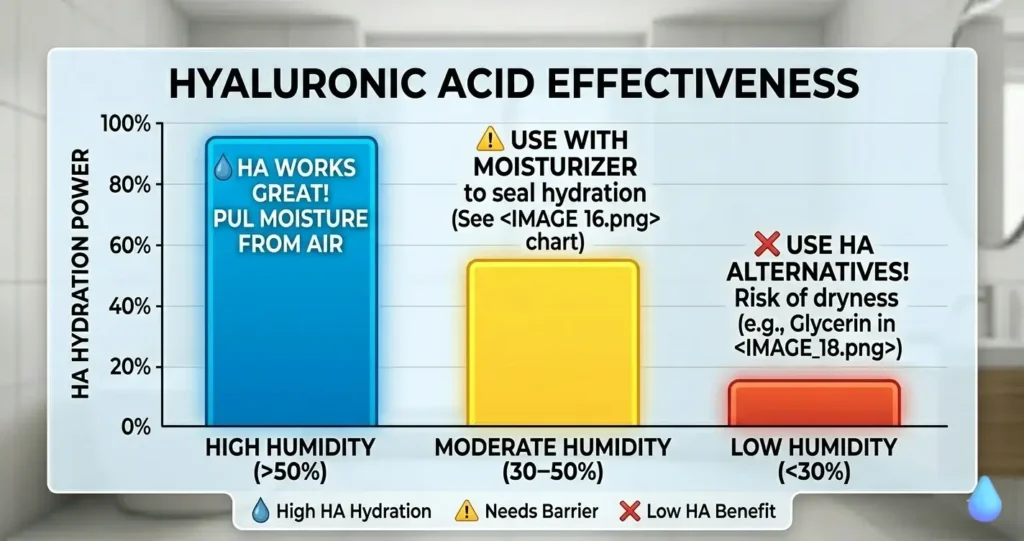
The Role of Humidity (Below 40%)
Humidity plays a major role in how effective hyaluronic acid is.
- Above 50% humidity → works very well ✅.
- 30–50% humidity → works with support ⚠️.
- Below 40% humidity → risk of dehydration ❌.
In very dry environments—like desert climates or heated indoor spaces—humidity can drop below 30%.
👉 At this level, hyaluronic acid becomes less reliable on its own.
That’s why using it without:
- damp skin
- a moisturizer
- or an occlusive layer
can lead to increased transepidermal water loss (TEWL).
Choosing the Right Type of Hyaluronic Acid for Dry Climates
Not all hyaluronic acid works the same—especially in Arid Weather.
The type and formulation you choose can make a big difference in how your skin responds.
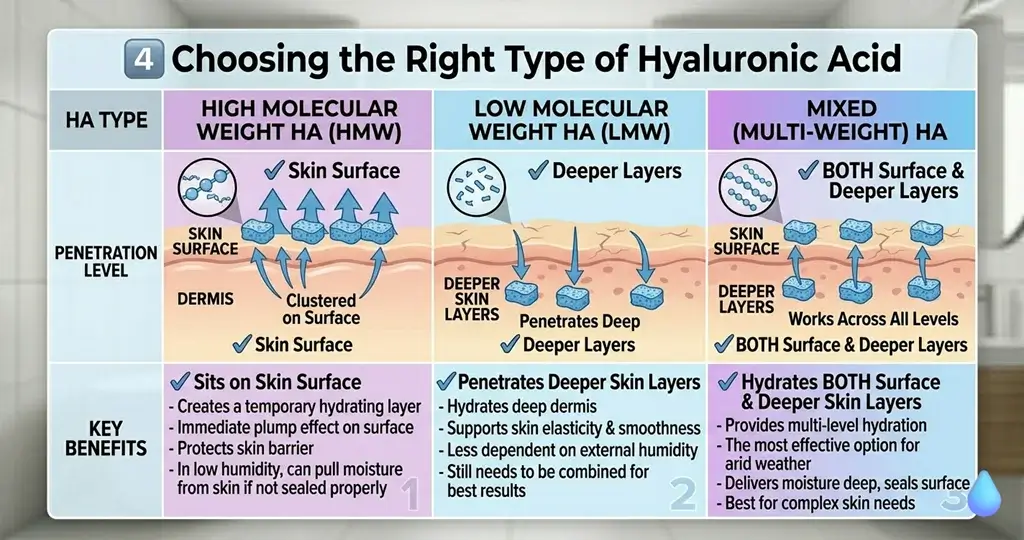
🔹 High Molecular Weight Hyaluronic Acid (HMW-HA)
This type sits on the surface of your skin and helps create a temporary hydrating layer.
✔️ Provides instant hydration
✔️ Forms a protective film
❗ But in low humidity, it may pull moisture from your skin if not sealed properly
🔹 Low Molecular Weight Hyaluronic Acid (LMW-HA)
These smaller molecules penetrate deeper into the skin.
✔️ Helps hydrate deeper layers
✔️ Supports skin elasticity and smoothness
✔️ Less dependent on external humidity
❗ However, it still needs to be combined with other ingredients for best results
🔹 Multi-Molecular (Hybrid) Hyaluronic Acid
This is the most effective option for hyaluronic acid in dry climates.
It combines both high and low molecular weights to:
- hydrate the surface
- deliver moisture deeper into the skin
- reduce the risk of dehydration in low humidity
💡 Best practice:
Look for formulas that also include:
- glycerin (strong humectant).
- ceramides (barrier repair).
- panthenol (soothing hydration).
🧠 Simple Takeaway:
Hyaluronic acid does work in dry climates…
👉 but only if you:
- understand how humidity affects it.
- use the right type of formula.
- and lock in the moisture properly.
Otherwise, it may do the opposite of what you expect
When Hyaluronic Acid Works vs When It Fails
One of the biggest mistakes people make when using hyaluronic acid in dry climates is assuming it works the same everywhere.
The truth is: 👉 its effectiveness depends heavily on humidity levels.
Instead of guessing, here’s a simple framework to help you decide when hyaluronic acid will work—and when it might backfire.
| Humidity Level | Should You Use HA? | Expert Recommendation |
|---|---|---|
| 50%+ | ✅ Yes | Works well. Hyaluronic acid can pull moisture from the air and hydrate your skin effectively. |
| 30–50% | ⚠️ Maybe | Use with caution. Always apply on damp skin and seal with a moisturizer. |
| Below 30% | ❌ Risky | High chance of dryness. Consider alternatives like glycerin or use a strong occlusive layer. |
🧠 How to Use This in Real Life
- If you live in a humid climate, hyaluronic acid can be one of the best ingredients for skin hydration.
- If you’re in a moderately dry environment, it still works—but only with the right routine.
- But in very dry climates or desert-like conditions, using hyaluronic acid alone can actually make your skin feel worse.
This is why many people say:
👉 “hyaluronic acid not working for me”
when in reality, it’s the environment that’s the problem.
🟡 So, is hyaluronic acid good in dry climates?
The answer is: 👉 Yes—but only if you use it correctly. Hyaluronic acid isn’t bad, But in low humidity, it becomes less reliable on its own.
💡 To make it work, you need to:
- apply it on damp skin.
- combine it with a moisturizer.
- or switch to better alternatives in very dry air.
Hyaluronic acid works best when your environment supports it. If not, it’s up to your routine to replace what the air is missing.
How to Use Hyaluronic Acid in Dry Climates (Step-by-Step)
If you’re using hyaluronic acid in dry climates, the difference between hydrated skin and dry, tight skin often comes down to how you apply it.
Follow this simple step-by-step routine to make hyaluronic acid actually work—even in low humidity.
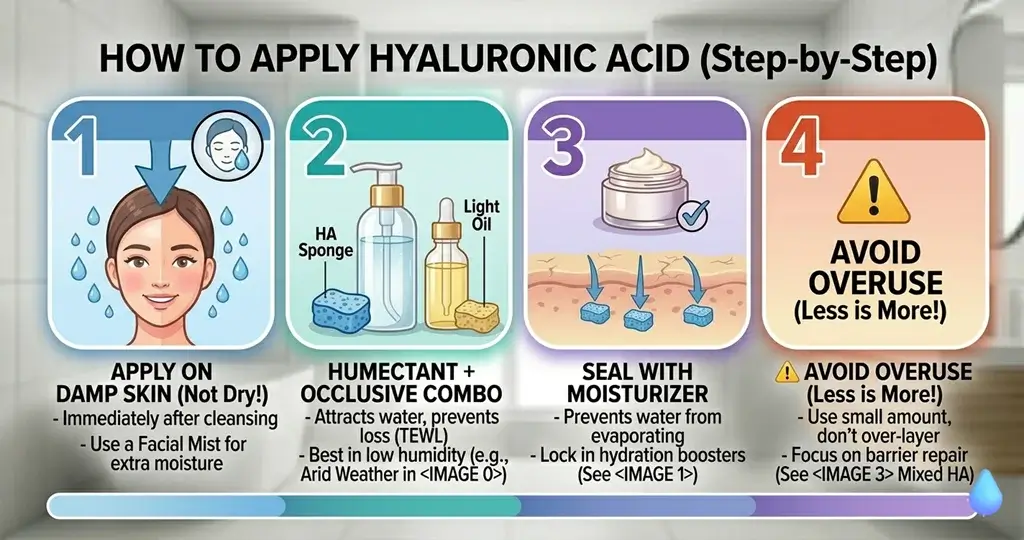
Step 1: Apply on Damp Skin (Not Dry)
This is the most important step.
Hyaluronic acid needs water to bind to. If you apply it on completely dry skin, especially in low humidity, it may pull moisture from your skin instead of hydrating it.
👉 Always apply it on:
- slightly damp skin after cleansing.
- or right after using a facial mist.
Step 2: Use a Humectant + Occlusive Combo
Hyaluronic acid alone is not enough in dry climates.
You need to combine it with:
- humectants (like glycerin) to attract moisture.
- and occlusives (like creams or oils) to prevent water loss.
👉 This combination helps reduce transepidermal water loss (TEWL) and keeps hydration inside your skin.
💡 Think of it like this:
Hyaluronic acid brings the water… but something else needs to keep it there.
Step 3: Seal It with Moisturizer
This is where most people go wrong.
If you don’t apply a moisturizer after hyaluronic acid, the water it attract can evaporate quickly—especially in dry air.
👉 Always follow with:
- a moisturizer rich in ceramides
- or a slightly heavier cream in very dry climates
This step creates a barrier that locks hydration into your skin.
Step 4: Avoid Overuse in Extremely Dry Air
More is not always better.
In very dry environments (below ~30% humidity), using too much hyaluronic acid or layering it excessively can actually make things worse.
👉 Instead:
- use a smaller amount.
- avoid over-layering multiple HA products.
- focus more on barrier-repair ingredients.
🧴 Bonus Tips (Make It Work Even Better)
- Use a facial mist before applying HA to add extra water.
- Try layering: mist → HA → moisturizer.
- Consider using a humidifier if your indoor air is very dry.
- Combine HA with ingredients like glycerin or panthenol for better hydration.
🧠 Golden Tip (From Experience):
If there’s one thing that makes the biggest difference, it’s this: 👉 Don’t treat hyaluronic acid as a moisturizer. Treat it as a hydration booster.
From experience, the moment you stop relying on it alone—and start pairing it with the right products—your skin behaves completely differently.
In dry climates, it’s not about using more hyaluronic acid…
👉 it’s about building a routine that supports it.
Common Mistakes That Make Hyaluronic Acid Worse
Even though hyaluronic acid is one of the most effective skincare ingredients, many people unknowingly reduce its benefits—especially in dry climates. Small mistakes in how you use it can actually make your skin feel drier or tighter instead of hydrated.
Here are the most common mistakes, explained clearly:
- Applying on dry skin – HA needs water to attract. Using it on dry skin can pull moisture from your own skin, causing tightness and dryness.
- Not sealing with a moisturizer – Without a protective layer, the hydration HA attracts can evaporate quickly, reducing effectiveness.
- Using it in very low humidity – In air below ~30% humidity, HA struggles to pull water from the environment and may instead pull from your skin.
- Over-layering HA products – Using multiple serums or creams with HA can overwhelm your skin and even increase water loss (TEWL).
- Treating HA as a moisturizer – HA is a hydration booster, not a replacement for a cream that seals water in.
- Skipping occlusive ingredients – Without a barrier like ceramides or oils, water evaporates faster, reducing HA’s benefit.
- Using too much product – More is not always better; excessive HA can overwhelm the skin and lead to imbalance.
💡 Tip: Correcting just one of these mistakes can dramatically improve how your skin responds to hyaluronic acid.
💬 Question for readers: Have you ever made one of these mistakes?
👉 Tell me in the comments: what’s the biggest skincare mistake you’ve made with hyaluronic acid?
Signs Hyaluronic Acid Is NOT Working for You
Even the best hyaluronic acid products won’t work if conditions or routine aren’t right. Here are the most common signs your HA isn’t delivering hydration:
- Skin feels tighter after applying – Instead of feeling plump, your skin feels pulled or constricted.
- Dryness increases – Your skin seems drier even after using HA.
- Flaky patches appear – Indicates moisture isn’t being retained properly.
- No hydration effect – Skin doesn’t feel softer or smoother after application.
💡 Pro tip: Sometimes, the culprit isn’t your HA product—it could be hard water in your area, which reduces HA effectiveness and damages your skin barrier.
👉 That’s why I created a full guide on reversing hard water effects on skin: How to Reverse the Effects of Hard Water on Skin .
💬 Tip for readers:
If you notice these signs, review your routine and environment before blaming the product. Even the best hyaluronic acid needs the right conditions to work.
Best Alternatives to Hyaluronic Acid in Dry Climates
You might be wondering: “What to use instead of hyaluronic acid in a dry climate?”
The truth is, hyaluronic acid isn’t the only way to hydrate your skin. In very low humidity, some alternatives can actually perform better and safer than HA. Here’s a concise guide to the most effective options.
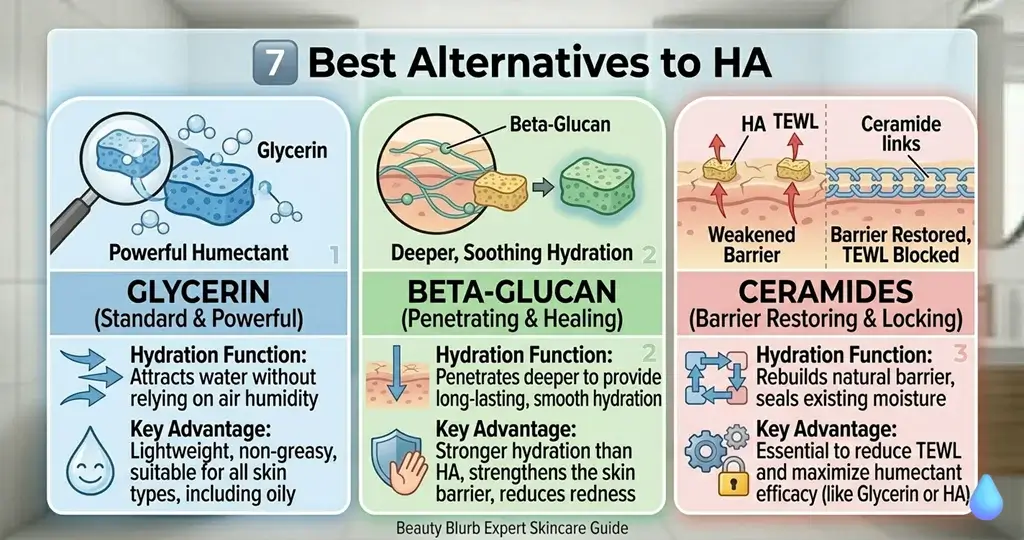
Glycerin (Better in Low Humidity)
- Powerful humectant – attracts water without depending heavily on environmental humidity.
- Lightweight and safe – works well for all skin types, including oily skin.
- Easy to layer – can be combined with occlusives or moisturizers for long-lasting hydration.
💡 Perfect for those living in desert climates or heated indoor spaces.
Beta-Glucan (Stronger Hydration)
- Penetrates deeper into the skin to provide long-lasting hydration.
- Enhances skin barrier function and helps repair damage.
- Soothes irritation and strengthens skin resilience.
💡 Ideal for anyone struggling with tightness, flakiness, or low humidity dryness.
Ceramides (Barrier Repair)
- Restore and reinforce the skin’s natural protective barrier.
- Reduce transepidermal water loss (TEWL) and lock in moisture.
- Works synergistically with humectants like glycerin or HA to maximize hydration.
💡 Essential for anyone in a harsh dry climate or exposed to hard water.
💡 Key takeaway:
Hyaluronic acid is great—but in very dry climates, glycerin, beta-glucan, and ceramides can often outperform it.
Using the right combination of these ingredients ensures your skin stays plump, hydrated, and healthy, even when the air is dry.
FAQ About Hyaluronic acid and Dry Climates
Hyaluronic acid should not be applied on completely dry skin or when humidity is very low (below ~30%). In such conditions, it may pull water from your deeper skin layers instead of hydrating. Use it on damp skin with a moisturizer to prevent dehydration.
For very low humidity, consider using humectants like glycerin, skin-soothing beta-glucan, or barrier-repairing ceramides. These ingredients provide consistent hydration without relying on environmental moisture.
Apply hyaluronic acid or glycerin on slightly damp skin, then seal with a moisturizer containing occlusives like ceramides or squalane. Using a facial mist before application can boost hydration, and avoid over-layering products.
In dry climates, HA without a proper occlusive layer can pull moisture from deeper skin layers. Always apply on damp skin and follow with a moisturizer or barrier ingredient to prevent dehydration.
Hyaluronic acid is lightweight and non-comedogenic, so it hydrates without clogging pores. Oily or combination skin can benefit from HA in dry climates if applied correctly with damp skin and a moisturizer.
Apply HA in your morning and/or evening routine. Always pair with a moisturizer to lock in hydration. Avoid excessive layering, which can stress the skin and reduce effectiveness in dry climates.
You can combine HA with vitamin C, niacinamide, or peptides. Apply HA on damp skin first, then follow with actives that suit your routine. Avoid harsh exfoliants immediately after HA to prevent irritation in dry climates.
Hard water can interfere with HA absorption and contribute to dryness. Consider using filtered water or incorporating barrier-repair ingredients like ceramides and glycerin. Check out our full guide: How to Reverse the Effects of Hard Water on Skin.
We’ve covered everything you need to know about Hyaluronic Acid in Dry Climates: how it works, common mistakes, the correct protocols, and the best alternatives for keeping your skin hydrated in dry environments.
Remember, the key is understanding your skin type, the humidity level, and following simple steps that ensure optimal hydration without irritation or dryness.
Thank you for reading this complete guide! 🌸 Don’t forget to subscribe to get the latest tips delivered straight to you. And we’d love to hear from you in the comments:
what has your experience been with Hyaluronic Acid IN Arid Weather? Have you faced challenges, or discovered a routine that works perfectly for your skin? Sharing your journey helps others and creates a community focused on healthy, hydrated skin—even in the driest conditions.
Try the protocols we’ve shared, and let us know how they work for you. Your feedback is invaluable, and together we can make skincare in dry climates simple, effective, and enjoyable.
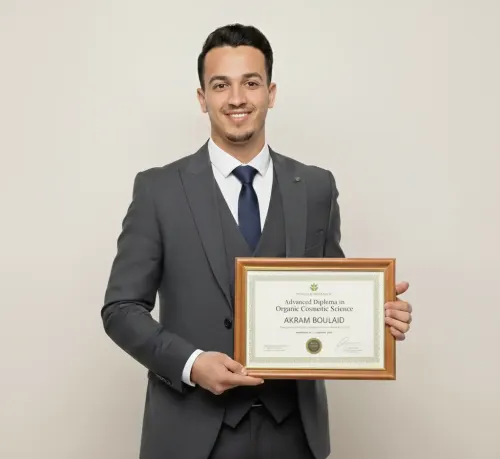
Akram Boulaid is a dedicated Skincare Researcher and Analyst with over 7 years of intensive focus on dermatology and cosmetic ingredient science. As a globally recognized expert, his insights have been featured in major international publications, including the New York Post and GB News. A verified expert on Qwoted, Akram connects with health journalists to provide evidence-based analysis. He founded Beauty Blurb to bridge the gap between complex clinical data and practical skincare routines, specializing exclusively in the needs of oily and acne-prone skin through rigorous analysis of peer-reviewed scientific literature.