
If you’re wondering “Salicylic Acid Before or After Moisturizer?” the short answer is: apply salicylic acid before your moisturizer.
This way, the active ingredient can penetrate your pores, reduce excess oil, and fight acne without any barrier blocking its effect. Once it absorbs (usually 2–5 minutes), you can lock everything in with a gentle moisturizer.
For sensitive skin, dermatologists often recommend a “buffering” method — applying moisturizer before and after salicylic acid — but keep in mind this can slightly reduce the acid’s strength.

In this guide, we’ll walk step by step through the correct skincare order, explain when to use salicylic acid before versus after moisturizer, and highlight common mistakes to avoid.
You’ll also discover what moisturizer to use after salicylic acid to maximize results without irritation, plus dermatologist-backed tips to make your routine both safe and effective.
What Is Salicylic Acid and How Does It Work?
Salicylic acid is a beta hydroxy acid (BHA) widely used in skincare for its ability to exfoliate the skin, unclog pores, and reduce acne.
Unlike water-based acids such as glycolic acid, salicylic acid is oil-soluble, which means it can penetrate deep into the pores and dissolve excess sebum — making it especially effective for oily and acne-prone skin.
When you apply salicylic acid correctly, it gently removes dead skin cells, helps regulate oil production, and prevents clogged pores that can lead to blackheads or breakouts.
This is why dermatologists often recommend salicylic acid for oily skin as a staple in daily skincare routines.
✅ Key Benefits of Salicylic Acid:
- Unclogs pores by dissolving oil and debris.
- Reduces acne and blackheads with anti-inflammatory properties.
- Exfoliates gently to promote smoother skin texture.
- Minimizes excess oil (sebum control), ideal for oily skin types.
- Calms redness and irritation often linked to acne breakouts.
- Enhances penetration of other skincare products by clearing surface buildup.
Clinical Evidence: Salicylic Acid in Action
One single-center clinical trial conducted by Liu et al. (2025) at Huashan Hospital (affiliated with Fudan University, Shanghai), evaluated a 2% salicylic acid gel applied twice daily by 42 participants (37 females, 5 males; average age ≈ 26).
with oily or combination skin and mild-to-moderate acne (IGA grades 2–3). Over 21 days, results included:
- Sebum reduction: –23.6% (p < 0.05).
- Skin hydration increase: +40.5% (p < 0.05).
- Improved skin barrier (TEWL down by 49%, p < 0.05).
- Acne severity (IGA score): improved by 23.8% (p < 0.001).
- 100% satisfaction reported by participants; only 5% experienced mild transient itching. Source.
✨ Understanding how salicylic acid works is the first step — because once you know how deeply it penetrates, you’ll understand why the order of applying it before or after moisturizer makes such a difference.
What are the rules for layering skincare?
When it comes to building a skincare routine, the general rule of skincare layering is simple: apply products from lightest to heaviest. This means water-based products (like toners and serums) go first, while thicker products (like creams and oils) come last.
Following the correct order of skincare ensures that each ingredient can absorb properly without being blocked by heavier layers.

✅ Why This Rule Matters:
- Helps active ingredients like salicylic acid work at full strength.
- Prevents product “pilling” or residue buildup.
- Maximizes hydration by sealing in lighter layers with moisturizer.
🔎 Skincare Routine Order (Basic):
- Cleanser
- Toner (optional)
- Treatment serums (e.g., salicylic acid)
- Moisturizer
- Sunscreen (morning only)
This layering skincare products rule is the key to answering whether salicylic acid should come before or after moisturizer — because once you understand the logic, the choice becomes much clearer.
Should I Use Salicylic Acid Before or After Moisturizer
I know you’re confused — everyone seems to have a different opinion, and it’s hard to tell what’s actually backed by science.
You’ve probably found yourself asking “do you apply salicylic acid before or after moisturizer?” and scrolling through endless skincare forums without a clear, trustworthy answer.
Here’s the good news: dermatologists agree on a simple rule that takes the guesswork out. The short answer is salicylic acid should usually be applied before moisturizer so it can penetrate your pores and do its job effectively.
But — and this is where things get interesting — there are special situations where using it after moisturizer (a method called “buffering”) is actually the smarter choice.
In the next sections, we’ll break down exactly when to use each approach, so you can follow the right routine for your skin type.
1: Salicylic Acid Before Moisturizer – Why It Works and How to Do It Right
Applying salicylic acid before moisturizer (especially for oily and acne-prone skin) lets the active ingredient penetrate deeply into your pores and dissolve excess oil, debris, and dead skin cells—making it far more effective than applying it afterward.
Experts across dermatology confirm that this order of application is key to unlocking salicylic acid’s full benefits.
How to Apply Salicylic Acid Before Your Moisturizer – Step by Step
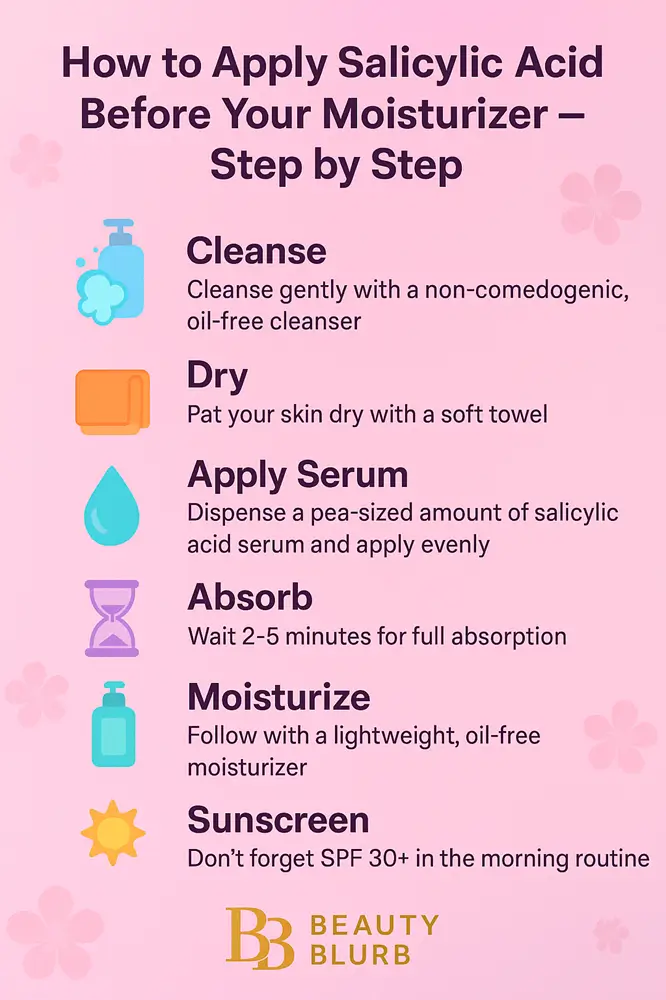
- Cleanse gently with a non-comedogenic, oil-free cleanser—especially important for oily skin.
- Pat your skin dry with a soft towel.
- Dispense a pea-sized amount of your salicylic acid serum (0.5–2%), and apply evenly—focus on oily or acne-prone areas.
- Allow it to fully absorb (waiting 2–5 minutes ensures deeper penetration).
- Follow with a lightweight, oil-free moisturizer to seal in hydration without clogging pores.
- Not to mention sunscreen, the most important step in your skincare routine for oily skin.
Pro Tips You Won’t Find Elsewhere
- Less is more. A pea-sized drop is enough—overusing can cause irritation.
- PM use is best, thanks to detected UV sensitivity after exfoliation. Cleveland Clinic
- Pair with niacinamide or hyaluronic acid, which help counteract dryness and soothe skin when used afterward.
| Skin Type | Why “Before Moisturizer” Works | Extra Precautions or Pro Tips |
|---|---|---|
| Oily / Acne-prone | Penetrates clogs deeply | Look for non-comedogenic gel formulas |
| Sensitive / Redness-prone | Still effective, but slower | Consider buffering: moisturizer → salicylic acid → moisturizer |
| Combination or Normal Skin | Can use full dose | Monitor for dryness; adjust frequency accordingly |
Backed by Experts:
The American Academy of Dermatology also emphasizes applying active treatments from thinnest to thickest layers, allowing actives like salicylic acid to penetrate fully before moisturizer. Source.
Takeaway
- Right: Apply salicylic acid before moisturizer to target oil, acne, and congestion effectively.
- Do it wisely: Use a low concentration, wait for absorption, and always finish with a suitable moisturizer (especially important for salicylic acid for oily skin).
- Need a gentler route? Buffering may reduce irritation—great for sensitive skin—but note it might slightly lower efficacy.
2: Salicylic Acid After Moisturizer (Buffering Technique) — When It Makes Sense
You might wonder:Can I use salicylic acid after moisturizer? The answer is yes—but only in certain situations.
This method is known as the “buffering technique”, and while it may reduce the acid’s direct penetration, it can offer a gentler approach for sensitive skin or first-time users.
Why Buffering Helps Sensitive Skin
- A single-center clinical trial by Liu et al.
- (2025) found a 2% salicylic acid gel to be well tolerated even by those with sensitive, acne-prone skin, significantly reducing sebum by ~24%, improving hydration (+40%).
- and strengthening the skin barrier (TEWL down ~49%) over 21 days—all with minimal irritation reported. PubMed.
This demonstrates that salicylic acid can be effective and gentle—especially when absorption is slowed by buffering.
Step-by-Step: How to Apply Salicylic Acid After Moisturizer (Buffering)
- Cleanse with a mild, non-comedogenic cleanser.
- Pat dry — skin should be slightly damp but not wet.
- Apply a lightweight moisturizer—preferably one that’s hydrating and barrier-supportive.
- Wait 1–2 minutes for it to settle slightly.
- Apply salicylic acid serum (0.5–2%) over the moisturized skin using a pea-sized amount.
- Follow with another thin layer of moisturizer if needed, especially in dry or particularly sensitive areas.
When to Use the Buffering Technique
- Sensitive or reactive skin types—buffering reduces stinging and redness.
- New users of salicylic acid—buffering eases the skin into the ingredient.
- Combined with strong actives (like retinoids or benzoyl peroxide)—buffering helps minimize cumulative irritation.
Pro Tips & Warnings
- Buffering can diminish the acid’s penetration and effectiveness—use as a transitional phase, not permanently.
- Always patch-test new formulas, especially when combining active ingredients.
- Use this method only in the evening, as layering acids and occlusive moisturizers overnight can increase sensitivity.

So, What to Apply After Salicylic Acid?
After applying salicylic acid—whether using the buffering method or the standard routine—choose a lightweight, non-comedogenic, hydrating moisturizer, ideally one rich in ceramides or humectants.
This will help seal in hydration, restore the skin barrier, and complement salicylic acid’s exfoliating effects—especially beneficial for oily or sensitive skin.
Possible Side Effects of Using Salicylic Acid Before or After Moisturizer
After learning how to apply salicylic acid before or after moisturizer, it’s equally important to understand the possible side effects.
While salicylic acid is one of the most effective ingredients for oily and acne-prone skin, using it incorrectly—or combining it with the wrong products—can cause irritation, dryness, or even worsen breakouts.
In this section, we’ll cover the most common and rare side effects you should know, whether you apply Salicylic Acid after or before Moisturizer.
1: Side Effects of Using Salicylic Acid Before Moisturizer
When you apply salicylic acid before moisturizer, the ingredient penetrates deeply into the pores. This increases its effectiveness but can also heighten the risk of irritation, especially if your skin is sensitive or if you’re new to acids.
Common side effects:
- Dryness and peeling skin (especially with daily use of 2% salicylic acid serum).
- Redness and irritation if applied too often or in large amounts.
- Burning or stinging sensation in sensitive skin areas.
- Excess oil rebound if the skin barrier becomes overly stripped.
2: Side Effects of Using Salicylic Acid After Moisturizer (Buffering)
When using the buffering technique—that is, applying salicylic acid after moisturizer—the risk of irritation is lower because the moisturizer acts as a protective barrier. However, this method comes with its own drawbacks:
Common side effects:
- Reduced effectiveness of salicylic acid, as it may not penetrate the skin as deeply.
- Mild breakouts in some people, since clogged pores may not clear as effectively.
- Product buildup or “pilling” if you layer too many thick moisturizers.
- Uneven results—some areas of skin may benefit, while others remain untreated.
What Moisturizer to Use After Salicylic Acid
I know you’re now asking yourself: “What moisturizer should i use after salicylic acid cleanser, face wash, or serum?” That’s a smart question—because the right moisturizer can make the difference between glowing, balanced skin and irritated, flaky skin.
Salicylic acid is powerful, but it can also be drying if not followed with proper hydration.
In this section, we’ll explore exactly why you need to moisturize after salicylic acid, the key ingredients to look for, and how to choose the perfect formula depending on your skin type.
1: Why Moisturize After Salicylic Acid?
- Prevents dryness and peeling → salicylic acid is a chemical exfoliant that removes excess oil and dead skin cells, but this can also strip your natural moisture.
- Strengthens the skin barrier → moisturizers rich in ceramides and hyaluronic acid help repair and protect the outer layer of your skin.
- Balances hydration and oil production → when skin is properly moisturized, it won’t overproduce sebum (a common issue for oily, acne-prone skin).
- Reduces irritation → applying a soothing moisturizer calms redness, flaking, and sensitivity often caused by acids.
2: What to Look For in a Moisturizer
✅ Hydrating Ingredients
- Hyaluronic Acid → draws water into the skin, keeping it plump.
- Ceramides → restore the skin barrier and prevent water loss.
- Glycerin → locks in hydration.
✅ Soothing Ingredients
- Niacinamide → reduces redness and strengthens barrier function.
- Aloe Vera or Centella Asiatica → calm irritation and inflammation.
✅ Texture Based on Skin Type
- Oily or Acne-Prone Skin: go for lightweight gel moisturizers or oil-free lotions (non-comedogenic).
- Sensitive Skin: choose gentle cream moisturizers free of fragrance and alcohol.
- Dry or Combination Skin: opt for balancing cream formulas with ceramides + humectants.
When and How to Apply Moisturizer
- Wait 5–10 minutes after applying salicylic acid serum to let it absorb fully.
- Use a pea-sized amount of moisturizer and spread evenly.
- Apply twice daily (AM & PM), adjusting the texture to your routine (lighter in the morning, richer at night if needed).
- Always finish with sunscreen in the morning—salicylic acid can increase sun sensitivity.
Why Moisturize After?
Prevents dryness, supports the skin barrier, balances oil, and reduces redness.
why moisturize after salicylic acidKey Ingredients
- Hyaluronic Acid — hydrates and plumps.
- Ceramides — restore barrier strength.
- Niacinamide — calms irritation.
By Skin Type
- Oily/Acne-Prone: lightweight gel or lotion.
- Sensitive: fragrance-free soothing cream.
- Dry: rich cream with humectants.
So, if you’re asking yourself “what moisturizer to use after salicylic acid”, the answer is simple: a gentle, hydrating formula with ceramides, hyaluronic acid, and niacinamide—tailored to your skin type.
This ensures you get the acne-fighting benefits of salicylic acid without compromising your skin barrier.
FAQ Of Salicylic Acid Before or After Moisturizer
For maximum effectiveness in fighting acne, it’s best to apply Salicylic Acid directly to clean, dry skin. However, if you experience dryness, using the “buffering” method (moisturizer first) is a smart way to maintain a healthy skin barrier without losing the acid’s long-term benefits.
Thank you so much for reading 💕. I hope this guide has helped you finally clear up the confusion about Salicylic Acid Before or After Moisturizer and given you the confidence to use it the right way in your skincare routine.
If you found this article useful, don’t forget to subscribe to our newsletter so you’ll never miss more beauty tips, skincare guides, and product recommendations made just for you. 🌸
And now it’s your turn! ✨ I’d love to hear about your own journey with salicylic acid — have you tried applying it before or after moisturizer? What worked best for your skin type? Share your story in the comments below and let’s inspire each other. 💬💖

Akram Boulaid is a dedicated Skincare Researcher and Analyst with over 7 years of intensive focus on dermatology and cosmetic ingredient science. As a globally recognized expert, his insights have been featured in major international publications, including the New York Post and GB News. A verified expert on Qwoted, Akram connects with health journalists to provide evidence-based analysis. He founded Beauty Blurb to bridge the gap between complex clinical data and practical skincare routines, specializing exclusively in the needs of oily and acne-prone skin through rigorous analysis of peer-reviewed scientific literature.