

You might be wondering: should you apply snail mucin before or after vitamin C? In most skincare routines, vitamin C should go first, followed by snail mucin.
Vitamin C serums work best when applied directly to clean skin, especially because they’re usually lightweight active treatments designed to absorb quickly.
Snail mucin, on the other hand, is more hydrating and soothing, so it’s typically used afterward to help lock in moisture and support the skin barrier. That said, the right order can sometimes depend on the texture and formulation of the products you’re using.
- ✅ First; Start with a gentle cleanser.
- ✅ Apply your vitamin C serum on dry skin, wait a few seconds until it absorbs.
- ✅ Then, Apply snail mucin as a hydrating layer.
- ✅ Finish with moisturizer.
In this guide, we’ll break down exactly how to layer snail mucin and vitamin C together, why the order matters, and when there may be exceptions to the usual rule.
You’ll also learn how product texture affects layering, whether you can use them in the same routine, common mistakes to avoid, and the best way to build a simple routine that works for your skin.
Why Does the Order Matter?
When using products in your skincare routine, the order you apply them can make a huge difference in how effective they are on your skin. A good skincare routine is not only about choosing the right ingredients, but also about applying them in the correct order to ensure proper absorption and better results.
Think of it like feeding your children — you wouldn’t serve them fruit before the main meal full of protein, right? Skincare works in a similar way. Every product has its ideal place in your routine.
There’s a well-known rule in skincare called the “thin to thick” rule. In simple terms, this means applying lightweight, watery products before heavier or thicker ones.
Most vitamin C serums are lightweight and designed to absorb quickly into clean skin., which is why they are typically applied first on clean, dry skin.
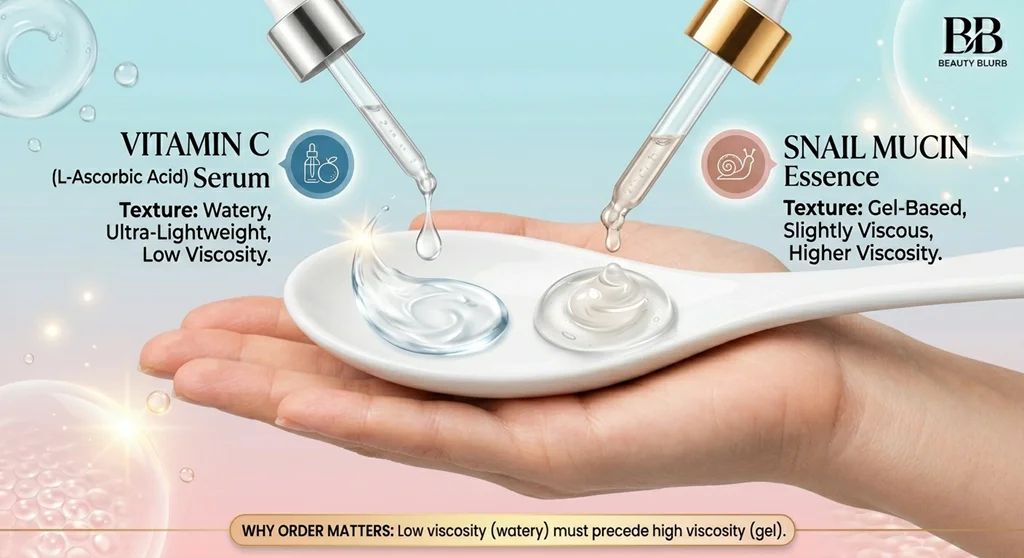
Another reason why skincare layering order matters is absorption. Active ingredients like vitamin C are designed to make direct contact with the skin, allowing them to absorb more effectively. If heavier or thicker products are applied first, they may reduce how evenly lighter products spread and absorb into the skin.
That said, skincare is not always as strict as some people make it seem online. Product texture and formulation often matter more than internet myths or rigid rules.
Some snail mucin products are lightweight essences, while others are thick creams. The same applies to vitamin C products. Understanding the texture of your products is often more useful than blindly following one layering rule for every skincare routine.
What Goes First, Vitamin C or Snail Mucin?
In most cases, and according to many dermatologists such as Dr. Abby, it’s generally recommended to apply vitamin C first, followed by snail mucin.
Vitamin C is usually formulated in lightweight serums designed to absorb quickly into clean skin. Applying it first gives your skin the best chance to absorb the ingredient properly before adding any hydrating or thicker layers on top, helping you get the full benefits of the serum.
As for snail mucin, its main role is hydration and skin barrier support. It helps your skin retain moisture, soothes irritation, and makes the skin feel less dry after using active ingredients like vitamin C or retinol.
However, this doesn’t mean you should skip moisturizer in your daily skincare routine — and that brings us to the next step.
How to Layer Snail Mucin and Vitamin C Together
Simply follow these steps:
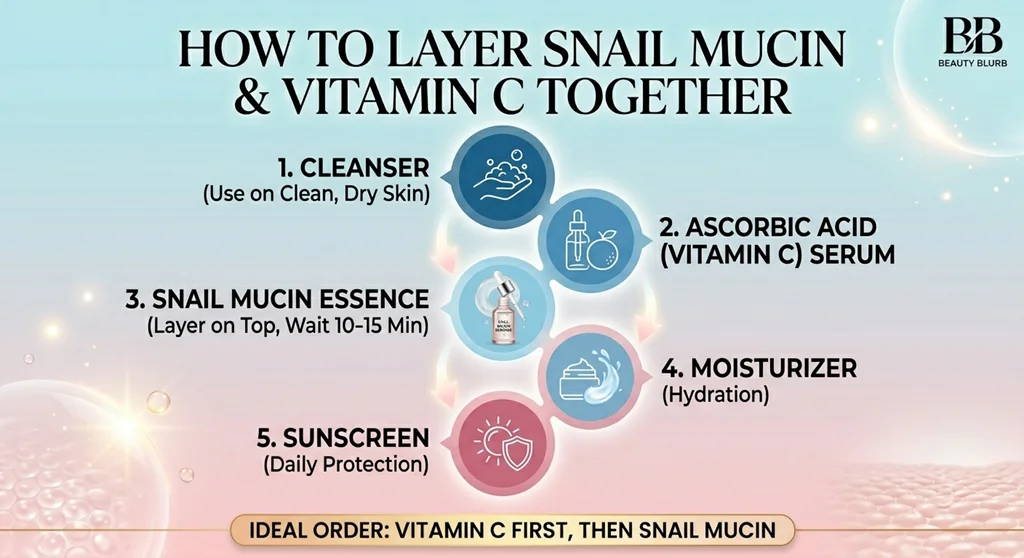
- Start with cleansing your skin. I personally recommend using a foaming water-based cleanser, especially if you have oily skin. If you follow a Korean skincare routine, begin with an oil cleanser first, followed by a water-based cleanser.
- After cleansing and drying your skin, apply your vitamin C serum directly onto the skin.
- Next, apply snail mucin to hydrate and soothe the skin.
- Finish with moisturizer, and in the morning, always apply sunscreen as the last step.
You might now be wondering: what about the nighttime routine? Should you repeat the same steps again?
From my personal experience, I don’t recommend using vitamin C again at night if you already used it in the morning. In most cases, using it once a day is enough for many people, especially beginners or those with sensitive skin.
Overusing active ingredients can sometimes lead to dryness, irritation, or a weakened skin barrier. At night, I personally prefer focusing on hydration and skin recovery by using snail mucin along with a moisturizer or other gentle skincare products.
Benefits of vitamin v & snail mucin them together
Vitamin C According to dermatological research published on PubMed, topical vitamin C (especially L-ascorbic acid) is a well-studied antioxidant in skincare.
It plays an important role in protecting the skin from oxidative stress caused by UV exposure and environmental damage. It also helps stimulate collagen production, improve skin brightness, and reduce hyperpigmentation over time. However, its effectiveness depends heavily on formulation stability, pH level, and proper absorption into the skin (Source).
Snail mucin: Recent scientific reviews show that snail mucin is a bioactive cosmetic ingredient rich in glycoproteins, hyaluronic acid, peptides, and antioxidants.
Studies suggest that it supports skin hydration, wound healing, and barrier repair, and may also help improve skin texture and inflammation in certain dermatological conditions. However, most current research is still limited to small clinical studies or preclinical data, meaning more large-scale trials are still needed to fully confirm all claims (Source).
a summary:
From both sets of research, we can clearly understand that vitamin C and snail mucin work in different but complementary ways. Vitamin C focuses on brightening, collagen stimulation, and antioxidant protection, while snail mucin mainly supports hydration, soothing, and skin barrier repair.
This is why combining them in a skincare routine is generally considered beneficial — not because they interact directly, but because they target different layers of skin health and improve overall skin balance when layered correctly.
When Can Snail Mucin Go First?
There are actually some situations where you can reverse the usual order — and this is where skincare becomes less about strict rules and more about truly understanding your products. In real skincare routines, flexibility often matters more than blindly following a single guideline.
One of the main cases is when you’re using a thicker vitamin C formula, such as cream-based vitamin C or balm-like treatments. These are not the typical lightweight serums. Because they are richer in texture, they don’t always absorb quickly into the skin. In these cases, applying them first can sometimes feel heavy and may not layer smoothly with the rest of your routine.
On the other hand, some snail mucin products come in extremely watery essence forms, almost like a toner in texture. They feel very light on the skin and absorb almost instantly.
When snail mucin is lighter than your vitamin C product, it can make more sense to apply it first, simply because it spreads more easily and prepares the skin for the next layers.
Another important situation is the sensitive skin buffering technique. If your skin is easily irritated by vitamin C, applying a thin layer of snail mucin first can help “buffer” the skin.
This doesn’t reduce the effectiveness of vitamin C, but it can make the experience much gentler by reducing stinging, dryness, or discomfort — especially when using higher-strength vitamin C products.
Simple Guide: When to Apply Each First
| Situation | Correct Order |
|---|---|
| Vitamin C serum + Snail mucin essence | Vitamin C first |
| Vitamin C serum + Snail mucin serum | Vitamin C first |
| Vitamin C serum + Snail mucin cream | Vitamin C first (always) |
| Snail mucin essence + Vitamin C serum | Snail mucin first |
| Sensitive skin buffering technique | Snail mucin first (optional) |
| Thick vitamin C + watery snail mucin | Depends on absorption speed, but usually snail mucin first |
Finally, the most important factor is always product formulation differences. Not all vitamin C serums are the same, and not all snail mucin products behave the same way.
Some are watery essences, others are gel-like or slightly creamy. Because of this, the ideal order is not fixed — it depends on which product is lighter, which absorbs faster, and how your skin personally responds to each layer.
Common Mistakes When Using Snail Mucin and Vitamin C Together
One of the most common mistakes people make is applying vitamin C on damp or wet skin, not giving enough time between layers, using high-strength vitamin C with snail mucin immediately, and most importantly, skipping sunscreen — which completely reduces the long-term benefits of your routine.
Here are the most common mistakes you should avoid:

- Applying vitamin C on damp or wet skin
Vitamin C serums usually work best on clean, dry skin. When applied on wet skin, the formula can become diluted, which may reduce its effectiveness and stability. - Not waiting between layers
Skipping a short absorption time between vitamin C and snail mucin can lead to pilling and uneven layering. A few seconds to about a minute is usually enough for the skin to absorb each layer properly. - Using high-strength vitamin C and layering immediately with snail mucin
Strong vitamin C formulas can sometimes cause irritation if layered too quickly. While snail mucin helps soothe and calm the skin, giving your skin a short adjustment time is still important. - Skipping sunscreen
This is one of the biggest mistakes. Vitamin C can support the skin against free radical damage, but it does not replace sunscreen. Without SPF, the overall effectiveness of your routine is significantly reduced. - Using too much product
More product does not mean better results. Overloading the skin can cause pilling, irritation, and can even block proper absorption of active ingredients. - Mixing too many active ingredients at once
Combining multiple strong actives in the same routine can overwhelm the skin barrier. When adding vitamin C and snail mucin, it’s better to keep the routine simple and balanced. - Applying products on improperly prepped skin
If the skin is not properly cleansed or has leftover residue from previous products, absorption of both vitamin C and snail mucin can be affected.
By avoiding these mistakes, you allow both ingredients to work together more effectively — vitamin C for brightening and protection, and snail mucin for hydration, soothing, and skin barrier support.
Best Snail Mucin and Vitamin C Products to Use Together
1: Best Snail Mucin Products
If you feel a bit confused and need guidance choosing the right product, don’t worry — based on my personal experience (and feedback from friends who tried them too), these are two of the most reliable options I recommend for a snail mucin and vitamin C routine.
COSRX Advanced Snail 96 Mucin Power Essence
This is honestly my personal favorite.
What makes it stand out is its lightweight gel-essence texture that absorbs easily into the skin without feeling heavy or sticky. It layers beautifully after vitamin C, helping to calm the skin and deeply hydrate it at the same time.
It’s also quite affordable, often priced around $19 on Amazon, which makes it a great everyday option if you want something effective without spending too much.
COSRX Advanced Snail 92 All In One Cream
This is another excellent product from COSRX.
Unlike the essence, this one has a richer, creamier texture, making it perfect for your nighttime routine. It helps strengthen the skin barrier and locks in all previous layers, especially after using active ingredients like vitamin C.
If you’re someone who deals with dryness or wants extra nourishment at night, this is a great choice.
2: 🍊 Best Vitamin C Products to Pair With Snail Mucin
SkinCeuticals C E Ferulic
I can’t talk about vitamin C without mentioning this one.
It contains L-Ascorbic Acid, Vitamin E, and Ferulic Acid, which makes it one of the most stable and well-formulated vitamin C serums available. It absorbs quickly into the skin and works extremely well when followed by snail mucin, which helps calm and hydrate afterward.
It’s definitely on the premium side, but in terms of results, it’s considered a gold standard.
Timeless 20% Vitamin C + E Ferulic Acid Serum
A great budget-friendly alternative.
It delivers strong antioxidant benefits and works well for building a consistent morning routine. It layers nicely under snail mucin and is a solid choice if you want effective results without a high price tag.
La Roche-Posay Pure Vitamin C10 Serum
This is a gentler option, especially suitable for sensitive skin.
It provides a softer vitamin C experience while still helping with brightness and skin texture. It’s a good starting point if you’re new to vitamin C and want something easy to combine with snail mucin without irritation.
❓ Final Answer: Can One Product Contain Both Snail Mucin and Vitamin C?
Yes, there are products that combine snail mucin and vitamin C in a single formula.
However, they are not always the most effective option for everyone.
The reason is simple:
- Vitamin C works best in a stable, low-pH environment
- Snail mucin focuses on hydration and skin barrier repair
When combined, the formulation can sometimes limit the full potential of one or both ingredients depending on how it is designed.
👉 That’s why many skincare experts still prefer using them separately in layers, where each ingredient can fully perform its role.
FAQ About Snail Mucin Before or After Vitamin C
At the end of the day, there is no complicated rule when it comes to using snail mucin and vitamin C together — it mostly comes down to understanding your skin and your products. In most cases, vitamin C goes first because it is a lightweight active that needs direct contact with clean skin, while snail mucin comes after to hydrate, soothe, and support the skin barrier.
What really matters is not memorizing strict rules, but learning how your skin reacts. Some routines may need small adjustments depending on texture, sensitivity, or product formulation, and that is completely normal.
If you keep your routine simple, consistent, and balanced, both ingredients can work beautifully together — giving you brighter, healthier, and well-hydrated skin over time.

Akram Boulaid is a dedicated Skincare Researcher and Analyst with over 7 years of intensive focus on dermatology and cosmetic ingredient science. As a globally recognized expert, his insights have been featured in major international publications, including the New York Post and GB News. A verified expert on Qwoted, Akram connects with health journalists to provide evidence-based analysis. He founded Beauty Blurb to bridge the gap between complex clinical data and practical skincare routines, specializing exclusively in the needs of oily and acne-prone skin through rigorous analysis of peer-reviewed scientific literature.