
How to use The Ordinary Glycolic Acid is simpler than you might think. Apply the toner to clean, dry skin at night using a cotton pad, sweep it gently across your face while avoiding the eye area, and let it absorb before following with a moisturizer.
Begin with 2–3 times per week, then gradually increase as your skin builds tolerance. And don’t forget: daily sunscreen (Spf 30+) is a must, since glycolic acid can make your skin more sensitive to the sun.

In this guide, we’ll dive deep into how to use glycolic acid The Ordinary way—not just for your face, but also for oily skin, armpits, and even the body.
You’ll learn the best routines, how often you can really use it (daily or not), plus safety tips and pairing advice to get the most from this cult-favorite toner.
Whether you’re a beginner or just looking for smarter ways to include it in your skincare, this article has you covered.
What Is The Ordinary Glycolic Acid 7% Toning Solution?
The Ordinary Glycolic Acid 7% is one of the brand’s most popular exfoliating toners. Unlike regular toners, this formula contains glycolic acid, an AHA (alpha hydroxy acid) that works by gently dissolving dead skin cells on the surface.
The result? Smoother texture, brighter skin, and a refreshed look.
This toner is especially loved by people with oily skin or congested pores, since it helps reduce excess oil, minimize dullness, and improve overall clarity. It’s also a budget-friendly option, which makes it a go-to choice for beginners in chemical exfoliation.
Here are some of its main benefits Of The Ordinary Glycolic Acid 7% toner:
- ✨ Exfoliates gently: removes dull, dead skin cells.
- 🌟 Brightens complexion: leaves skin looking more even and glowing.
- 🧴 Unclogs pores: helps reduce congestion and blackheads.
- 💧 Balances oily skin: minimizes excess shine over time.
- 💸 Affordable skincare: pro-level results without breaking the bank.
- 🙌 Multi-use power: not just for the face—it’s often used on armpits, elbows, and other body areas to smooth skin and reduce discoloration.
- 🎯 Fades dark spots: with regular use, it can help lighten hyperpigmentation and uneven tone.
💡 And hey, if you’re the curious type (or just love skincare gossip 👀), we already did a full review with all the juicy details. You can check it out here: The Ordinary Glycolic Acid Review.
how to use The Ordinary glycolic acid On Face?
Maybe you’re wondering — “how do you use ordinary glycolic acid in routine?” Let me break it down for you in a friendly, easy-to-follow way. Whether you’re just starting or already familiar, this guide is here to tell you exactly when and how to include it—no guesswork.
Step-by-Step Routine
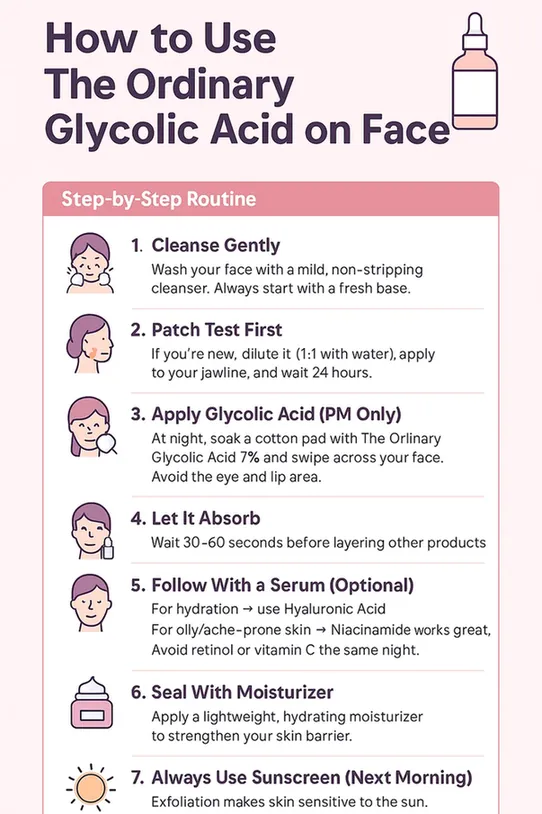
- Cleanse Gently
Wash your face with a mild, non-stripping cleanser to prep the skin. Always start with a clean base. - Patch Test First
Especially if you’re new: dilute (1:1 with water), apply to your jawline, and wait 24 hours. No irritation? You’re good to go. - Apply Glycolic Acid (PM Only)
At night, soak a cotton pad with The Ordinary Glycolic Acid 7% and sweep it across your face. Avoid eyes and lips. - Let It Absorb
Give it 30–60 seconds to penetrate the skin before layering anything else. - Follow With a Serum (Optional but Powerful)
- If you want to boost hydration → use a hyaluronic acid serum.
- For oily/acne-prone skin → a niacinamide serum works beautifully after glycolic acid.
- Avoid strong actives (like retinol or vitamin C) on the same night.
- Seal With Moisturizer
Lock in the benefits with a lightweight, hydrating moisturizer. This helps maintain your skin barrier. - Always Use Sunscreen (Next Morning)
Never skip SPF 30+ the day after. Glycolic acid exfoliates, which makes skin more vulnerable to UV damage. - Frequency & Progression
- Beginners: 2–3 times per week at night.
- Sensitive skin: once a week, diluted.
- Build up only if your skin tolerates it well.
Clinical Evidence: Skin Test Facts
Let’s back this up with some science — studies not on our specific the ordinary glycolic acid uses, but on glycolic acid’s real-world effectiveness:
- Study 1: Thibault et al. (1998)
A double-blind, randomized, placebo-controlled trial with 75 volunteers used a 5% glycolic acid cream daily for 12 weeks.
Result: statistically significant improvements in skin texture and discoloration compared to placebo. (P. K. Thibault, J. Wlodarczyk & A. Wenck). Source. - Study 2: Indian Journal of Dermatology (2025)
Compared 50% glycolic acid peel vs. 80% lactic acid peel in 40 patients with melasma (20 per group). After four sessions, glycolic acid significantly reduced MASI scores more than lactic acid (median reduction: 2.85 vs. 1.8; P = 0.009), with similar safety profiles. (Dr. Priya P. Kadu et al.). Source.
These clinical findings support the idea that glycolic acid—when used correctly—can improve skin tone, discoloration, and texture. It reassures us that the The Ordinary Glycolic Acid 7%, in a well-tolerated routine, follows science-backed benefits.
how to use the ordinary glycolic acid on armpits
Using The Ordinary 7% Glycolic acid toning solution on your armpits is more than just a beauty trend—it’s a smart skincare move. Thanks to its gentle chemical exfoliation, it helps slough away dead skin cells, which in turn can:
- Brighten dark spots and even out tone under your arms—no harsh strips needed.
- Smooth texture and reduce ingrown hairs, especially after shaving.
- Lower underarm odor, since exfoliation helps break down odor-causing bacteria by reducing the buildup on skin.
- Multitask like a pro: act as both a textural treatment and light brightener for tough spots.
How do you use glycolic acid for best results to Your Armpits

- Clean & Dry the Area
Start with a clean, dry underarm—post-shower is perfect. Avoid applying to freshly shaved or irritated skin. - Patch Test First
Swipe a diluted amount (1:1 with water) on one pit. Wait 24 hours. No redness or burning? Safe to proceed. - Application — Gentle and Targeted
Dampen a cotton pad lightly with Acide glycolique The Ordinary aisselle (the glycolic solution) and swipe it gently across the underarm area. - Let It Dry Naturally
Wait 30–60 seconds. Avoid immediate friction or deodorant application to prevent irritation. - Moisturize (Optional but Helpful)
If your skin feels dry, follow with a soothing, fragrance-free moisturizer or a light aloe lotion. - Frequency: Start Slowly
Begin with once or twice a week at night. Increase frequency gradually only if tolerated well. Overuse can lead to dryness or irritation. - Standard Deodorant Still Needed
While glycolic helps reduce odor-causing bacteria, it does not reduce sweating. Continue using a deodorant or antiperspirant in the morning as needed.
A clinical study applying a glycolic-acid formulation found significant improvement in hyperpigmentation and skin luminosity starting in week 4 and continuing to week 12. The tested product was well tolerated and effective for tone and brightness. Source.
Interpretation: If the ordinary glycolic acid can brighten facial discoloration, it likely works similarly well on underarm hyperpigmentation—supporting its “brightening aisselle” effect.
how to use glycolic acid The Ordinary for Strawberry Legs
Ever wondered why your legs look like they have tiny dark “seeds” after shaving? These are often called strawberry legs—they’re essentially open pores filled with oil and dead skin that darken when exposed to air. Regular and gentle exfoliation is key to keeping them under control.
Our favorite—The Ordinary Glycolic Acid—does more than just clear your face. Its chemical exfoliation action helps:
- Loosen and remove dead skin trapped in pores.
- Prevent ingrown hairs and reduce post-shave bumps.
- Smooth rough texture and fade dark dots over time.
If you’re googling The Ordinary Glycolic Acid how to use, you’ve come to the right place. Let’s get those legs photo-ready!
How to Use It — Step-by-Step Guide
- Shave with Care
Use a gentle exfoliating body wash and shaving cream to prep your skin. Shave with a clean, sharp razor—always in the direction of hair growth to minimize irritation. - Apply Glycolic Acid (Post-shave)
While your skin is still slightly damp, spray or swipe The Ordinary Glycolic Acid 7% lightly over your legs. This maximizes absorption and exfoliation. - Let It Absorb & Dry
Allow 30–60 seconds before moving—this prevents friction and helps the product do its job. - Moisturize Thoroughly
After the acid has dried, apply a hydrating, urea-based lotion to calm and soften skin. This step is vital for comfort and barrier repair. - Adjust Frequency Carefully
- Begin with application once or twice a week at night.
- Increase frequency only if your skin tolerates it well—moderation is key to avoiding dryness or irritation.Reddit
- Morning Routine
Always follow with SPF if your legs will be exposed—the acid makes your skin extra sensitive to sunlight.
Reddit Tip — Real Users, Real Results:
One Redditor shared a simple but effective hack: “I fill a spray bottle with The Ordinary Glycolic Acid, mist it on after a shower, let it dry, then apply moisturizer. In under a week, my strawberry legs were so much smoother.”
Dermatologists, including Harvard-trained professionals, recommend applying a glycolic acid spray after shaving as the third step in your routine to minimize strawberry legs. Finish with a moisturizing product that contains urea to soothe and hydrate the skin. Source.
This method works because glycolic acid’s AHA properties gently dissolve the plugs in pores (helping with both bumps and dark spots) while hydrating ingredients support the skin barrier long-term.
How to Use The Ordinary Glycolic Acid for Acne
If you’re dealing with breakouts, glycolic acid can be a game-changer. This AHA gently dissolves the “gunk”—dead skin cells and excess oil—that clog pores and fuel pimples.
Unlike harsh scrubs, it exfoliates without abrasion, helping prevent blackheads, whiteheads, and future breakouts while smoothing texture. It’s also surprisingly hydrating, making it a gentler option compared to many drying acne treatments.
Table: glycolic acid the ordinary how to use For acne prone
| Step | What to do | Notes / Frequency |
|---|---|---|
| Cleanse | Use a mild, non-abrasive cleanser to remove dirt and oil. Avoid physical scrubs that can overstimulate acne-prone skin. Prepares the skin for effective acid absorption. |
PM • Every use Do not combine with harsh scrubs the same night. |
| Patch test | Apply a diluted amount (1:1 with water) behind the ear or on the jawline. Wait 24 hours to check for sensitivity. |
Once before first use Repeat if products or routines change. |
| Apply (PM only) | Sweep The Ordinary Glycolic Acid 7% with a cotton pad across the face, avoiding eyes and lips. Use only in the evening. |
PM only Do not use before daytime sun exposure. |
| Let it absorb | Wait 1–2 minutes to allow the acid to penetrate and work—this prevents it from being wiped away by the next step. |
30–120 sec Short wait improves efficacy. |
| Serum | Optional: apply a gentle serum (e.g., hyaluronic acid or niacinamide) after absorption to boost hydration and barrier support. |
Optional Avoid strong actives same night (no retinol together). |
| Moisturize | Seal with a lightweight, non-comedogenic moisturizer to reinforce the skin barrier after exfoliation. |
PM • Every use Supports healing and reduces dryness. |
| Retinoid timing | Do not use retinol or tretinoin the same night as glycolic acid. Alternate nights or use retinoids in the morning/other routine as advised. |
Alternate nights Reduces irritation risk & barrier breakdown. |
| SPF (next day) | Apply broad-spectrum SPF 30+ every morning—glycolic acid increases sun sensitivity and risk of hyperpigmentation. |
AM • Every day Non-negotiable for safety. |
| Build tolerance | Start with 2–3 nights/week. For very reactive skin, begin 1–2 nights/week. Increase gradually only if tolerated. |
2–3x/wk (typical) Listen to your skin—reduce frequency if irritation appears. |
A user on Reddit shared positive practical feedback:
“I get cystic acne on my shoulders regularly and started using TO glycolic acid about 3 weeks ago. As long as I’m consistent, it keeps acne at bay and some scars are already fading.” Source.
Clinical study:
- A notable skin study examined a combination of retinoic acid (a potent anti-acne agent) and glycolic acid in 35 patients over 12 weeks.
- Nearly 91% saw significant improvement in acne scars and post-inflammatory hyperpigmentation.
- This highlights glycolic acid’s effectiveness—not just for acne clearance, but also for healing and fading acne marks.
💡 Pro-tip: If you have oily or acne-prone skin and wonder how glycolic acid fits into a bigger plan, don’t worry — we’ve got you covered.
Check out our Dermatologist-Recommended Skin Care Routine for Oily Skin for a step-by-step guide that makes your glow last longer .
Have you tried The Ordinary Glycolic Acid for your skin, armpits, or even body acne? ✨ Share your personal experience in the comments below — what worked, what didn’t, and any tips you’ve discovered. Your story might be exactly what another reader needs to finally feel confident trying it! 💬💕
How Often Should You Use The Ordinary Glycolic Acid?
After we’ve walked through how to use The Ordinary Glycolic Acid 7% Toning Solution step by step, the next big question is: how often should you actually use it?
The truth is, frequency matters just as much as technique. Overusing glycolic acid can lead to irritation, while using it too little won’t deliver the smoothing, brightening results you’re hoping for.
In this section, we’ll break down the ideal usage schedule for beginners, oily skin types, and those with more sensitive or acne-prone skin — so you can enjoy all the benefits without overdoing it.
| Skin type | Starting frequency | Ramp-up (if tolerated) | Max recommended | Notes |
|---|---|---|---|---|
| Normal / Combination | 2–3×/week | Increase to 3–4×/week over 4–6 weeks | 4–5×/week | Good tolerance common—watch for dryness. Always use SPF next day. |
| Oily / Acne-prone | 2–3×/week | Move to alternate nights after 3–6 weeks if no irritation | 3–5×/week | Helps unclog pores and reduce breakouts; pair with light moisturizer. |
| Sensitive / Reactive | 1×/week (diluted 1:1) | Gradual: 1→2→3×/week over several months only if fully tolerated | 2–3×/week (careful) | Start diluted (1:1 with water). Stop if persistent stinging/redness occurs. |
| Very Reactive / Rosacea-prone | Not recommended without derm | Use under dermatologist supervision if considered | — | Better to consult a dermatologist; acids can worsen active rosacea. |
| Body (legs / underarms / back) | 1–2×/week | Increase to 2–3×/week for areas that tolerate it | 3×/week | Use after shower on damp skin; consider mist bottle for hard-to-reach areas. |
| Using with actives (retinoids) | Alternate nights | Do not layer retinoid + glycolic same night | Separate routines | Example: glycolic PM, retinoid on different PMs to avoid irritation. |
I’ve worked with The Ordinary Glycolic Acid long enough to see that it’s not just about a quick glow—it’s really about building a safe exfoliation habit that supports your skin’s long-term health.
The trick isn’t using it every night or rushing results, but finding that sweet balance where your skin stays smooth, hydrated, and calm.
If you’re consistent, glycolic acid can help you with dark spots, dull texture, strawberry legs, and even those stubborn underarm concerns.
But from my own experience, the biggest win comes when you combine it with a gentle routine, a supportive moisturizer, and daily SPF. That’s when your skin thanks you with that natural, healthy glow we’re all after.
So, if you’re curious about how to bring The Ordinary Glycolic Acid into your own routine, start slow, listen to your skin, and enjoy the process.
And of course—share your journey with us in the comments. Your experience might be the exact tip another reader needs! 💕
What Should You Never Mix With Glycolic Acid?
I know, my dear—you’re probably wondering right now: what should I avoid when using The Ordinary Glycolic Acid? It’s such a smart question, because mixing the wrong actives can mean irritation instead of glow. Let’s keep it simple and clear.
🚫 Ingredients to Avoid with Glycolic Acid
- Retinol / Tretinoin → Both are powerful exfoliators; using them together is a recipe for redness and peeling.
- Vitamin C (L-ascorbic acid) → Using it in the same routine can overwhelm your skin.
- Salicylic Acid (BHA) → Too much exfoliation at once can strip your barrier. Alternate days instead.
- Niacinamide (sometimes) → It’s not dangerous, but layering directly can reduce effectiveness. Best to use in separate routines (e.g., glycolic at night, niacinamide in the morning).
- Strong physical scrubs → Double exfoliation is a fast track to irritation.
Think of glycolic acid as a star player in your routine — it shines brightest when you let it work solo or pair it with calming, hydrating friends like hyaluronic acid, ceramides, or a soothing moisturizer.
Keep it simple, balance with Vitamin C in the AM, and your skin will thank you with that healthy, smooth glow. ✨
What Is Best to Layer With Glycolic Acid?
One of the biggest skincare secrets I’ve learned is this: glycolic acid works best when you pair it with the right friends.
The wrong combination can cause irritation, but the right layers can boost hydration, smooth texture, and brighten your glow even faster. So if you’ve been wondering “what to use with glycolic acid?” — here’s the ultimate cheat sheet.
✅ Best Ingredients to Layer with Glycolic Acid
- Hyaluronic Acid → A hydration powerhouse that helps balance glycolic acid’s exfoliating action. Think of it as giving your skin a big drink of water after exfoliation.
- Niacinamide → Calms redness, strengthens the skin barrier, and balances oil production. A smart pick if you have oily or acne-prone skin.
- Ceramides & Peptides → Repair and soothe, perfect for anyone with sensitive skin.
- Vitamin C (L-ascorbic acid) → Yes, it is one of the best partners — but only when layered correctly. As we discussed earlier, apply Vitamin C in the morning (for antioxidant protection and brightness), and The Ordinary Glycolic Acid in the evening (for gentle exfoliation). This combo supports a smoother, brighter, and more even complexion without clashing.
🌸 Key Takeaway
When it comes to layering skincare acids, less is more. Pair your The Ordinary Glycolic Acid with hydrating, soothing, or brightening ingredients in separate routines. For example:
- Morning: Cleanser → Vitamin C → Moisturizer → SPF
- Evening: Cleanser → Glycolic Acid → Hydrating Serum (Hyaluronic/Niacinamide) → Moisturizer
That way, you’re not just exfoliating — you’re giving your skin a complete 24-hour care cycle. ✨
The Ordinary Glycolic acid before and after
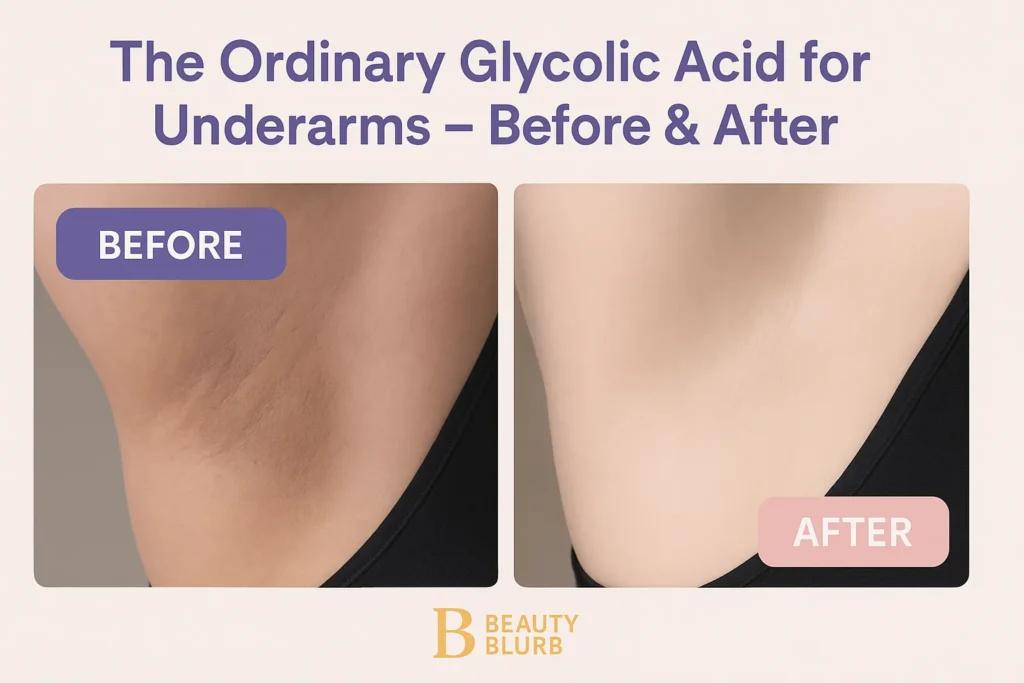
I’ve gathered a few before and after photos to give you a real look at how The Ordinary Glycolic Acid Toner works in everyday routines.
One is from a lovely follower who shared her journey with me, and the others are curated from Reddit and Pinterest, where skincare lovers openly posted their results.
We’ve brought them together here so you can see the genuine transformations for yourself. ✨
THIS is the ordinary glycolic acid for underarms before and after:
FAQ Of The Ordinary Glycolic Acid Toner
Thank you so much for staying with me until the end of this guide on How to Use The Ordinary Glycolic Acid.
I truly hope it gave you the clarity and confidence you need to start (or improve) your skincare journey with this powerful toner.
If you haven’t tried it yet, give it a go — your skin might surprise you with the glow it can achieve.
And if you’re already using it, I’d love to hear about your personal experience. Share your journey in the comments below so we can all learn from each other.
Don’t forget to subscribe to stay updated with more expert skincare tips, real reviews, and step-by-step guides tailored just for you. Your skin deserves the best care — and together, we’ll get there. 🌸✨

Akram Boulaid is a dedicated Skincare Researcher and Analyst with over 7 years of intensive focus on dermatology and cosmetic ingredient science. As a globally recognized expert, his insights have been featured in major international publications, including the New York Post and GB News. A verified expert on Qwoted, Akram connects with health journalists to provide evidence-based analysis. He founded Beauty Blurb to bridge the gap between complex clinical data and practical skincare routines, specializing exclusively in the needs of oily and acne-prone skin through rigorous analysis of peer-reviewed scientific literature.