If you’re wondering, is salicylic acid good for fungal acne? the short answer is yes – but with a twist. Salicylic acid can help unclog pores, remove dead skin cells, and reduce excess oil, which creates an environment less friendly for fungal acne.
However, it is not an antifungal, so it works best alongside proper antifungal treatments.
In this article, we’ll explore how to use salicylic acid for fungal acne safely and effectively. You’ll learn the best routines, recommended products, common mistakes to avoid, and expert tips to keep your skin clear and healthy.
By the end, you’ll know exactly how to include salicylic acid in your fungal acne treatment plan.
What is Salicylic Acid and How Does It Work
Before we get into the big question — does salicylic acid remove fungal acne. we first need to understand what this ingredient actually is and how it works on the skin.
Knowing its function will help you see why it can play such an important role in managing breakouts, including fungal acne.
Salicylic acid is a beta-hydroxy acid (BHA) that’s oil-soluble, meaning it can penetrate deep into your pores where excess oil and dead skin cells build up.
This unique ability allows it to exfoliate the skin from within, clearing blockages that often lead to clogged pores and acne. For people with oily skin, this is especially helpful because it reduces shine and keeps the skin balanced.
By loosening the bonds between dead skin cells, salicylic acid encourages gentle skin exfoliation, leaving your complexion smoother and less congested.
While it doesn’t directly kill the yeast behind fungal acne, it helps create a skin environment that makes fungal breakouts less likely to thrive. That’s why it’s often recommended as part of a broader skincare routine for those dealing with both oily skin and fungal acne.
Fungal Acne vs Regular Acne
Many people struggle to tell the difference between fungal acne and regular acne — and that confusion often leads to the wrong treatments.
Before deciding if salicylic acid can really help, it’s important to understand what fungal acne actually is, and how it differs from the breakouts most of us are used to dealing with.
1: What Is Fungal Acne?
Fungal acne, also known as Malassezia folliculitis, isn’t actually “acne” in the traditional sense. Instead of being caused by bacteria and clogged pores, it’s triggered by an overgrowth of yeast that naturally lives on our skin.
When this yeast multiplies, it inflames the hair follicles and creates itchy, uniform bumps that often appear on the forehead, chest, or back.
Unlike regular pimples, fungal acne usually feels itchy and stubborn, and it doesn’t respond well to standard acne treatments.
2: What Makes It Different from Regular Acne?
Regular acne develops when pores become blocked with oil, dead skin cells, and bacteria. It usually appears as blackheads, whiteheads, or inflamed pimples that can vary in size.
Fungal acne, on the other hand, is caused by yeast, not bacteria — which means treatments like antibiotics or benzoyl peroxide often don’t work.
This is where ingredients like salicylic acid come into play: while it doesn’t kill the yeast, it can reduce the oil and buildup that fuel both types of breakouts, making it an effective supporting ingredient in a fungal acne routine.
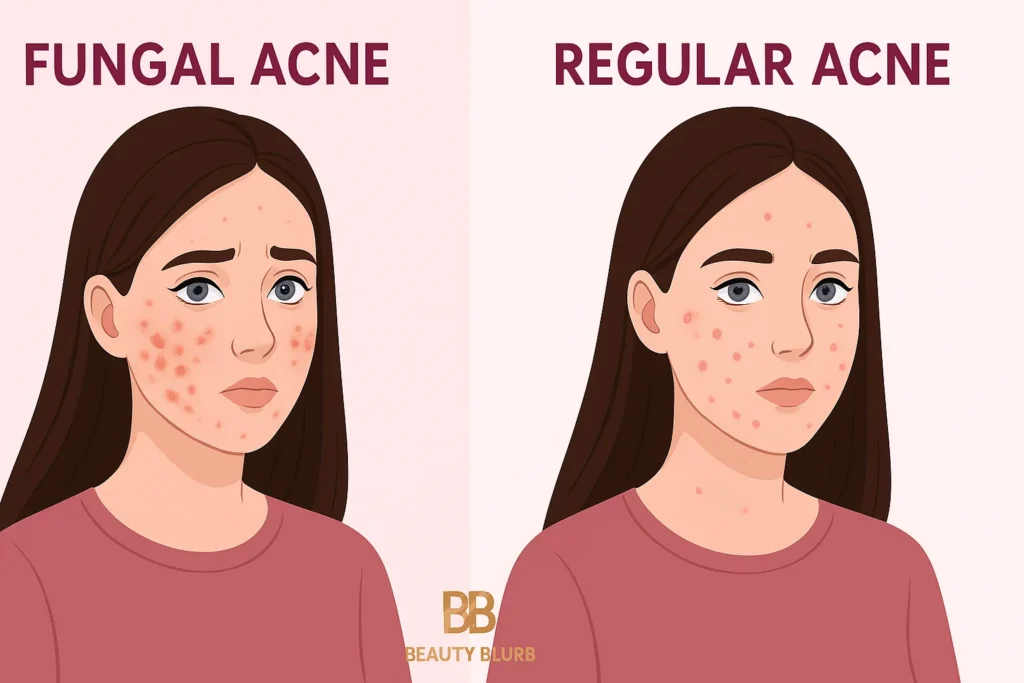
3: Fungal Acne vs. Regular Acne: Key Differences
In short, the main difference is that fungal acne is caused by yeast, while regular acne is caused by bacteria and clogged pores. That’s why treatments differ — and why ingredients like salicylic acid can support both, but only as part of the right routine.
What Causes Fungal Acne?
Before we even ask, can you use salicylic acid for fungal acne?, it’s crucial to first understand fungal acne causes —this knowledge gives you the best shot at accurate diagnosis and effective treatment.

- Warm, Humid Environments & Excessive Sweating
Malassezia yeast thrives in moist, hot conditions—so sweaty skin or tight, non-breathable clothing or Not changing into clean clothes after exercise. creates a perfect breeding ground. - Occlusion and Friction
Activities or clothing that trap moisture or rub against skin—like workout gear, hot tubs, or tight fabrics—increase follicular occlusion, encouraging yeast overgrowth. - High Sebum Production (Oily Skin)
Malassezia is lipophilic—it feeds on fatty acids. Excess skin oil provides nourishment, making oily skin a risk factor. Source. - Antibiotic Use & Dysbiosis
Broad-spectrum antibiotics can disrupt the skin’s bacterial balance, reducing bacteria that normally compete with yeast and allowing yeast to flourish. - Immune Suppression & Hormonal Factors
Conditions like diabetes or immunity-altering treatments, as well as hormonal surges during puberty, menstruation, or pregnancy, can predispose someone to fungal acne. - Genetic Predisposition & Existing Skin Conditions
A family history of fungal-related skin issues or a personal history of seborrheic dermatitis or tinea versicolor increases the likelihood of developing fungal acne.
Now that you’re clear on the root causes of fungal acne, do you feel you have a better grasp of the possible symptoms—and whether salicylic acid for fungal acne might actually fit into your treatment plan?
Symptoms of Fungal Acne
Recognizing fungal acne can be tricky, because at first glance it often looks just like regular acne. But here’s the catch: the signs are slightly different — and knowing them will help you (and your dermatologist) find the right treatment.
Here are the most common fungal acne symptoms you should watch out for:
- 🔹 Small, uniform bumps: usually the same size, unlike bacterial acne where pimples vary in size.
- 🔹 Itchiness: one of the biggest giveaways. Regular acne doesn’t usually itch, but fungal acne often does.
- 🔹 Clusters on oily or sweaty areas: especially the forehead, chest, shoulders, or back.
- 🔹 No response to standard acne treatments: if antibiotics, benzoyl peroxide, or retinoids don’t work, fungal acne might be the culprit.
- 🔹 Redness and irritation: caused by the inflammation of hair follicles.
💡 Quick Tip: If you notice your “acne” gets worse after sweating, wearing tight clothing, or using oily skincare products, there’s a good chance it might actually be fungal acne.
Quick Self-Check: Is It Fungal Acne?
Answer these quick questions to get a better idea:
- Do your breakouts feel itchy?
- ✅ Yes → That’s a red flag for fungal acne.
- ❌ No → More likely to be regular acne.
- Are the bumps all about the same size and appear in clusters?
- ✅ Yes → Classic sign of fungal acne.
- ❌ No → Regular acne usually varies in size.
- Do your breakouts get worse after sweating or wearing tight clothes?
- ✅ Yes → That points toward fungal acne.
- ❌ No → Probably just regular acne flare-ups.
is salicylic acid good for fungal acne
So, my friend, we’ve finally arrived at the big question of this article: “can I use salicylic acid for fungal acne?”
Yes, you can use salicylic acid for fungal acne—but think of it more like a helpful teammate rather than the star player. It doesn’t zap the yeast directly. Instead, it steps in to:
- Gently exfoliate dead skin cells that clog your pores.
- Reduce excess oil, which yeast thrives on.
- Calm redness and swelling thanks to its anti-inflammatory properties.
These actions make your skin environment less inviting for fungal overgrowth and help antifungal treatments work more effectively.
1: What Makes It Really Valuable
Let me walk you through those powerful benefits:
- Unclogging & Exfoliating Pores:
Salicylic acid dissolves the glue-like bonds between dead skin cells so they can be sloughed off easily, keeping your pores clean. That means fewer hiding spots for Malassezia yeast. - Balancing Oil Production:
This BHA doesn’t just clear—it also regulates oily skin, depriving the fungus of its fuel source. - Soothing Inflammation:
It’s not just about cleaning—its anti-inflammatory effect helps reduce the redness and irritation common in fungal acne.
2: Science-Backed Proof
There’s a standout study involving a 30% salicylic acid peel applied once weekly for four weeks on patients with Malassezia-related skin issues.
Around 88% of participants achieved both clinical and lab-confirmed improvement—though again, not by killing the yeast, but by cleaning and rebalancing the skin. Source.
Additionally, combinations like Whitfield’s ointment (3% salicylic acid + 6% benzoic acid) have long been used to treat fungal skin conditions. The idea is simple: the salicylic acid clears thickened skin to help antifungal ingredients penetrate better. Source.
So, yes—salicylic acid is a powerful support ingredient when you’re dealing with fungal acne. It prepares the skin terrain for antifungal treatments to work better, while also calming and balancing. But remember—it’s most effective as part of a targeted routine, not the entire routine.
💡 Pro tip: If you have oily skin and want to dive deeper into how salicylic acid can balance excess sebum, check out our full guide on the benefits of salicylic acid for oily skin. It’s the perfect companion read to this one!
How to Use Salicylic Acid into Your Fungal acne skincare routine
After we’ve answered the big question — Is Salicylic Acid Good for Fungal Acne On Face? — let’s move on to something more practical: how to fit it into your daily routine. Because knowing the science is great, but the real change happens when you use it the right way.
🌞 Morning Routine
- Cleanser: Use a salicylic acid cleanser (0.5–2%) to clear excess oil and gently exfoliate.
- Toner (optional): If you love toners, choose one with a low % of salicylic acid or soothing ingredients (like niacinamide) that are fungal-acne safe. This preps your skin for better absorption.
- Serum: Go for a lightweight, non-oily serum with calming or hydrating actives (e.g., niacinamide or hyaluronic acid). Avoid serums with heavy oils.
- Moisturizer: Stick to an oil-free, gel-based moisturizer (squalane or glycerin are great).
- Sunscreen: Always finish with a broad-spectrum, non-comedogenic SPF.
🌙 Evening Routine
- Cleanser (alternate): If you used salicylic acid in the morning, stick with a gentle cleanser at night. If not, this is a good time to use it.
- Toner: A soothing toner without alcohol can help calm skin after cleansing. If you didn’t use salicylic acid earlier, you can include it here in toner form.
- Serum: At night, you can add a targeted serum (like azelaic acid or niacinamide) — both are fungal-acne safe and boost results.
- Treatment: Use your antifungal cream (like ketoconazole) 2–3x a week, or as prescribed.
- Moisturizer: Lock everything in with a simple, non-fungal-trigger cream.
💡 Pro Tips
- Start with one salicylic acid product (cleanser or toner, not all at once).
- Serums are great add-ons but keep them light and fungal-safe.
- Avoid layering too many exfoliants — less is more.
- Remember: salicylic acid = pore and oil control, antifungal = root cause treatment.
Fungal acne treatment to Pair With Salicylic Acid
Here’s some solid, science-backed proof that helps you trust these go-to treatments—not just wishful thinking.
1. Ketoconazole 2% Cream — Direct Antifungal Action
A double-blind, randomized, placebo-controlled trial conducted in Thailand involved 41 adult women with acne. They applied 2% ketoconazole cream twice daily for 10 weeks. The results were remarkable:
- 42.9% of participants saw a noticeable improvement, compared to only 9.5% with the placebo.
- The success rate (meaning significant improvement) was 45% vs. 14.3%, in favor of ketoconazole. PubMed
This shows that ketoconazole doesn’t just fight yeast—it delivers real results when added to your skincare routine.
2. Zinc Pyrithione — Lab-Proven Antifungal Effect
An in vitro study and human skin testing found that zinc pyrithione (ZnPT) effectively inhibits the growth of Malassezia yeasts, including M. restricta and M. globosa. A small-scale skin study using quantitative PCR (qPCR) revealed a clear reduction in M. restricta after using a ZnPT-containing shampoo. PubMed.
So even if the evidence isn’t from massive trials, the lab and real-world results both confirm that ZnPT works against the root cause of fungal acne.
3. Whitfield’s Ointment — Classic Combo That Works
Whitfield’s ointment combines 3% salicylic acid and 6% benzoic acid. It’s been used for decades to treat skin infections, especially those involving yeast. It works in two ways:
- Keratolytic action (peeling off dead skin), helping antifungal ingredients penetrate deeper.
- Antifungal effect, reducing yeast survival on the skin. PMC
It’s a budget-friendly option that still delivers results—a trusted classic in many dermatology toolkits.
4. Fluconazole for fungal acne — When Oral Treatment Makes Sense
Oral fluconazole has also earned its stripes. According to 2023 European Academy of Dermatology & Venereology (EADV) guidelines, fluconazole (200 mg/day for 1–2 weeks or 200–300 mg/week for 3 weeks) is a Grade B recommendation for Malassezia folliculitis—especially in cases where topical treatments fall short.
Medscape
Additionally, a smaller study involving five adolescents with head and neck fungal infections showed significant improvement after just four weeks of weekly 150 mg fluconazole.
Summary Table: Evidence Highlights
Using these options in combination—with a thoughtful routine—means you’re hitting fungal acne from all angles: yeast reduction, exfoliation, and prevention.
Mistakes to Avoid When Using Salicylic Acid for Fungal Acne
Using salicylic acid for fungal acne can be a game-changer — but only if you use it the right way. Many people unknowingly make mistakes that slow progress or even make their skin worse. Let’s go through the 7 most common mistakes and how you can avoid them.
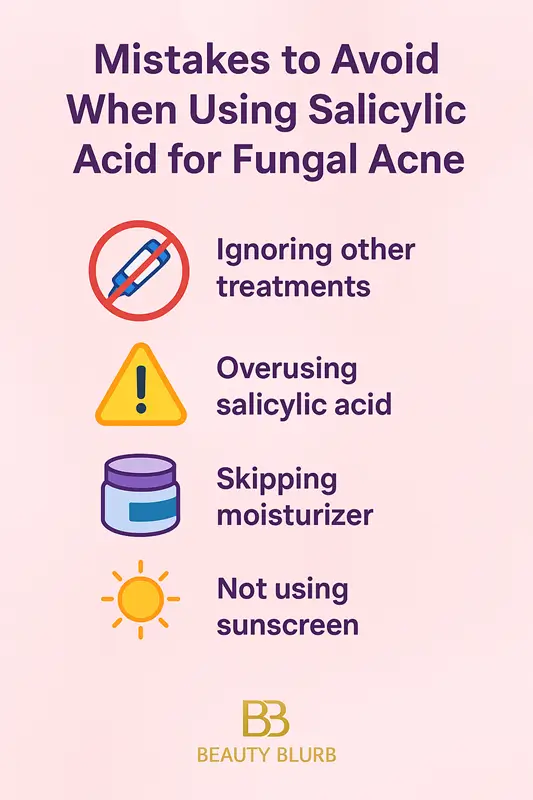
1. Overusing Exfoliants (like Salicylic Acid or Peels)
- Thinking “more is better” often backfires. Over-exfoliating strips your skin barrier, leaving it irritated and more prone to breakouts.
- Fix it: Limit salicylic acid use to 2–3 times per week and always follow with a gentle, fungus-safe moisturizer.
2. Layering Too Many Strong Actives Together
- Combining salicylic acid with AHAs, retinoids, or benzoyl peroxide can overwhelm your skin. The result? Redness, flaking, and barrier damage.
- Fix it: Stick to one exfoliant per routine. Simpler routines often bring the best results.
3. Choosing Oil-Based or Fatty Acid-Rich Products
- Malassezia (the fungus behind fungal acne) feeds on certain oils and fatty acids. Using the wrong moisturizer or sunscreen can worsen your breakouts.
- Fix it: Choose oil-free, gel-based, or water-based products labeled non-comedogenic.
4. Relying Only on Topical Treatments
- Fungal acne isn’t just about what’s on your skin — sweat, diet, and lifestyle can also trigger flare-ups.
- Fix it: Pair topical antifungals and salicylic acid with lifestyle adjustments (like breathable clothing, managing sweat, and reducing high-sugar foods). For stubborn cases, ask your dermatologist about oral antifungals.
5. Self-Diagnosing Without Professional Help
- Not every breakout is fungal acne. Using the wrong treatment (like benzoyl peroxide) can make fungal acne worse.
- Fix it: If your acne doesn’t improve, see a dermatologist for proper diagnosis. They may run a quick skin test and guide you to the right treatment.
6. Skipping Moisturizer Completely
- Many think moisturizers “feed” fungal acne. The truth? Without hydration, your skin overproduces oil, creating a better environment for fungus.
- Fix it: Use a lightweight, fungal-acne-safe moisturizer with glycerin, hyaluronic acid, or squalane.
7. Not Using Sunscreen Daily
- Sun exposure weakens your skin barrier and increases irritation. Plus, salicylic acid can make skin more sensitive to the sun.
- Fix it: Apply an oil-free, broad-spectrum sunscreen every morning. Gel or water-based formulas are ideal.
Quick Takeaway
Most mistakes come from doing too much or skipping the basics. Balance is key: gentle exfoliation, lightweight hydration, daily sun protection, and fungus-safe products. Do that, and your routine will actually work with your skin instead of against it.
What is the best acid for fungal acne?
Now that we’ve answered the big question — is salicylic acid good for fungal acne — it’s time to zoom out and look at the bigger picture. Salicylic acid can be really helpful for controlling oil and unclogging pores, but is it truly the best acid for fungal acne? Let’s break it down together.
Salicylic Acid: This BHA is great at dissolving excess oil, loosening dead skin cells, and keeping pores clear. While it doesn’t kill the yeast behind fungal acne directly, it makes your skin a much less friendly environment for it to thrive.
Azelaic Acid: Probably the most effective acid for fungal acne, because it has both antifungal and anti-inflammatory properties. Clinical studies (Dr. Thiboutot et al., 2008, 289 patients, 12 weeks) showed azelaic acid reduced fungal-related acne lesions while calming redness.
Mandelic Acid: A gentle AHA that exfoliates without irritating the skin. It’s safe for fungal acne and can also help brighten uneven skin tone.
is benzoyl peroxide or salicylic acid better for fungal acne
Quick answer: benzoyl peroxide (BP) targets bacteria, while salicylic acid (SA) helps by unclogging pores and reducing oil. For fungal acne (Malassezia folliculitis), SA is generally the smarter pick and pairs well with antifungal treatments.
Tip: For fungal acne, combine salicylic acid (oil control + pore clearing) with a true antifungal (e.g., ketoconazole or zinc pyrithione). Benzoyl peroxide remains great for bacterial acne, but it isn’t a primary solution for Malassezia.
Bottom line: If your main concern is fungal acne, choose <strong>salicylic acid</strong> within a balanced routine and reserve <strong>benzoyl peroxide</strong> for clear bacterial breakouts. Consistency + gentle care win.
What Not to Use with Fungal Acne
When I first dealt with fungal acne, I was frustrated because so many “popular” skincare products actually made my skin worse.
It took me a while (and lots of trial and error) to realize that some ingredients don’t just fail — they can actually feed the yeast that causes fungal acne. Let me share the biggest lessons I learned.
- Fatty Acids & Certain Oils
Coconut oil, olive oil, and even some plant oils that are rich in long-chain fatty acids made my breakouts flare like crazy. That’s because Malassezia (the yeast behind fungal acne) feeds on these lipids. Once I cut them out, my skin calmed down. - Esters and Polysorbates
At first, I didn’t even know what these were. But they’re often hidden in creams and serums as emulsifiers. Unfortunately, they act as food for yeast, and I noticed products with them always made me itchier and bumpier. - Fermented Ingredients
I loved K-beauty, but things like galactomyces and rice ferment filtrate didn’t love me back. They actually aggravated my fungal acne, which makes sense since some fermented extracts can feed yeast. - Heavy Occlusive Creams
I once used a thick cream because I thought my skin was “dry from treatments.” Instead, it trapped sweat and heat, making fungal acne multiply overnight. Lesson learned: lightweight, breathable hydration only. - Benzoyl Peroxide
This one was tricky. It’s a lifesaver for bacterial acne, but when I used it on fungal acne, it didn’t help. In fact, my skin just got red and irritated without any improvement. It taught me that fungal acne needs a completely different strategy. - High-Sugar Diet (bonus but real!)
This isn’t skincare, but when I cut down on sugar, I noticed fewer flare-ups. Yeast thrives on sugar, and while diet isn’t the only factor, it definitely made a difference for me.
Takeaway:
Avoiding these triggers was honestly half the battle for me. Once I stopped “feeding” the yeast with the wrong products, everything else I used (like salicylic acid and antifungal creams) worked so much better.
FAQ Of Salicylic Acid for Fungal Acne
Thank you so much for staying with me through this guide! 🌷 I know how confusing and overwhelming skin issues like fungal acne can feel, but remember—you’re not alone in this journey.
By now, you should have a clearer picture of is salicylic acid good for fungal acne and how it can support your skin when used the right way.
I’d truly love to hear about your experience 💌 Have you tried salicylic acid or any antifungal treatments? What worked for you and what didn’t? Share your story in the comments below—your journey might inspire and help another reader going through the same struggle.
And if you found this helpful, don’t forget to share it with a friend who might be facing the same skin concerns. Together, we can spread knowledge and confidence.
Stay kind to your skin, stay consistent, and most importantly, stay patient with yourself. You’ve got this!

Akram Boulaid is a dedicated Skincare Researcher and Analyst with over 7 years of intensive focus on dermatology and cosmetic ingredient science. As a globally recognized expert, his insights have been featured in major international publications, including the New York Post and GB News. A verified expert on Qwoted, Akram connects with health journalists to provide evidence-based analysis. He founded Beauty Blurb to bridge the gap between complex clinical data and practical skincare routines, specializing exclusively in the needs of oily and acne-prone skin through rigorous analysis of peer-reviewed scientific literature.