
Can you use azelaic acid and salicylic acid together? Absolutely — you can, and when used thoughtfully, they complement each other to target oily, acne-prone skin more effectively.
Azelaic acid works gently on the skin’s surface to reduce redness, hyperpigmentation, and inflammation, while salicylic acid penetrates deep into the pores to unclog them and prevent breakouts.
The key is knowing how to layer them safely, A simple way to minimize irritation is to use them at different times of the day — for example, salicylic acid in the morning and azelaic acid in the evening.
so you can enjoy the benefits of both without over-drying or stressing your skin.
In this article, we’ll walk you through everything you need to know about using salicylic acid and azelaic acid together.
You’ll learn the science behind each ingredient, the benefits of combining them, practical routines for different skin types, common mistakes to avoid, and expert tips to safely integrate these acids into your daily skincare.
By the end, you’ll have a clear, actionable plan to harness their power effectively and confidently — no guesswork, just results.
What Is Salicylic Acid?
Salicylic acid is a beta hydroxy acid (BHA) widely recognized for its deep pore-cleansing ability, making it one of the most effective treatments for breakouts.
It penetrates through oil, dissolves dead skin cells, and prevents clogged pores — which is why dermatologists often recommend salicylic acid for oily skin and acne-prone complexions.
Regular use can reduce blackheads, whiteheads, and excess shine while improving skin texture. When used together with azelaic acid, salicylic acid works as the “pore purifier.”
By keeping pores clear and minimizing congestion, it enhances the impact of azelaic acid, which can then focus on calming irritation, reducing redness, and addressing post-acne dark spots.
This makes the combination a powerful approach to managing oily and acne-prone skin.
What Is Azelaic Acid?
Azelaic acid is a naturally occurring dicarboxylic acid found in grains and produced by skin-friendly yeast.
It gently targets multiple concerns at once: calming inflammation, reducing redness, and fading hyperpigmentation like acne scars and uneven tone.
Because of its soothing nature, azelaic acid for oily skin is often used to complement stronger actives, offering both brightening and anti-inflammatory benefits without excessive irritation.
When paired with salicylic acid, azelaic acid plays the role of “the corrector.” While salicylic acid clears and unclogs pores, azelaic acid refines the skin’s surface, evens out skin tone, and reduces sensitivity.
Together, they create a balanced routine that helps fight breakouts, fade marks, and support a healthier, clearer complexion.
Can You Use Azelaic Acid and Salicylic Acid Together?
Many people type the question “Can I mix salicylic acid with azelaic acid?” into Google, but that’s not really the issue. The more important question is: what’s the correct way to use them together so you get results without damaging your skin?
The truth is, both ingredients are powerful on their own — salicylic acid keeps pores clear and controls excess oil, while azelaic acid calms inflammation and fades stubborn dark spots.
But when used in the same routine, they can work in harmony to give you clearer, smoother, and more even-toned skin.
The secret lies in understanding their combined benefits and then learning the safe methods to layer or alternate them. That’s exactly what we’ll uncover next.
Benefits of Using Azelaic Acid and Salicylic Acid Together
“Think of this combo as a double-action filter for your skin. While Salicylic Acid goes deep into your pores to ‘vacuum’ out the oil and gunk, Azelaic Acid stays on the surface to calm the fire (redness) and erase those stubborn dark spots left behind by old breakouts.
Together, they don’t just treat the acne you see today—they prevent the scars of tomorrow while keeping your skin barrier surprisingly calm. If you’ve been struggling with ‘maskne,’ congestion, or post-inflammatory hyperpigmentation (PIH), this is the strategic partnership your routine has been missing.”
Below are clinically proven benefits, supported by recent trials, plus key perks that go beyond what each can do alone.
1: Improved Control of Acne and Breakouts
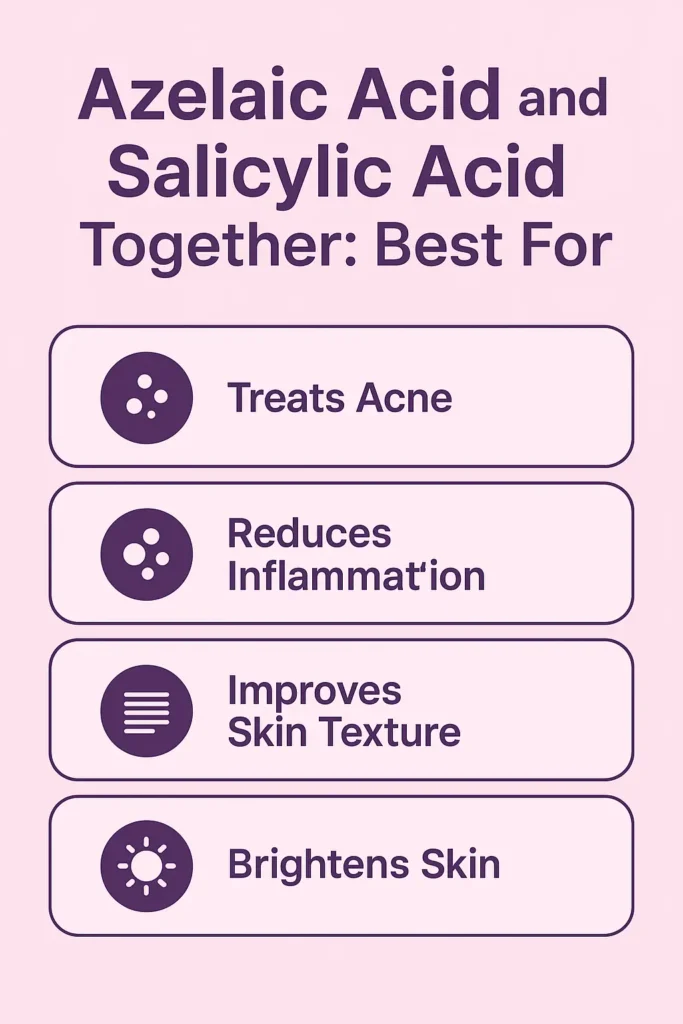
Salicylic acid works by deeply exfoliating inside pores, dissolving sebum and dead skin cells, which helps prevent clogged pores and blackheads. Azelaic acid complements this by reducing inflammation, calming irritation, and fighting acne-causing bacteria.
Together, they reduce both inflammatory and non-inflammatory acne more effectively than using each alone, especially in salicylic acid for oily skin routines.
Clinical Study:
- In a randomized controlled trial (Abdel Hay R., Hegazy R., Abdel Hady M., Saleh N., Cairo University).
- patients with mild-to-moderate acne used a combination peel of 20% azelaic acid + 20% salicylic acid, every two weeks (4 sessions) on one side of the face versus 25% TCA on the other side.
- After two sessions, the SA+AA side showed better improvement in inflammatory lesions, and by the end both non-inflammatory and inflammatory lesions had significantly improved.
- Patients also reported less discomfort on the SA+AA side. PubMed
2: Enhanced Fading of Post-Acne Dark Spots (PIH)
One of the biggest frustrations with acne is the lingering dark spots or post–inflammatory hyperpigmentation. Azelaic acid inhibits excess melanin production and pigment cell activity, helping fade PIH.
Salicylic acid’s role in exfoliating and promoting cell turnover helps remove pigmented dead skin cells, accelerating fade.
For those following an azelaic acid for dark spots regimen, this means less downtime and more visible results in tone-evening.
3: Balanced Sebum Control and Pore Refinement
For oily, acne-prone skin, oil overproduction and clogged pores are central problems. Salicylic acid targets oily skin by breaking down oils and clearing blocked follicles.
Meanwhile, azelaic acid helps regulate sebum production and calms irritation that can spur over-secretion of oil.
Together, they help reduce shine, minimize pore appearance, and improve skin texture—key for anyone using salicylic acid for oily skin or azelaic acid for oily skin.
4: Lower Risk of Irritation Compared to Stronger Peels
Stronger treatments, like high-percentage chemical peels (example: TCA), are effective but often cause significant redness, peeling, and downtime.
The SA + AA combination, as shown in the Cairo University RCT, provided comparable results for lesion reduction while being better tolerated—less discomfort, reduced irritation, especially in early treatment. PubMed
5: Faster Visible Results for Sensitive Types
Patients in the same trial reported that inflammatory lesions started improving after just two sessions, meaning about four weeks of bi-weekly treatments.
That’s faster than many expect when using acids separately or without a clear plan.
If you have oily and acne-prone skin, using both actively (with correct scheduling) can provide more rapid clarity, provided you support your skin barrier well.
Now that we’ve uncovered the key benefits of using azelaic acid and salicylic acid together — from controlling breakouts and calming inflammation to fading post-acne marks.
the next step is learning how to actually use them in your routine. In the following section, we’ll break down safe layering methods and dermatologist-backed tips to help you maximize results while minimizing irritation.
How to Use Salicylic Acid and Azelaic Acid Together
I know you’re probably asking: Which goes first, salicylic acid or azelaic acid? you generally apply salicylic acid first, because it helps “open up” clogged pores and remove barriers (dead skin buildup), so that azelaic acid can absorb more effectively.
But that’s not the entire story — depending on your skin type, tolerability, and product formulations, there are smarter ways to layer or alternate them that reduce irritation and optimize results.

how to layer azelaic acid and salicylic acid together (Step-by-step routine)
Here are three practical strategies to combine salicylic acid and azelaic acid together, tailored to different skin conditions and tolerance levels:
Strategy 1: Alternate Days (Gentle Start)
Best for: Sensitive skin, first-time users, or those already using potent actives.
How to do it:
- Day 1: Use salicylic acid (either a leave-on or cleanser form)
- Day 2: Use azelaic acid
- Continue alternating, always following with a barrier-supporting moisturizer
- In daytime, always finish with a broad-spectrum SPF 30+
Why it works:
- Prevents layering overload and reduces risk of irritation
- Gives skin time to recover between actives
- Gradually builds tolerance
Clinical evidence (support):
- A randomized controlled trial from Cairo University applied a combined peel of 20% salicylic acid + 20% azelaic acid every two weeks over 4 sessions on one side of the face, comparing it to 25% TCA peel on the other side.
- They found that inflammatory lesions improved faster on the SA+AA side, and patient satisfaction was higher because of less discomfort. PubMed
This supports that combining SA + AA (even in potent peel form) can be effective while maintaining tolerability.
Strategy 2: Split Routine (AM / PM)
Best for: Skin with medium tolerance that wants both actives but less overlap.
How to do it:
- Morning: Cleanse → salicylic acid → moisturizer → sunscreen
- Evening: Cleanse → azelaic acid → moisturizer
Why it works:
- Utilizes salicylic acid’s pore-clearing action during the day
- Places azelaic acid at night for anti-inflammatory and brightening benefits
- Minimizes direct interaction between the two actives
Strategy 3: Layer in the Same Routine (For Tolerant Skin)
Best for: Skin that has adapted, or for dedicated routines where you want maximal effect.
How to do it:
- Cleanse face
- Apply salicylic acid (leave-on serums are ideal)
- Wait ~30–60 seconds to allow absorption
- Apply azelaic acid
- Follow with a light, calming moisturizer
- (If morning) Finish with SPF 30+
Safety tips & adjustments:
- Use lower concentrations initially (e.g. salicylic acid 0.5–1%, azelaic acid 10–15%)
- If redness or stinging occurs, reduce frequency or switch to an alternate-day schedule
- Consider buffering (apply a light moisturizer in between) if skin is reactive
Pro tip (with a wink): If you’re feeling a bit like a “mad scientist” mixing acids and still not sure where they fit in your day-to-day routine, don’t worry—I’ve got you covered.
Check out my guide: Dermatologist Recommended Skincare Routine for Oily Skin. Think of it as the GPS for your skincare journey—because even superheroes (yes, your acids!) need a well-planned mission.
🧩 Tips & Adjustments by Skin Type
- Oily / acne-prone skin: You can start with Option C if your skin is resilient. Use moderate concentrations (salicylic 1%, azelaic 10%) and monitor for dryness.
- Combination / normal skin: Consider Option B (split routines) to give skin breathing room and maximize absorption.
- Sensitive / easily irritated skin: Stick with Option A (alternate days) for 2–4 weeks, then evaluate progress.
- Always patch-test before full application.
⚠️ Pro Tips to Minimize Irritation
- Start slowly: Use each acid alone for 1 week before combining.
- Give at least 30–60 seconds between layers, and don’t layer on wet skin.
- Choose gentle formulas (non-comedogenic, alcohol-free).
- Always apply a calming, barrier-supporting moisturizer (ceramides, humectants).
- Use sunscreen (SPF 30+) diligently, especially when combining actives.
- If you experience persistent redness or stinging, back off to alternate-day use.
No matter which method you use, always start slow and observe how your skin reacts. The goal isn’t to force both actives at maximum strength immediately, but to find the balance where using azelaic acid and salicylic acid together helps your skin clarity, tone, and texture without causing flare-ups.
In the next section, we’ll dive into precise layering order, recommended concentrations for different skin types, and real-world example routines you can copy directly.
What Percentage of Azelaic Acid Is Safe to Use with Salicylic Acid?
When people search this, they want a single, practical answer: how strong can each product be when you’re using them together? Instead of vague “use lower strengths” advice, here are clinician-grounded ranges and real-world rules you can copy — plus clear notes for pregnancy. These ranges come from dermatologist guidance, major dermatology bodies, and clinical studies (sources cited).
Quick intro
- Short answer: use conservative, dermatologist-recommended concentrations when combining these active.
- typically salicylic acid in the 0.5–2% range (OTC leave-ons/cleansers), and azelaic acid between 10–15% for everyday topical use (10% OTC; 15–20% often used by prescribers).
- If you’re combining them in the same routine, favor the lower end of each range and follow the safety tips below. Pregnant people should follow stricter guidance (see table).
| Use case / Person | Salicylic acid (recommended range) | Azelaic acid (recommended range) | Notes & Sources |
|---|---|---|---|
| General combination (same routine, tolerable skin) | 0.5% – 2% (leave-on); up to 2% OTC is standard | 10% – 15% | Many dermatologists recommend up to 2% SA and 10–15% AA. The Ordinary |
| Conservative approach (new to acids / sensitive skin) | 0.5% (or use a salicylic cleanser rather than leave-on) | 10% (OTC) | Alternate days or AM/PM split. SkinCeuticals |
| Aggressive clinical protocols (in-office peels, supervised) | Up to 20% (peel formulations, clinic use) | 20% (peel / prescription / clinic use) | Clinical studies confirm efficacy but only under medical supervision. PMC study |
| For pregnant or breastfeeding people | Use caution — low-exposure cleansers preferred; avoid strong leave-on | Azelaic acid is considered safe (OTC topical) | AAD and ACOG confirm azelaic is safe; salicylic should be limited. AAD guidance |
Short actionable rules (copy these into your routine)
- If you’re layering same day, use salicylic acid at ≤2% (often 0.5–1% works well) and azelaic 10%–15%; wait 30–60s between layers and moisturize. (Derms recommend lower potencies when combining.)
- If your skin is sensitive, start with alternate-day use or split AM/PM and keep concentrations at the lower end (salicylic cleanser or 0.5% leave-on; azelaic 10%).
- Do NOT try high-strength peel protocols at home (clinical peels use much higher percentages under supervision). The RCT that used 20% SA + 20% AA showed good efficacy but was performed in clinic with monitoring.
Final Takeaway
When it comes to combining salicylic acid and azelaic acid Together, less is often more. Most dermatologists agree that 2% salicylic acid and 10–15% azelaic acid are safe and effective starting points for daily or alternate-day routines.
Stronger percentages, like 20%, are typically reserved for clinical peels under professional supervision. For sensitive skin or beginners, it’s always better to go slow and keep concentrations low.
And if you’re pregnant or breastfeeding, azelaic acid is considered safe, while salicylic acid should be used with caution and only in mild forms.
The golden rule? Listen to your skin, start gentle, and seek a dermatologist’s guidance if in doubt.
Myth vs Truth: azelaic and salicylic acid together
When it comes to using azelaic acid and salicylic acid together, there’s a lot of skincare gossip floating around. Let’s separate the hype from the science:
🌀 Myth 1: You can’t mix salicylic acid and azelaic acid—it’s too harsh.
✅ Truth: At proper concentrations, this combo is dermatologist-approved. Studies confirm that layering azelaic acid and salicylic acid in the same routine can improve acne, blackheads, and post-acne marks without excessive irritation—especially if you introduce them gradually.
🌀 Myth 2: Azelaic acid is weaker and less effective than salicylic acid.
✅ Truth: While salicylic acid excels at decongesting pores, azelaic acid for oily skin targets inflammation, discoloration, and redness. Dermatologists often recommend azelaic acid for rosacea and pigmentation—areas where salicylic acid isn’t as effective. They’re complementary, not rivals.
🌀 Myth 3: Salicylic acid is only for teenagers with acne.
✅ Truth: This is outdated. Salicylic acid for oily and acne-prone skin works at any age. Adults benefit from its exfoliating and pore-clearing action, especially when combined with azelaic acid to brighten uneven skin tone.
🌀 Myth 4: Stronger percentages mean better results.
✅ Truth: More isn’t always better. Dermatologists caution that exceeding2% salicylic acid or 20% azelaic acid (omoderate strengths used consistently.
🌀 Myth 5: You can’t combine other actives when using these two.
✅ Truth: With the right routine, you can safely incorporate niacinamide, hyaluronic acid, or ceramides to buffer irritation. The key is listening to your skin and not overloading it with too many exfoliants.

✨ Bottom line: Myths exaggerate risks, but the truth is that azelaic and salicylic acid together can be a powerhouse duo for clearer, calmer skin—if used wisely.
Salicylic Acid and Azelaic Acid Together Side Effects
When people search for the best ingredients for oily skin, salicylic acid and azelaic acid almost always top the list.
And for good reason—they’re both proven, dermatologist-recommended actives that fight acne, blackheads, and uneven tone. But even the best ingredients can cause problems if they’re combined or used incorrectly.
Here are the most common side effects of using salicylic acid and azelaic acid together—and how to avoid them.
1. Over-exfoliation
- What happens: Dryness, flakiness, stinging.
- Why: Both acids exfoliate—salicylic inside pores, azelaic on the surface. Too frequent use or high concentrations = irritation.
- Fix: Start slowly (2–3 times a week), then build up if your skin tolerates it.
2. Ignoring skin sensitivity
- What happens: Redness, burning sensation, or worsening rosacea.
- Why: Sensitive or reactive skin may not handle daily layering.
- Fix: Try alternating mornings/evenings or using a salicylic acid cleanser (short contact) instead of a leave-on.
3. Skipping moisturizer
- What happens: Tightness, irritation, and increased breakouts (from a compromised barrier).
- Why: Both ingredients can reduce natural oils.
- Fix: Always follow with a barrier-supporting moisturizer containing ceramides or hyaluronic acid.
4. Forgetting SPF
- What happens: Hyperpigmentation, uneven skin tone, and sun sensitivity.
- Why: Acids thin the stratum corneum temporarily, making skin more vulnerable to UV rays.
- Fix: Daily broad-spectrum sunscreen (SPF 30+) is non-negotiable.
5. Using the wrong concentrations
- What happens: Excess irritation without better results.
- Why: People assume higher % = faster results.
- Fix: Stick to dermatologist-recommended ranges: 0.5–2% salicylic acid and 10–15% azelaic acid for daily routines. Stronger concentrations (20%) belong in a clinic, not at home.
✨ Key takeaway: The main side effects of salicylic acid and azelaic acid together—redness, dryness, sensitivity—are usually preventable.
With the right concentrations, consistent moisturizing, and sunscreen, you’ll reap the benefits without damaging your barrier.
What Not to Mix with Salicylic Acid and Azelaic Acid
salicylic acid and azelaic acid they don’t always play well with every other active. Layering the wrong products can cause irritation, dryness, or even cancel out the benefits. Let’s break it down.
Ingredients to Avoid with Salicylic Acid + Azelaic Acid
| Ingredient | Why It’s a Problem | Better Alternative |
|---|---|---|
| High-strength AHAs (like glycolic acid 20%+) | Too much exfoliation at once → dryness, peeling, barrier damage. | Use a gentle AHA toner (5–7%) on alternate days. |
| Strong Vitamin C (L-ascorbic acid 15%+) | Can destabilize with acids, increase irritation. | Use Vitamin C in the morning, azelaic/salicylic in the evening. |
| Harsh physical scrubs | Double exfoliation = microtears + sensitivity. | Stick with chemical exfoliation only. |
| Benzoyl Peroxide (high %) | Too drying with SA + AA, increases risk of irritation. | Use benzoyl peroxide in a separate routine (AM vs PM). |
Can You Use Azelaic Acid with Salicylic Acid and Niacinamide?
Yes—this trio is actually one of the most dermatologist-recommended routines for oily and acne-prone skin.
- Salicylic acid unclogs pores.
- Azelaic acid reduces redness, pigmentation, and inflammation.
- Niacinamide strengthens the skin barrier, regulates oil, and calms irritation.
👉 This makes niacinamide the “buffer” that allows you to safely combine the other two. Just introduce them gradually to avoid overwhelming your skin.
Can I Use Salicylic Acid with Azelaic Acid and Retinol?
This combo is trickier. While it’s possible, dermatologists caution against starting all three at once.
- Why: Retinol + acids can cause peeling, dryness, and irritation.
- Best approach: Use retinol at night and alternate with salicylic/azelaic routines on different evenings.
- Pro tip: If you’re new to retinol, avoid layering it directly with salicylic acid until your skin builds tolerance.
✨ In short: Niacinamide plays well with both. Retinol needs a more careful, alternate-day approach.
Best Products to Combine Salicylic Acid and Azelaic Acid
Finding the right products is just as important as knowing the science.
Not every formula is gentle enough to pair, but the good news is that several dermatologist-approved options are designed to work well when layering salicylic acid and azelaic acid together.
The key is looking for moderate concentrations, lightweight textures, and supporting ingredients like niacinamide, hyaluronic acid, or ceramides to buffer potential irritation.
| Category | Product | Why It Works |
|---|---|---|
| Cleanser | CeraVe Renewing SA Cleanser | Gentle salicylic acid formula with ceramides and niacinamide—ideal first step without over-drying. |
| Azelaic Acid Cream | Paula’s Choice 10% Azelaic Acid Booster | Lightweight cream-gel texture, combines azelaic acid with salicylic acid in safe concentrations, great for daily use. |
| Serum | The Ordinary Azelaic Acid Suspension 10% | Budget-friendly option, effective against redness and uneven tone; pairs well after a salicylic acid cleanser. |
| Spot Treatment | SkinCeuticals Blemish + Age Defense | Targets adult acne and pigmentation; combines salicylic with glycolic and dioic acid for multitasking results. |
| Moisturizer | La Roche-Posay Toleriane Double Repair | Barrier-repairing moisturizer with niacinamide—perfect follow-up after exfoliating actives. |
Choosing the right product isn’t just about percentages—it’s about the full formula. Supporting ingredients like ceramides, niacinamide, and soothing emollients make all the difference when layering actives.
💡 And here’s the good news: I’ve already written a full review about one of the most popular picks, The Ordinary Salicylic Acid. You can read it here
FAQ Of salicylic acid and azelaic acid together
Salicylic acid unclogs pores while azelaic acid calms redness and targets pigmentation. Many dermatologists recommend layering salicylic acid first, then azelaic acid, or alternating days if your skin is sensitive.
Salicylic acid works faster on breakouts, while azelaic acid takes longer (8–12 weeks) to fade redness and hyperpigmentation. Consistency + daily sunscreen = best results.
Dermatologists consider azelaic acid safe in pregnancy. For salicylic acid, brief-contact cleansers are generally acceptable, but avoid high-strength leave-on products unless your doctor approves.
Niacinamide reduces irritation, balances oil, and strengthens the barrier, making it a perfect buffer when combining salicylic and azelaic acid. Apply it after acids or choose formulas that already blend them safely.
Combining too many actives (like glycolic acid, benzoyl peroxide, or high-strength retinoids) can overload your skin, causing irritation. Instead, keep it simple: acids + moisturizer + sunscreen.
Oily or acne-prone skin often tolerates daily use, while sensitive skin may need alternating days. Always start slowly (2–3 times weekly) and increase frequency only if your skin stays calm.
Both acids can increase sun sensitivity. Daily broad-spectrum SPF 30+ protects your progress, prevents new dark spots, and keeps irritation at bay.
The combo controls oil, clears pores, and fades post-acne marks. Sensitive or very dry skin types can still use it, but with lower concentrations and plenty of hydration.
Salicylic Acid is superior for clearing active congestion (blackheads/whiteheads) because it’s oil-soluble. However, Azelaic Acid is “better” for inflammatory acne and redness, as it kills bacteria and fades the dark spots (PIH) left behind. If you have oily skin, go for BHA; if you have sensitive skin with redness, Azelaic is your winner.
Thank you so much for reading, beautiful 💜 I hope this guide gave you clarity on the Azelaic Acid and Salicylic Acid Together and how to combine them safely and effectively in your daily routine.
Remember, skincare is a personal journey — what works for you may inspire someone else too.
I’d love for you to subscribe and stay updated with more dermatologist-backed tips and easy routines.
And don’t forget to share your own experience in the comments — tell us about your skincare journey and how these ingredients worked for you.
Your story might inspire another reader to start her path toward healthier, glowing skin. 🌿💫

Akram Boulaid is a dedicated Skincare Researcher and Analyst with over 7 years of intensive focus on dermatology and cosmetic ingredient science. As a globally recognized expert, his insights have been featured in major international publications, including the New York Post and GB News. A verified expert on Qwoted, Akram connects with health journalists to provide evidence-based analysis. He founded Beauty Blurb to bridge the gap between complex clinical data and practical skincare routines, specializing exclusively in the needs of oily and acne-prone skin through rigorous analysis of peer-reviewed scientific literature.