
can I use azelaic acid and niacinamide together? Yes, you can use them together, and in fact, they work exceptionally well as a duo.
Azelaic acid gently exfoliates, reduces acne-causing bacteria, and fades dark spots, while niacinamide strengthens the skin barrier, balances oil, and soothes redness. F
The easiest way to combine them is to apply niacinamide in the morning for oil control and barrier support, then use azelaic acid at night to target acne and pigmentation.
If you prefer layering, apply niacinamide first, followed by azelaic acid, always finishing with a moisturizer and sunscreen during the day.

In this guide, we’ll cover everything you need to know about using azelaic acid and niacinamide together.
why they complement each other, the best way to layer them in your routine, concentration tips, common mistakes to avoid, dermatologist-backed advice, and answers to the most frequently asked questions.
By the end, you’ll know exactly how to get the maximum benefits of this powerful skincare combination.
What is Niacinamide and How Does It Work?
Niacinamide, also known as vitamin B3, is one of the most popular skincare ingredients — and for good reason. It’s water-soluble, gentle on most skin types, and incredibly versatile.
If you’ve ever searched for niacinamide for oily skin, you probably know it’s famous for controlling excess oil and minimizing shine. But niacinamide does so much more than that.
Here’s how it works: niacinamide strengthens your skin barrier, which is your skin’s natural shield against irritation and moisture loss.
A stronger barrier means fewer breakouts, less redness, and improved tolerance when using active ingredients like azelaic acid.
It also reduces inflammation, balances sebum production, and helps fade dark spots over time. Many people use it in the form of a niacinamide serum, layering it easily into both morning and evening routines.
In short, niacinamide is a multitasker: it calms, balances, and protects your skin, making it the perfect partner for azelaic acid.
What is Azelaic Acid and How Does It Work?
Azelaic acid is a dermatologist-loved ingredient that often flies under the radar compared to retinol or vitamin C — but it deserves a spot in every skincare routine for acne-prone and oily skin.
Naturally found in grains like barley and wheat, it’s a dicarboxylic acid that’s both gentle and powerful.
Here’s how it works: azelaic acid unclogs pores by removing dead skin cells, reduces the growth of acne-causing bacteria, and calms redness and irritation.
That’s why it’s often recommended for rosacea, acne, hyperpigmentation, and uneven skin texture. Unlike stronger exfoliating acids, it doesn’t aggressively strip the skin, making it suitable for sensitive types as well.
One of its standout benefits is its ability to fade dark spots and post-acne marks while preventing future breakouts.
Many people use azelaic acid for acne to keep pimples under control, or azelaic acid for oily skin to manage shine and congestion.
It also works beautifully with other soothing ingredients, which is exactly why combining it with niacinamide is such a game-changing skincare duo.
Can I Use Azelaic Acid and Niacinamide Together?
As we mentioned at the beginning of this article, the answer is definitely yes — and in fact, it’s often better to use them together rather than separately.
The real challenge isn’t whether you can combine them, but how you combine them in your daily routine.
Before we dive into the step-by-step application, let’s first understand what actually happens to your skin when you pair niacinamide and azelaic acid.
Benefits of Azelaic Acid and Niacinamide Together
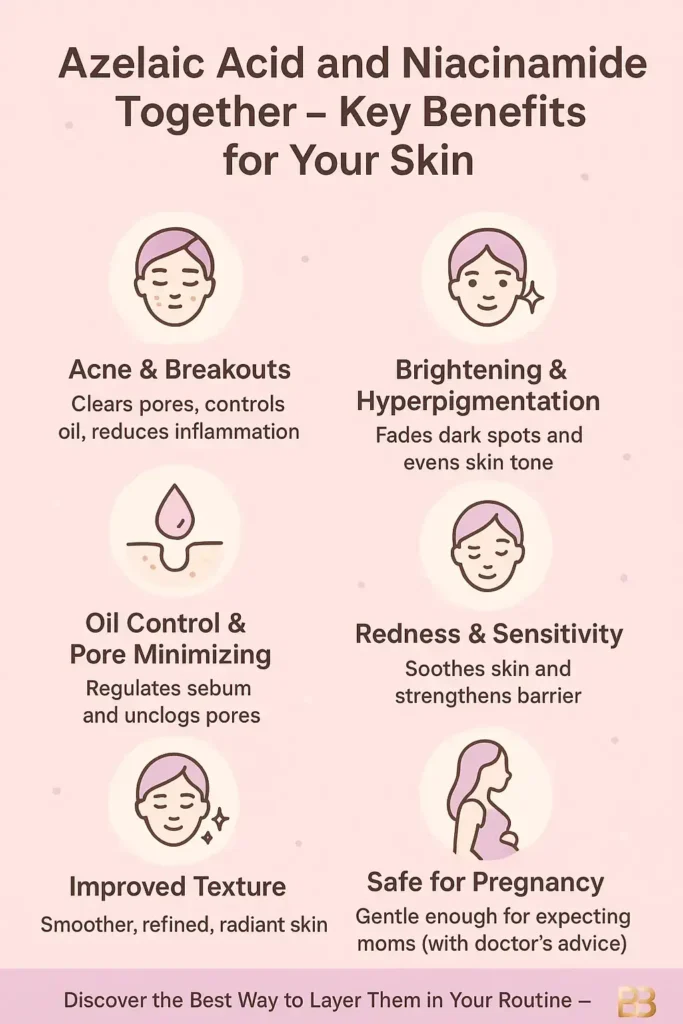
When using azelaic acid and niacinamide together, your skin can enjoy a synergy that’s more powerful than either ingredient alone. Below are the main benefits that this combination offers — backed by mechanisms, practical effects, and some clinical evidence.
1. Better control of acne and breakouts
Azelaic acid works by gently exfoliating inside pores, reducing the buildup of dead skin cells and inhibiting acne-causing bacteria.
Niacinamide complements it by reducing inflammation and regulating excess sebum production. Together, they help reduce both inflammatory and non-inflammatory lesions more effectively than each alone.
- In a clinical trial, azelaic acid was shown to reduce both types of acne lesions in patients with mild-to-moderate acne. PMC
- A review of dermatologic therapies identifies niacinamide as a promising anti-inflammatory agent beneficial in acne management. PMC
2. Enhanced fading of post-inflammatory hyperpigmentation (PIH)
Post-acne dark spots are a common frustration. Azelaic acid helps inhibit melanin production and limits pigment cell activity.
Niacinamide, on the other hand, impedes the transfer of pigment (melanosomes) to skin cells. The result is a more uniform skin tone over time.
- A clinical report in Clinical Approaches in Vogue for Combination Therapies describes a case using 5% niacinamide gel + 20% azelaic acid cream, resulting in a 75% reduction in acne lesions and an 85% improvement in PIH over 16 weeks, with good tolerability. Cosmoderma
- Systematic reviews of natural ingredients for pigmentation also include azelaic acid and niacinamide among agents with evidence of efficacy and safety for skin brightening. PMC
3. Improved skin barrier function & reduced irritation
One common problem with active ingredients is irritation. Niacinamide supports the skin barrier by increasing ceramide synthesis and reducing transepidermal water loss.
This helps buffer the action of azelaic acid, making the combination gentler—especially for sensitive or reactive skin types.
4. Oil control & minimized pore appearance
As a duo, they help with sebum regulation and cleaning out clogged pores:
- Niacinamide moderates oil production.
- Azelaic acid assists in clearing clogged pores.
This combination can make pores look smaller and reduce shine.
5. Calming redness and anti-inflammatory effects
Both ingredients have anti-inflammatory properties:
- Azelaic acid reduces oxidative stress and inflammatory mediators.
- Niacinamide suppresses pro-inflammatory signals and soothes irritation.
Together, they help calm redness and sensitivity, especially in skin types prone to inflammation.
6. Smoother texture & more even skin tone
With consistent use, the combination promotes a refined, smoother texture. Azelaic acid works on texture via mild exfoliation; niacinamide supports regeneration and hydration, creating more uniform, clearer skin over time.
Now that you know the key benefits of azelaic acid and niacinamide together, the next logical step is learning how to actually use them in your skincare routine.
Because while the science is clear about their synergy, the results you see will depend heavily on how you layer, when you apply, and what concentrations you choose.
Let’s break down the correct way to combine them for maximum results and minimal irritation.
How to Use Azelaic Acid and Niacinamide Together
If you’re wondering “Which should I apply first niacinamide or azelaic acid?” the simple answer is:
niacinamide goes first. Since niacinamide serums are usually lightweight and water-based, they should be applied before thicker creams or gels like azelaic acid. This order allows niacinamide to absorb fully while helping your skin tolerate the stronger effects of azelaic acid.
How to Layer Niacinamide and Azelaic Acid together (Step-by-Step Routine)
Here’s a dermatologist-inspired routine that works for most skin types:
- Cleanser: Start with a gentle, hydrating cleanser to remove dirt and oil without stripping your skin.
- Toner (optional): If you use a toner, apply it now. Stick to hydrating, non-exfoliating formulas.
- Apply Niacinamide: Use a water-based serum (2–5%). This step calms inflammation, controls oil, and preps the skin barrier.
- Apply Azelaic Acid: Follow with your azelaic acid cream or gel (10–20%). It targets acne, redness, and hyperpigmentation.
- Moisturizer: Lock in hydration with a lightweight but nourishing moisturizer. This step is especially important to minimize irritation.
- Sunscreen (AM only): Always finish your morning routine with broad-spectrum SPF 30 or higher. Azelaic acid makes skin more sun-sensitive.

When to Alternate Instead of Layering
Not everyone’s skin can tolerate multiple active ingredients in the same routine. If you have sensitive skin or are new to these actives, try alternating:
- Morning/Evening Split: Use niacinamide in the morning to control oil and strengthen your barrier, then azelaic acid at night to fight acne and fade dark spots.
- Skin Cycling: Apply niacinamide daily, but use azelaic acid every other night until your skin adjusts.
- Alternate Days: Use niacinamide one day and azelaic acid the next. This reduces potential redness or dryness.
Pro Tips for Best Results
- Patch Test First: Always test new actives on a small area before applying to your whole face.
- Start Low, Go Slow: Begin with lower concentrations (e.g., 5% niacinamide, 10% azelaic acid) and build up.
- Listen to Your Skin: If you notice irritation, scale back to alternating use.
- Combine with Moisturizer: Applying azelaic acid over a thin layer of moisturizer (the “sandwich method”) can reduce stinging.
So, now you know exactly how to layer niacinamide and azelaic acid without turning your skincare routine into a chemistry experiment gone wrong.
The good news? With the right order and a little patience, your skin will thank you.
But wait—before you rush to slather on that azelaic acid, there’s one small detail that can make or break your results: the percentage. Too little, and you may not see the benefits.
Too high, and your skin might stage a protest. Let’s dive into what strength of azelaic acid is actually safe and effective.
💡 Pro Tip: If you want a complete routine designed for oily, acne-prone skin, check out my detailed guide here:
Dermatologist Recommended Skincare Routine for Oily Skin — it’s the perfect roadmap to pair with niacinamide and azelaic acid.
What Percentage of Azelaic Acid Is Safe to Use with Niacinamide?
When it comes to azelaic acid and niacinamide together for acne, choosing the right percentage of azelaic acid makes all the difference.
Niacinamide is generally safe across concentrations from 2% up to 10%, but azelaic acid comes in varying strengths, each with specific benefits and tolerability. Here’s a simple breakdown:
| Azelaic Acid % | Best Skin Types | Combination with Niacinamide | Notes (Including Pregnancy) |
|---|---|---|---|
| 10% (OTC serum/cream) | Beginners, sensitive skin, mild acne | Pairs well with 5% niacinamide daily | Gentle start; good for redness, early acne, safe in pregnancy |
| 15% (prescription in some regions) | Oily skin, moderate acne, rosacea | Works effectively with 5–10% niacinamide | Stronger acne and pigmentation control, usually well tolerated |
| 20% (Rx strength) | Stubborn acne, hyperpigmentation | Combine cautiously; start 2–3x weekly | Higher chance of irritation; dermatologist guidance recommended; safe in pregnancy under medical supervision |
✨ Key Takeaways
- Start Low, Build Up: If you’re new to actives, begin with 10% azelaic acid + 5% niacinamide, then move to higher strengths if tolerated.
- Safe During Pregnancy: Azelaic acid (even up to 20%) is considered safe for pregnant and breastfeeding women, unlike retinoids. Pairing with niacinamide offers a gentle, effective option.
- Listen to Your Skin: Sensitive or dry skin may do better alternating azelaic acid and niacinamide rather than layering every day.
🔻 Closing Thought:
The “best” percentage depends less on chasing the highest number and more on finding what your skin can comfortably handle.
Even 10% azelaic acid with niacinamide can deliver visible results for acne, redness, and pigmentation when used consistently.
Think of it as a marathon, not a sprint—slow and steady will get your skin to the finish line.
Myth vs Truth: Can Niacinamide Be Mixed with Acids?
You may have heard the old skincare rumor that niacinamide should never be combined with acids because it can “cancel out” or cause irritation.
This is one of the most common myths that still pops up in skincare forums.
So, let’s clear it up once and for all—especially when it comes to using azelaic acid and niacinamide together for acne.

The Myth
“Niacinamide turns into niacin when combined with acids, causing flushing, irritation, and making the product useless.”
The Truth
✅ Modern cosmetic science shows this concern is outdated.
The original idea came from old laboratory studies using pure niacinamide and ascorbic acid (Vitamin C) at very high temperatures and extreme pH levels—conditions that don’t apply to your skincare routine.
- Stability matters: Today’s niacinamide serums are well-formulated and stable.
- Azelaic acid’s pH range (≈4.0–5.0): It is acidic, but not nearly harsh enough to cause niacinamide breakdown under normal conditions.
- Flushing is rare: If you do experience redness, it’s usually due to skin sensitivity or introducing multiple actives too quickly—not because niacinamide and azelaic acid “chemically clash.”
What Dermatologists Say
Leading dermatologists confirm that niacinamide and acids, including azelaic acid, are safe and effective together. In fact, they can complement each other:
niacinamide calms and strengthens the skin barrier, while azelaic acid targets acne, pigmentation, and texture.
👉 Bottom line: Azelaic acid and niacinamide together are not just safe, they’re one of the most dermatologist-approved combinations for acne-prone, oily, and sensitive skin.
Risks & Common Mistakes When Using Niacinamide and Azelaic Acid Together
While azelaic acid and niacinamide together are generally safe and well-tolerated, there are still some mistakes that can reduce their effectiveness—or worse, irritate your skin. Here’s what you should watch out for:
1. Starting With High Concentrations
- Risk: Jumping straight into 20% azelaic acid or 10%+ niacinamide can overwhelm sensitive skin.
- Better Approach: Begin with 10% azelaic acid and 5% niacinamide, then gradually increase if your skin tolerates it.
2. Over-Layering Too Many Actives
- Risk: Combining azelaic acid and niacinamide plus strong actives like retinol, AHAs, or benzoyl peroxide in the same routine can trigger redness, peeling, or dryness.
- Better Approach: Keep your routine simple. Layer niacinamide + azelaic acid first, then slowly introduce other actives if needed.
3. Not Waiting Between Layers
- Risk: Applying products back-to-back without letting them absorb can dilute effectiveness.
- Better Approach: After applying niacinamide serum, wait 30–60 seconds before adding your azelaic acid cream/gel.
4. Skipping Sunscreen
- Risk: Both ingredients target hyperpigmentation, but without daily SPF, dark spots can return or worsen.
- Better Approach: Always apply a broad-spectrum sunscreen in the morning—this step is non-negotiable.
🔹 5. Ignoring Skin Sensitivity Signs
- Risk: Redness, burning, or persistent dryness often means your skin barrier is struggling.
- Better Approach: If irritation occurs, scale back to using azelaic acid at night and niacinamide in the morning, or alternate days.
6. Pregnancy & Breastfeeding Caution
- Risk: While azelaic acid is considered safe during pregnancy and niacinamide is low-risk, misusing high concentrations without professional guidance may stress sensitive skin.
- Better Approach: Stick with lower strengths and consult your dermatologist for a pregnancy-friendly routine.
✅ Bottom line: Most of these “risks” come down to user error, not the ingredients themselves. By avoiding these mistakes, you can maximize the synergy of niacinamide and azelaic acid for clearer, healthier, and more radiant skin.
What Not to Mix with Niacinamide and Azelaic Acid
Even though niacinamide and azelaic acid together are considered a safe and effective duo, they don’t always play nicely with every skincare ingredient.
Mixing them with the wrong actives can trigger irritation, reduce effectiveness, or even damage your skin barrier. Here’s what you should be cautious about or not to use with azelaic acid & not to use with niacinamide:
🚫 Ingredients to Avoid Mixing
| Ingredient | Why It’s a Problem | Safer Alternative |
|---|---|---|
| Strong AHAs (like Glycolic or Lactic Acid) | Combined with azelaic acid, it can over-exfoliate, causing stinging and barrier disruption. | Alternate usage: AHAs one night, niacinamide + azelaic acid on another. |
| High-strength Vitamin C (L-Ascorbic Acid) | At very low pH, it can destabilize niacinamide and potentially irritate sensitive skin. | Use Vitamin C in the AM, niacinamide + azelaic acid in the PM. |
| Prescription Retinoids (high strength) | Layering with acids may increase peeling, dryness, and irritation. | Use retinoids on alternate nights, not with azelaic acid + niacinamide. |
Can I use Niacinamide, Azelaic Acid, and Retinol Together?
Yes, you can—but with caution. This trio can be powerful for acne, texture, and anti-aging, but layering all three at once may overwhelm your skin. The smarter approach is:
- AM: Niacinamide (calms + oil control).
- PM (alternate nights): Retinol or Azelaic Acid—not both on the same night.
👉 This way, you avoid irritation while still reaping the benefits.
Can You Use Salicylic Acid, Azelaic Acid, and Niacinamide Together?
Yes, but balance is key. All three are acne-friendly ingredients, but piling them into one routine can dry out your skin. A safer breakdown would be:
- Morning: Niacinamide + SPF.
- Evening (2–3x/week): Azelaic Acid or Salicylic Acid.
- Alternate Nights: Keep it simple with just niacinamide and moisturizer.
👉 Think of it like skincare “team rotation”—not everyone has to play at the same time to win the game.
🌸 Play It Smart (and Kind to Your Skin)
At the end of the day, skincare isn’t about throwing every active into the mix—it’s about balance.
Your skin barrier is like a best friend: treat it kindly, don’t overwhelm it, and it’ll always have your back.
💡 Pro Tip: If you feel lost, start with niacinamide daily, then slowly invite azelaic acid or salicylic acid into the routine. Skincare is a marathon, not a sprint—your glow-up will come with patience.
Best Products with Azelaic Acid and Niacinamide
If you’re wondering which products combine azelaic acid and niacinamide together for acne in the most effective way, you’re in the right place.
The skincare market is filled with options, but not all are dermatologist-approved or worth your money.
To save you the trial-and-error, we’ve handpicked top-rated products loved by both dermatologists and skincare enthusiasts.
These products balance oil control, acne treatment, and skin barrier support—perfect for oily and acne-prone skin.
Best Niacinamide Products
Top-rated niacinamide serums & creams for oily, acne-prone, and sensitive skin.
| Product | Main Benefits | Form / Strength | Rating | Buy / Review |
|---|---|---|---|---|
TO | Best budget-friendly niacinamide serum for oily & acne-prone skin. | Serum / 10% Niacinamide | ⭐⭐⭐⭐⭐ | View / Buy |
PC | Advanced treatment for stubborn pores & uneven tone. | Treatment / 20% Niacinamide | ⭐⭐⭐⭐⭐ | View / Review |
CV | Lightweight lotion with niacinamide + ceramides for sensitive skin. | Lotion / Contains Niacinamide | ⭐⭐⭐⭐ | View / Buy |
💡 Tip: Start with 5–10% niacinamide serums before moving to higher concentrations for acne-prone skin.
Good news for you! 🥳 Lucky for you, I’ve already written a complete review of The Ordinary Niacinamide 10% + Zinc 1% — one of the most popular niacinamide serums on the market.
I highly recommend checking it out before making your purchase, so you’ll know exactly what to expect in terms of results, texture, and possible side effects.
👉 Read my full review of The Ordinary Niacinamide 10% + Zinc 1%.
Best Azelaic Acid Products
Dermatologist-approved azelaic acid creams and serums for acne, redness, and hyperpigmentation.
| Product | Main Benefits | Form / Strength | Rating | Buy / Review |
|---|---|---|---|---|
TO | Gentle cream that reduces redness, dark spots, and uneven skin texture. | Cream / 10% Azelaic Acid | ⭐⭐⭐⭐⭐ | View / Buy |
PC | Lightweight booster to fade dark spots & calm sensitive skin. | Booster / 10% Azelaic Acid | ⭐⭐⭐⭐⭐ | View / Review |
FZ | Highly effective gel for rosacea, acne, and post-inflammatory marks. | Gel / 15% Azelaic Acid (Prescription) | ⭐⭐⭐⭐⭐ | View / Buy |
💡 Tip: For beginners, start with a 10% azelaic acid cream. If dealing with rosacea or stubborn acne, ask your dermatologist about prescription-strength options like Finacea Gel 15%.
FAQ of azelaic acid and niacinamide serum together
Niacinamide calms skin and strengthens the barrier, while azelaic acid works on acne, redness, and pigmentation. Applying them at night reduces the risk of sun sensitivity. Always finish with a light moisturizer to avoid dryness.
1) Cleanse and dry your face. 2) Apply niacinamide serum (water-based). 3) Once absorbed, apply azelaic acid (gel/cream). 4) Finish with tretinoin as directed. Always use moisturizer and sunscreen daily, since tretinoin increases sensitivity.
Both are non-irritating and suitable for daytime use. Niacinamide strengthens your barrier, while azelaic acid helps with redness and spots. However, always apply a broad-spectrum SPF on top to prevent UV-triggered pigmentation.
Vitamin C (morning) protects against free radicals, while azelaic acid (night) treats acne and pigmentation. Using them at separate times maximizes benefits and reduces chances of irritation.
If azelaic acid feels slightly tingly, niacinamide can calm redness and support the skin barrier. That’s why these two are often recommended together as a balanced pair for sensitive or acne-prone skin.
Niacinamide can reduce oil and redness within a few weeks, while azelaic acid gradually fades dark spots and clears acne. Patience and consistency are key — always pair with sunscreen for lasting results.
Thank you, beautiful soul, for making it all the way to the end of this guide on niacinamide and azelaic acid together 🌿.
I poured a lot of love and research into this so you can feel confident and safe while adding these powerhouse ingredients into your skincare routine.
Now it’s your turn — I’d love to hear from you! 💌 Have you tried combining niacinamide with azelaic acid before? What was your experience like?
Share your story in the comments below, because your journey might inspire someone else who’s just starting out.
And don’t forget to subscribe so you won’t miss out on future tips, reviews, and guides designed just for you 💕.

Akram Boulaid is a dedicated Skincare Researcher and Analyst with over 7 years of intensive focus on dermatology and cosmetic ingredient science. As a globally recognized expert, his insights have been featured in major international publications, including the New York Post and GB News. A verified expert on Qwoted, Akram connects with health journalists to provide evidence-based analysis. He founded Beauty Blurb to bridge the gap between complex clinical data and practical skincare routines, specializing exclusively in the needs of oily and acne-prone skin through rigorous analysis of peer-reviewed scientific literature.