
💡 Quick Insight:
Does Retinol Make You Break Out? Yes — retinol can make your skin break out at first, but not because it’s creating new acne.
What you’re seeing is a temporary reaction called retinol purging, where the ingredient speeds up cell turnover and pushes already-forming clogs to the surface faster than usual.
This can lead to a short spike in bumps, dryness, or irritation, especially for people using retinol for the first time or those with oily, congestion-prone skin.
The good news? This phase is normal, it usually lasts 4 to 6 weeks, and it’s often a sign the retinol is doing exactly what it should: clearing your pores, resurfacing your skin, and preparing it for long-term improvement.
In this guide, we’ll break down why does retinol make you break out, how to tell the difference between purging and true breakouts, and what you can do to minimize irritation while still getting the full benefits of retinol.
You’ll learn what’s normal, what’s not, how long the purge should last, and the exact steps dermatologists recommend to get through this phase safely and comfortably.
Let’s make your retinol journey easier—and your results even better.
What Is Retinol Purging How Does it Affect The Skin?
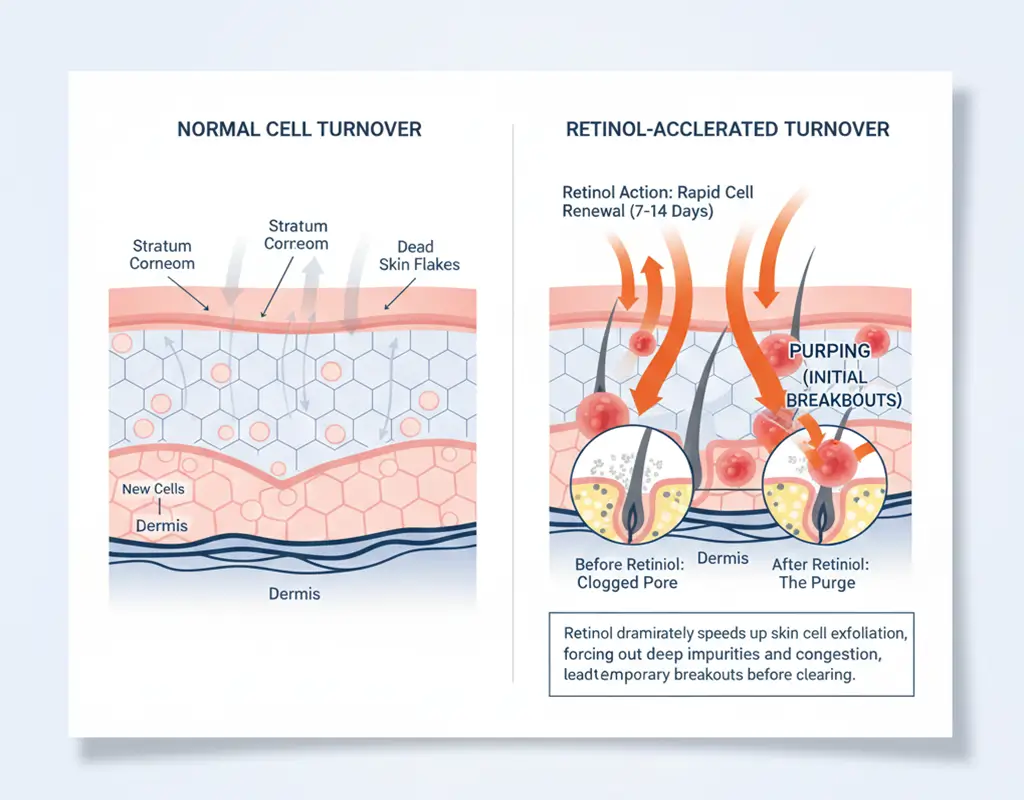
Retinol works by speeding up the rate at which your skin sheds old cells and creates new ones — a process called cell turnover.

When you start using retinol, this accelerated turnover can bring impurities that were forming deep within your pores to the surface more quickly than usual.
While it might look like a classic acne breakout, this isn’t about new acne: it’s simply buried congestion being cleared out.
In oily skin, this effect tends to be more noticeable because of higher baseline sebum production and more clogged pores.
The extra oil helps trap dead skin cells and debris, so when retinol accelerates renewal, that buildup gets pushed out — which is why purging often mimics a short-term flare-up.
Clinical Study:
A clinical trial supports this mechanism: in a 2024 study, NOWAK et al. tested a retinol formulation (lipid nanoparticle-loaded retinol) on participants with oily, acne-prone skin.
Over eight weeks of daily use, they measured sebum production on the cheeks and forehead and found a consistent reduction in oil output, suggesting retinol helps regulate sebum over time (Source).
This aligns with what dermatologists observe: purging is a transient effect, not a worsening of acne.
Why Purging Happens More With Oily Skin
If you have oily skin, you’re more likely to experience a pronounced retinol purge. Here’s why:
- Excess Sebum + Clogged Pores
Oily skin typically produces a lot of sebum. That oil, combined with dead skin cells, can clog pores more easily. When retinol kicks in and speeds cell turnover, those blockages get flushed out faster, triggering more visible bumps and lesions at first. - Ingredient Interactions Can Amplify Purging
If you’re already using other active ingredients, like salicylic acid or AHA/BHA exfoliants, the reaction can intensify.
These ingredients also increase cellular turnover or help clear out pores, so when used with retinol, they can accelerate the purging process.
For example, salicylic acid helps open pores, and combining it with retinol means your skin may shed more congestion faster, but also temporarily irritate more. - Retinoid Effects on Skin Oil Regulation
Over time, retinoids like retinol can actually help balance oil production. The same clinical evidence (NOWAK et al., 2024) showed that consistent retinol use reduced overall sebum secretion in oily skin after the purging phase.
So while purging feels rough, it’s often a signal that retinol for oily skin is starting to do its job: regulating oil, clearing out deep congestion, and leading to smoother, clearer skin in the long run.
Acne Breakout vs Retinol Purge: How to Tell the Difference
When your skin starts acting up after using retinol, it can be confusing to tell whether you’re experiencing a normal retinol purge or a real breakout.
While both can look similar on the surface, purging is your skin clearing existing congestion at a faster rate—short-lived, predictable, and part of the adjustment phase.
A true breakout, however, is caused by irritation, bacteria, or excess oil and continues to worsen unless you change what’s triggering it. The key difference? Purging gets better with consistent retinol use; real breakouts get worse.
1: Purging vs Breakouts: Side-by-Side Comparison
| Feature | Retinol Purging | Breakouts |
|---|---|---|
| Location on Face | Appears where you normally get acne | Can appear anywhere (even new areas) |
| Duration | 4–6 weeks, then improves | Lasts indefinitely unless the cause is treated |
| Type of Pimples | Small whiteheads, clogged pores, tiny bumps | Whiteheads, blackheads, cysts, painful inflammation |
| Severity | Mild to moderate | Mild to severe |
| Triggers | Increased cell turnover from retinol | Irritation, bacteria, excess oil, comedogenic products |
| When to Stop Retinol | Only if symptoms persist past 6–8 weeks | Stop if skin becomes painful, inflamed, or cystic |
| Purging in Oily Skin | More intense due to deeper congestion and excess sebum | Varies; may worsen if skin barrier becomes irritated |
2: Signs You Are Purging (Backed by Science)
When you first start using retinol, it can be hard to tell whether your skin is improving or reacting badly.
But dermatologists note several clear signs that what you’re experiencing is purging — not a true breakout.
These signs match what research shows about how retinoids push out mature comedones and reduce micro-comedones under the skin.
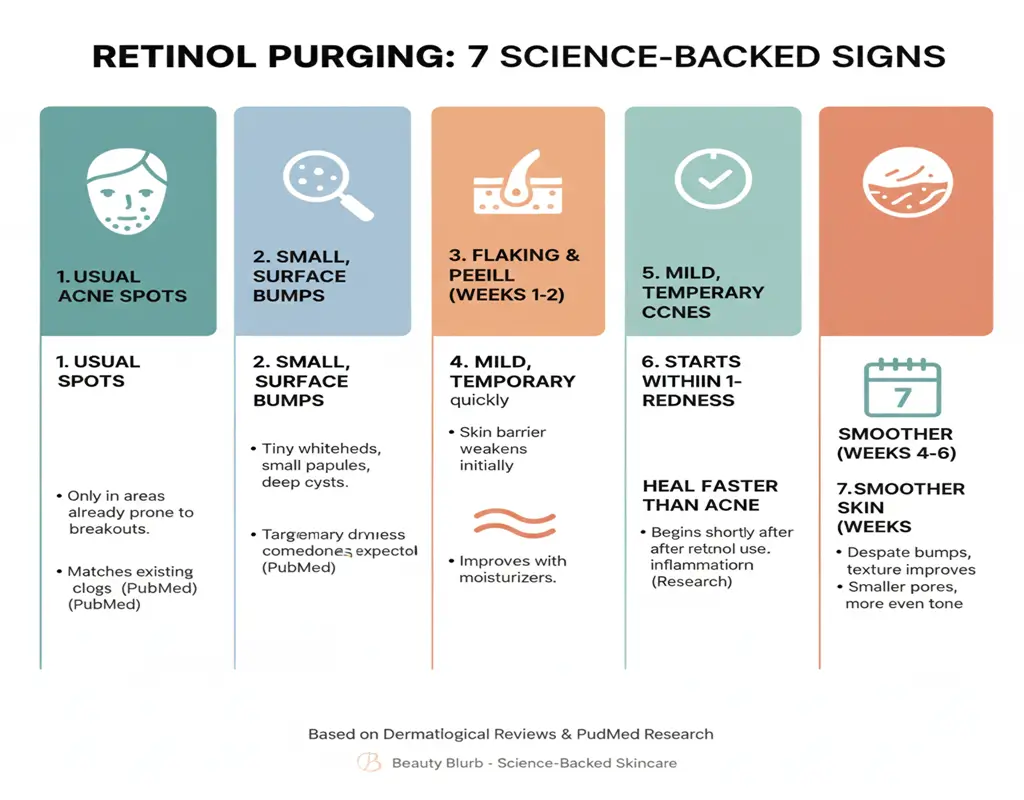
1. Breakouts Show Up Exactly Where You Usually Get Acne
Purging only happens in areas that were already prone to congestion — because retinol speeds up the removal of existing clogs (as confirmed in PubMed reviews on retinoids’ comedolytic effects).
If you suddenly get bumps in new or unusual areas, that’s usually not purging.
2. Small, Surface-Level Bumps — Not Deep, Painful Cysts
Most purging looks like:
- tiny whiteheads
- small papules
- slightly rough or bumpy texture
This matches scientific evidence showing that retinoids target micro-comedones, not deep inflammatory lesions.
3. Flaking and Peeling in the First Weeks
As retinol speeds up cell turnover, old dead skin sheds more quickly.
This can cause:
- light flaking
- mild peeling
- temporary dryness
Dermatology reviews (PubMed) confirm that early dryness and peeling are expected effects of retinoid therapy.
4. Redness or Mild Irritation That Improves With Time
Retinoids can temporarily weaken the skin barrier until the skin adapts.
Purging-related redness is usually:
- mild to moderate
- improves gradually
- manageable with moisturizer
But worsening redness, burning, or swelling may signal irritation — not purging.
5. New Bumps Heal Faster Than Your Normal Acne
Since purging bumps come from congestion already forming under the skin, they resolve faster than typical breakouts.
This aligns with research showing that retinoids reduce inflammatory duration by improving cell turnover.
6. Symptoms Begin Within 1–2 Weeks of Starting Retinol
True purging starts shortly after retinol introduction — usually around week 1 or week 2.
If your skin suddenly worsens after 5–6 weeks, that’s not purging.
7. Skin Begins Looking Smoother Around Weeks 4–6
This is one of the most important signs.
Despite the initial bumps, you’ll notice:
- smoother texture
- smaller-looking pores
- more evenness
- less roughness
Clinical reviews confirm that the comedolytic effect of retinoids becomes visible after about a month of continuous use.
In clinical study, titled “Topical retinoids in acne – an evidence-based overview,”:
suggests that retinoids have a “comedolytic” effect (i.e., they break down the heads) and have anti-inflammatory effects, supporting the idea that early pimples may actually be old blockages being expelled and not just new inflammation.
3: Signs It’s a Retinol-Induced Breakout (Not Purging)
Not every flare-up during your retinol journey is a retinol purge. Sometimes, your skin is simply irritated, overwhelmed, or reacting negatively to the product — especially if you’re using a high concentration, applying it too often, or pairing it with other strong actives.
Here are the clearest signs your skin is dealing with a retinol-induced breakout, not normal purging.
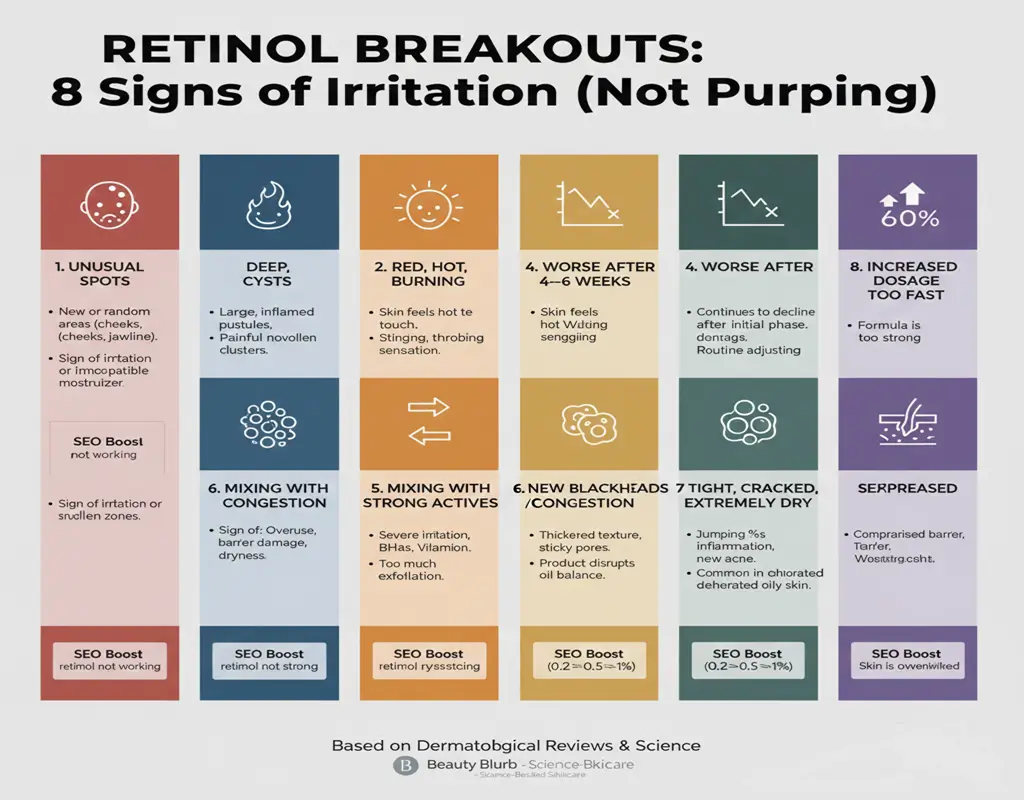
1. Breakouts Appear in Areas Where You Don’t Usually Break Out
Unlike purging, which happens in your usual acne-prone zones, a retinol breakout shows up in new or random places — such as the cheeks, jawline, or hairline if they were normally clear.
This is often a sign of:
- irritation
- barrier disruption
- or clogged pores from an incompatible moisturizer
SEO boost (natural): retinol breakout on cheeks, retinol not working
2. Pimples Are Deep, Painful, or Cystic
Purging brings small, surface-level bumps, but irritation breakouts often look more aggressive:
- deep cysts
- large inflamed pustules
- painful nodules
- swollen red clusters
These are not caused by cell turnover — they’re a sign your skin barrier is struggling or inflamed.
SEO boost: retinol irritation, retinol cystic acne
3. Your Skin Is Red, Hot, Burning, or Stinging
Mild redness is normal during a retinol purge — but intense inflammation isn’t.
If your skin feels:
- hot to the touch
- burning
- stinging
- throbbing
…this is irritation, not purging.
It means the retinol concentration, frequency, or product combination is too strong for your current barrier health.
4. Breakouts Get Worse After 4–6 Weeks Instead of Improving
A true retinol purge follows a predictable timeline: it improves around weeks 4–6.
If your skin continues to decline after that window, it’s a clear sign of:
- overuse
- barrier damage
- excessive dryness
- or an incompatible routine
This usually means your retinol for oily skin routine needs adjusting — not that your skin is “purging.”
5. You’re Using Retinol With Strong Actives (and Your Skin Is Overloaded)
Pairing retinol with ingredients like:
- AHAs
- BHAs
- benzoyl peroxide
- Vitamin C (low pH)
…can cause severe irritation and inflammation that mimics a breakout.
This isn’t purging — it’s too much exfoliation at once.
6. Breakouts Include Blackheads or New Congestion
Purging pushes existing clogs out, it does not create fresh ones.
But irritation breakouts often come with:
- new blackheads
- thickened texture
- sticky, congested pores
- whiteheads in areas that were previously smooth
That means the product is disrupting oil balance, not clearing it.
7. Skin Feels Tight, Extremely Dry, or Cracked
When your barrier is compromised, your skin can’t regulate oil properly — leading to inflammation, dryness, and new acne.
This can trigger a retinol breakout, especially in oily or combination skin that’s sensitive to dehydration.
8. You Increased the Dosage Too Quickly
Jumping from 0.2% → 0.5% → 1% too fast often causes:
- worsening breakouts
- persistent irritation
- prolonged inflammation
Purging doesn’t behave this way.
This is simply your skin being overwhelmed.
In short:
If the flare-up is happening in new areas, feels painful or inflamed, lasts longer than 6 weeks, or comes with stinging, burning, and severe dryness — you’re dealing with a retinol-induced breakout, not purging.
Conclusion
So, why is retinol making my face break out?
In most cases, what you’re seeing is a temporary retinol purge — your skin clearing out existing congestion and adjusting to faster cell turnover.
True retinol breakouts are less common and usually happen when the product irritates your skin, appears in new areas, or persists beyond the typical 4–6 week window.
Understanding the difference between purging and breakouts helps you stay consistent, avoid unnecessary panic, and get the full benefits of retinol for oily skin safely and effectively.
How Long Does Retinol Make You Break Out?
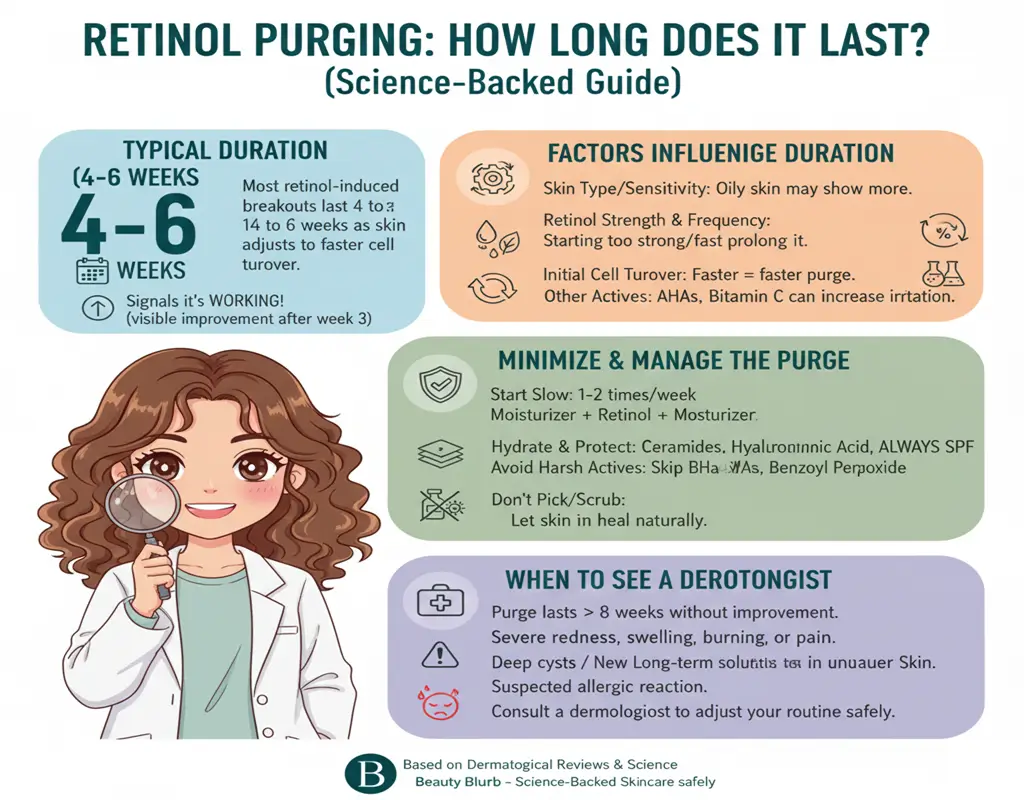
If you’re wondering How long does retinol breakout last?, most retinol-induced breakouts, or retinol purging, last 4 to 6 weeks as your skin adjusts to faster cell turnover, pushing existing clogs and micro-comedones to the surface.
Most people notice clearer, smoother skin after this initial period, but if breakouts persist beyond 8 weeks or cause severe redness, burning, or pain, it may be a true retinol breakout or irritation, and consulting a dermatologist is recommended.
Factors like skin type, oiliness, retinol strength, and combining with other actives can affect the duration, so patience and gentle supportive skincare are key.
1: Typical Duration of a Retinol Purge
For most people, a retinol purge lasts 4 to 6 weeks. During this time, your skin is accelerating cell turnover, pushing existing congestion and micro-comedones to the surface.
- Some individuals notice improvement as early as week 3, while others may take up to 8 weeks for all the bumps to settle.
- This phase is temporary and usually signals that the retinol is working as intended, particularly for retinol for oily skin routines.
2: Factors That Influence How Long Breakouts Last
Several variables can affect the duration and intensity of your skin’s reaction:
- Initial Cell Turnover: Faster turnover may bring more congestion to the surface quickly, intensifying the purge but shortening its duration.
- Skin Sensitivity and Type: Oily or combination skin may show more noticeable bumps due to higher sebum production, while sensitive skin may experience irritation that feels like extended breakouts.
- Strength and Frequency of Retinol: Using a high concentration too soon or applying it daily before your skin adjusts can prolong or worsen the purge.
- Other Active Ingredients: Combining retinol with AHA/BHA, salicylic acid, or benzoyl peroxide can speed up exfoliation but may increase irritation if not balanced.
3: What to do to minimize and manage a retinol purge
Managing a purge effectively helps your skin adjust without unnecessary setbacks:
- Stay Consistent: Stick to your routine — stopping and restarting will only restart the purging cycle.
- Start slow: Begin with a low concentration (e.g., 0.25–0.3%) 1–2 times per week. Gradually increase frequency as your skin adapts.
- Use the “sandwich” method: Apply a gentle, non-comedogenic moisturizer before and after retinol to cushion your skin and minimize irritation without reducing effectiveness.
- Hydrate and protect: Keep skin moisturized with barrier-friendly ingredients like ceramides and hyaluronic acid, and always wear broad-spectrum SPF, because retinol makes skin more sensitive to UV damage.
- Avoid other strong actives: In the early weeks, skip AHAs, BHAs, vitamin C, or benzoyl peroxide to prevent compounding irritation.
- Don’t pick or scrub: Let flaky skin and minor bumps resolve naturally. Over-exfoliating or picking can cause inflammation, scarring, and prolong the purge.
- Observe and adjust: If irritation persists beyond a few weeks or worsens, reduce frequency, lower the concentration, or consult a dermatologist to rule out a true retinol breakout.
- Scale Back if Needed: If irritation is severe, reduce frequency or use a lower concentration. Gradually increase as your skin adapts.
- Patience is Key: Retinoids are a long-term solution; visible results take weeks to appear.
4: When to See a Dermatologist
While purging is normal, certain signs indicate that your reaction may be a true retinol breakout or irritation:
- Purging lasts longer than 8 weeks without improvement
- Severe redness, swelling, burning, or pain
- Formation of deep cysts or new breakouts in unusual areas
- Suspected allergic reaction to the product
In these cases, it’s best to consult a dermatologist to adjust your routine safely.
Summary:
A retinol purge is usually temporary, lasting 4–6 weeks, and is part of how your skin adjusts to faster cell turnover.
By understanding the factors that influence duration, using supporting products, and monitoring for signs of irritation, you can navigate this phase confidently and maximize the benefits of retinol for oily skin.
How to Reduce Retinol Breakouts (Dermatologist-Guided Routine)
Experiencing breakouts while using retinol can be frustrating, but with the right approach, you can minimize irritation and support your skin’s adjustment.
Following a dermatologist-guided routine helps oily and acne-prone skin tolerate retinol better, reduces the risk of prolonged retinol purge, and maximizes the benefits of smoother, clearer skin.
1: Step-By-Step Beginner Protocol
- When starting retinol, slow and careful introduction is key. Begin by applying a pea-sized amount once or twice a week, gradually increasing as your skin adapts.
- The “sandwich” method — applying a thin layer of moisturizer before and after retinol — cushions the skin, reduces redness, and prevents excessive dryness without compromising effectiveness.
- Always pair your retinol with a broad-spectrum sunscreen during the day, because retinol accelerates cell turnover and makes skin more sensitive to UV damage.
- Consistency and patience are essential; this approach helps oily skin adjust safely and minimizes retinol breakouts.
2: What to Avoid During the Purge
Certain habits and product combinations can worsen irritation or prolong breakouts.
- Avoid overwashing, which strips natural oils and weakens the skin barrier, and skip overlapping exfoliating acids like AHAs and BHAs during the early weeks.
- Harsh cleansers or strong actives such as vitamin C can overload the skin, triggering more irritation instead of helping it.
- Sticking to gentle products while your skin adjusts is the safest way to navigate the retinol purge phase.
3: Best Soothing Ingredients for Oily Skin
Incorporating barrier-supportive ingredients can significantly reduce redness, dryness, and inflammation during the purge. Look for:
- Niacinamide, which regulates sebum production and strengthens the skin barrier.
- Panthenol, a humectant that improves hydration and calms irritation.
- Ceramides, essential for restoring lipid layers and preventing moisture loss.
- Aloe vera, which soothes redness and reduces the sensation of tightness.
Using these ingredients in your routine alongside retinol ensures that oily, congestion-prone skin stays balanced while gradually adapting to the treatment.
Best Retinol Choices for Oily Skin to Reduce Breakouts
If you’re looking to calm breakouts and refine texture without triggering more congestion, here are two standout retinols that dermatologists and skincare experts frequently recommend for oily skin:
- CeraVe Resurfacing Retinol Serum — Light, non-greasy, formulated with retinol + niacinamide + ceramides to help oily skin regenerate without clogging pores.
- The Ordinary Retinol 0.5% in Squalane — A simple formula at an excellent price, containing pure retinol with squalane for moisturizing without excess shine.
| Product | Concentration / Key Notes | Why It’s Great for Oily Skin | Rating |
|---|---|---|---|
| CeraVe Resurfacing Retinol Serum | Retinol + Niacinamide | Non‑greasy, helps clear pores, supports skin barrier. :contentReference[oaicite:2]{index=2} | ★★★★☆ |
| The Ordinary Retinol 0.5% in Squalane | 0.5% Retinol in Squalane | Hydrating yet lightweight, minimal greasy finish. :contentReference[oaicite:3]{index=3} | ★★★☆☆ |
| Dermalogica Retinol Clearing Oil | Retinol + Salicylic Acid | Lightweight oil‑serum that targets breakouts and refines texture. :contentReference[oaicite:4]{index=4} | ★★★★☆ |
| La Roche-Posay Redermic R | Pure Retinol + Linoleate | Expert‑recommended for oily, acne‑prone skin for its gentle but effective formula. :contentReference[oaicite:5]{index=5} | ★★★★☆ |
| Olay Regenerist Retinol 24 Night Serum | Retinol + B3 Complex | Hydrates 24h, fragrance‑free, absorbs quickly without heavy residue. :contentReference[oaicite:6]{index=6} | ★★★☆☆ |
FAQ About does retinol make you break out before it gets better
Your skin may appear slightly bumpier or redder during the first 7–14 days. This is because **retinol accelerates cell turnover**, bringing existing clogs to the surface faster. Early signs often appear where you normally break out.
Topical retinoids may improve **cell turnover** and reduce scaling, but they can initially irritate sensitive skin. For seborrheic dermatitis, start with a low concentration, patch-test, and always pair with gentle moisturizers.
The **1‑2‑3 rule** suggests: use retinol **once per week** in week 1, **twice per week** in week 2, and **three times per week** in week 3. This allows your skin to tolerate retinol while reducing the risk of purging or irritation.
During a **retinol purge**, bumps usually appear where you normally break out. Skin may feel rough, slightly red, or flaky. These changes are temporary and a sign that **retinol is accelerating cell turnover** and clearing clogged pores.
If you are experiencing a normal **retinol purge**, continue using it as recommended but consider lowering concentration or skipping days if irritation is strong. Consistency is key to achieving **smoother, clearer skin**.
Most **retinol purges** resolve within 4 to 6 weeks. Your skin adapts to increased cell turnover, and breakouts gradually decrease. If purging lasts beyond 8 weeks, consult a dermatologist to ensure it’s not a **retinol-induced breakout** or irritation.
Ingredients like **niacinamide, panthenol, ceramides, and aloe vera** help soothe irritation, strengthen the barrier, and maintain hydration. Pairing these with retinol can reduce redness and dryness while supporting skin adaptation.
So, now you know does retinol make you break out and why purging is a natural part of the process. Thank you for reading! 💜
We’d love to hear about your retinol journey — share your experiences and tips in the comments below. Don’t forget to subscribe for more skincare insights and expert advice to keep your skin glowing and healthy.

Akram Boulaid is a dedicated Skincare Researcher and Analyst with over 7 years of intensive focus on dermatology and cosmetic ingredient science. As a globally recognized expert, his insights have been featured in major international publications, including the New York Post and GB News. A verified expert on Qwoted, Akram connects with health journalists to provide evidence-based analysis. He founded Beauty Blurb to bridge the gap between complex clinical data and practical skincare routines, specializing exclusively in the needs of oily and acne-prone skin through rigorous analysis of peer-reviewed scientific literature.