
💡 Quick Insight:
If you’re wondering what moisturizer to use after salicylic acid, the answer is simple: go for a lightweight, oil-free, and non-comedogenic formula that restores hydration without clogging pores.
You need this because Salicylic Acid is an exfoliator that can temporarily disrupt your skin barrier and lead to excessive dryness, especially for those with oily skin.
Look for soothing ingredients like **Hyaluronic Acid, Niacinamide, and Ceramides**—these work to calm potential irritation and strengthen the barrier function.
Crucially, for daytime use, you must always finish your routine with a broad-spectrum, oil-free sunscreen (SPF 30+). This is because BHA increases **photosensitivity**, making your skin highly vulnerable to sun damage and hyperpigmentation.
In this article, we’ll explore everything you need to know about finding the best moisturizer after salicylic acid.
You’ll discover which ingredients to look for, which ones to avoid, how to match the right formula to your skin type, and practical tips to keep your routine simple yet effective.
By the end, you’ll feel confident choosing the perfect moisturizer that works in harmony with salicylic acid for healthier, clearer skin.
First, salicylic acid before or after moisturizer?
Before we dive into the best formulations to pair with your BHA, we must address the most common technical question: should you apply salicylic acid before or after your moisturizer?
The short answer is: Salicylic acid should always be applied BEFORE your moisturizer.
As an oil-soluble Beta Hydroxy Acid (BHA), salicylic acid needs to penetrate deep into the pores to dissolve sebum and debris.
Applying a moisturizer first creates an occlusive barrier that prevents the acid from reaching the skin’s surface effectively. To get the maximum clinical benefit, follow this sequence:
- Cleanse your skin thoroughly.
- Apply your salicylic acid treatment (toner or serum).
- Wait 2–3 minutes for it to absorb.
- Seal everything in with the right moisturizer.
“According to a key study in the Journal of Clinical and Aesthetic Dermatology, you should always pair your Salicylic Acid with a good moisturizer.
The research shows that while the acid exfoliates, adding Ceramides and Cholesterol is a game-changer—it helps fix your skin’s protective barrier, prevents irritation, and keeps your face from feeling dry or tight (source).
Expert Tip: If you want a deep dive into the molecular reasons why timing matters and how to avoid irritation during this process, check out our full guide on Salicylic Acid Before or After Moisturizer: The Scientific Sequence.
Why You Need a Moisturizer After Salicylic Acid
You might be wondering: Should I use a moisturizer with salicylic acid?
If so, the short answer is yes — always follow salicylic acid with a lightweight, non-comedogenic moisturizer to lock in hydration and protect your skin barrier.
The Key Benefits Of Using Moisturizer After salicylic Acid:
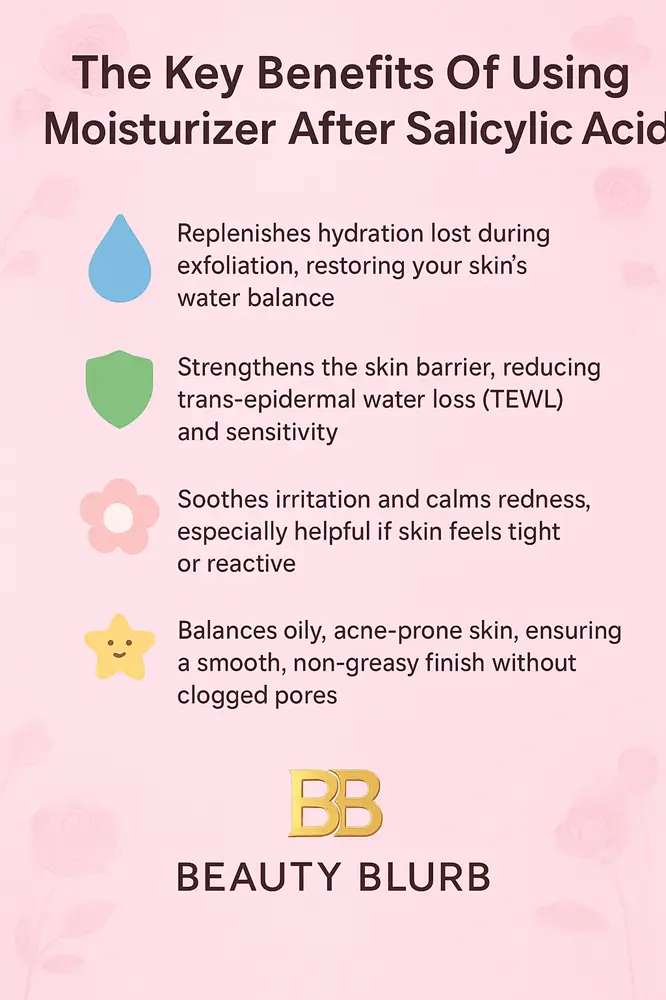
- Replenishes hydration lost during exfoliation, restoring your skin’s water balance.
- Strengthens the skin barrier, reducing trans-epidermal water loss (TEWL) and sensitivity.
- Soothes irritation and calms redness, especially helpful if skin feels tight or reactive.
- Balances oily, acne-prone skin, ensuring a smooth, non-greasy finish without clogged pores.
Clinical Evidence:
A 2025 clinical trial published in the Journal of Cosmetic Dermatology evaluated a 2% salicylic acid gel, applied twice daily for 21 days on 42 participants (37 women and 5 men, average age ~26, with oily or combination skin and mild to moderate acne)
The results were significant:
- Sebum production dropped by 23.65% (p < 0.05).
- Skin hydration increased by 40.5% (p < 0.05).
- TEWL decreased by 49.26% shortly after application (p < 0.05).
- Acne severity improved by 23.81% (p < 0.001) PubMed.
These figures reveal that while salicylic acid effectively controls oil and acne, it can also compromise hydration and skin barrier.
Follow-up with proper moisturizing is essential to maintain skin health and comfort.
From our experience at Beauty Blurb, we know that salicylic acid works wonders—but pairing it with the right moisturizer isn’t optional, it’s essential.
This combo keeps your skin clear yet hydrated, dramatically improving results while ensuring comfort for your oily skin.
What Moisturizer to Use After Salicylic Acid
You might be asking yourself: What kind of moisturizer to use after salicylic acid? Here’s the quick answer: opt for a lightweight, oil-free, non-comedogenic moisturizer that delivers hydration and supports barrier repair without compromising the acid’s effectiveness.
What to Look For in Your Moisturizer
- Lightweight & Oil-Free Texture
Ideal for oily or acne-prone skin—ensures hydration without clogging pores. - Non-Comedogenic Formula
Prevents breakouts by allowing skin to breathe. - Hydrating Actives
Look for hyaluronic acid, glycerin, or panthenol to lock in moisture effectively. - Barrier-Repair Ingredients
Ingredients like ceramides, niacinamide, and peptides help restore skin’s lipid barrier and strengthen resilience. - Soothing Additives
Calming ingredients such as aloe vera, allantoin, or green tea extract help reduce redness and irritation.
Clinical Insight to Support This:
- A cohort study published on PubMed evaluated the combined use of a ceramide-containing cleanser and cream with salicylic acid in 35 adults experiencing dry, flaking, or scaling skin.
- Over a period of 28 days, participants used a ceramide-containing cleanser and cream twice daily.
- Both physician assessments and patient-reported outcomes showed significant improvement.
- The evaluation was based on the Dry Skin Classification Scale and the GAIS (Global Aesthetic Improvement Scale).
- These findings demonstrate that using a moisturizer with ceramides after salicylic acid can effectively enhance hydration and restore the skin barrier.
From My personel experience at , we’ve learned that choosing the right moisturizer—that is hydrating yet lightweight, protective yet non-greasy—is the key to balancing the potency of salicylic acid with lasting comfort.
By focusing on these ingredient qualities, you’ll keep your skin clear, calm, and resilient—never stripped or irritated.
What Ingredients to Avoid After Salicylic Acid
You might be wondering: What should you not mix with salicylic acid? The short answer:
Avoid combining salicylic acid with other potent actives such as retinol, glycolic acid, benzoyl peroxide, or high-strength vitamin C.
These pairings can cause over-exfoliation, dryness, redness, and a weakened skin barrier.
Instead, apply them at different times of the day—such as salicylic acid in the morning and retinol at night—or alternate them on different days to let your skin recover and stay balanced.
Ingredients You Should Avoid Mixing with Salicylic Acid

- Retinol (Vitamin A)
Retinol is powerful for cell turnover, but when layered with salicylic acid it can lead to excessive dryness, peeling, and irritation. - Other Exfoliating Acids (AHAs like Glycolic or Lactic Acid)
Doubling up on acids means doubling the risk of redness, stinging, and barrier damage. Stick to one chemical exfoliant at a time. - Benzoyl Peroxide
While both are great for acne, using them together can cause significant irritation and cancel out each other’s effects. - Harsh Physical Scrubs
Exfoliating beads or rough scrubs on top of salicylic acid create micro-tears, leading to sensitivity and inflammation. - High-Strength Vitamin C (Ascorbic Acid)
This antioxidant is best used separately, as its effectiveness drops when combined with exfoliating acids.
Clinical Insight:
Dermatologists from the American Academy of Dermatology (AAD) consistently recommend avoiding “ingredient stacking” with exfoliants.
According to Dr. Lauren Ploch, board-certified dermatologist, layering salicylic acid with retinoids or other acids increases the likelihood of irritation and barrier disruption, especially for sensitive or acne-prone skin
At Beauty Blurb, we’ve seen firsthand that less is often more when it comes to active ingredients.
By avoiding these combinations, you’ll let salicylic acid do its job—clearing pores and reducing breakouts—without overwhelming your skin. Focus on balance, and your complexion will thank you.
What Is The best moisturizer after salicylic acid (Top Products)
After answering your big question—what moisturizer to use after salicylic acid serum—it’s finally time to talk products. As someone who’s tested countless creams (and yes, my bathroom shelf looks like a mini pharmacy 🙈).
I’ve teamed up with dermatologists to narrow down the Best Moisturizers to Use After Salicylic Acid. These picks are gentle, effective, and dermatologist approved—because your skin deserves the good stuff.
💡 Pro tip from me and my dermatologist colleagues:
You don’t need a 20-step skincare routine. Pick one of these moisturizers that matches your skin type, apply it after salicylic acid, and your skin will thank you (and maybe even glow enough to skip the filter on selfies 😉).
✨ Now I’d love to hear from you: Have you been using salicylic acid before or after moisturizer? Drop your answer in the comments—I’m super curious about your routine! 💬
How to Use Salicylic Acid and moisturizer Together
I know you’re probably wondering: How long should I wait to apply moisturizer after salicylic acid? or how to hydrate skin after salicylic acid?
The truth is—you don’t need to overcomplicate it. You can wait anywhere from 5 to 30 minutes, depending on your skin’s needs. If you want quick absorption, 5–10 minutes is fine.
If you prefer giving salicylic acid more time to work at its ideal pH, then wait 20–30 minutes. And if you’ve got sensitive skin, applying moisturizer right away can actually help buffer irritation and keep your skin barrier happy.
Now, when it comes to combining salicylic acid and niacinamide together, here’s a simple dermatologist-approved routine that works for most skin types:
✅ Step-by-Step Routine
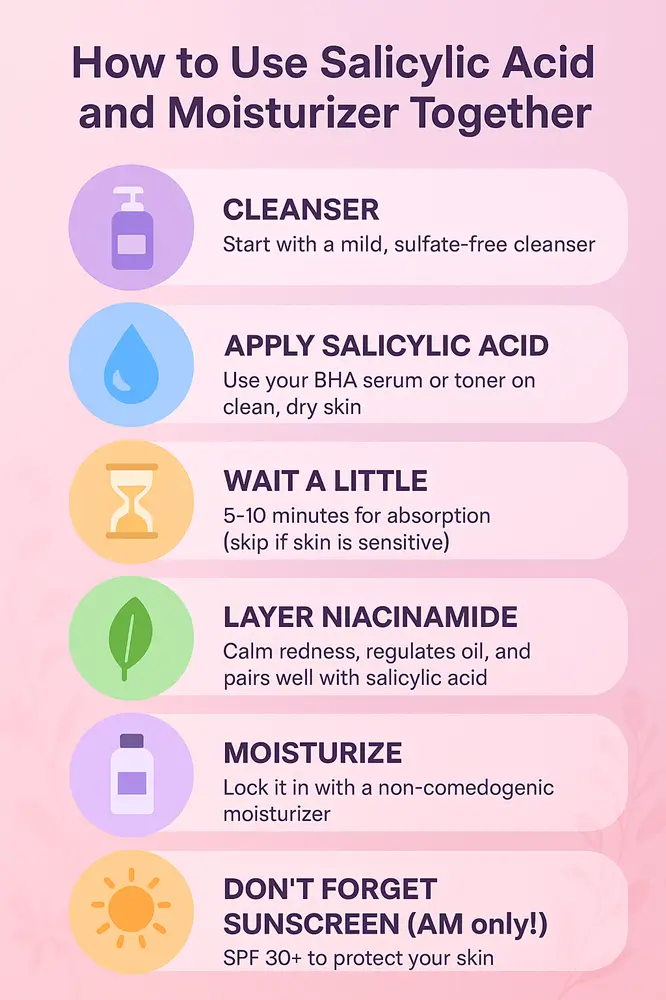
- Cleanse gently – Start with a mild, sulfate-free cleanser to prep your skin.
- Apply salicylic acid – Use your BHA serum or toner on clean, dry skin.
- Wait a little – 5–10 minutes is usually enough for absorption (unless you have very sensitive skin, then skip the wait).
- Layer niacinamide – Apply your niacinamide serum; it calms redness, regulates oil, and pairs beautifully with salicylic acid.
- Moisturize – Lock it all in with a non-comedogenic, hydrating moisturizer that suits your skin type.
- Don’t forget sunscreen (AM only!) – If it’s daytime, finish with SPF 30 or higher—your acids are useless without sun protection.
💡 Pro tip: Salicylic acid can sometimes be drying, while niacinamide is soothing and barrier-supporting. That’s why this duo works so well together—it’s like skincare yin and yang.
✨ Honestly, the best way to know if this routine is right for you is to try it yourself. Everyone’s skin has its own personality (some are chill, some are drama queens 🙃).
Test out this combo of salicylic acid + niacinamide + moisturizer, stick with it for a few weeks, and see how your skin responds. And hey—don’t keep it a secret! Share your experience in the comments. I’d love to hear how your skin reacts. 💬
⚡ Quick Note: If you’ve got oily skin and you’re thinking, “Okay, but what about the rest of my skincare routine?”—I’ve got you covered. Check out my full guide here: 👉 Dermatologist Recommended Skin Care Routine for Oily Skin.
Spoiler alert: it’s basically the skincare equivalent of a well-balanced diet—without the boring salad. 🥗😂
Common Mistakes When Using Salicylic Acid and Moisturizer
Using salicylic acid is powerful, but let’s be honest—it’s also easy to mess up. I’ve seen so many skincare lovers (and even a few of my own friends 😅) make simple mistakes that lead to irritation, breakouts, or wasted products.
To save your skin (and your wallet), here are the most common mistakes with salicylic acid and moisturizer you should avoid:
❌ 1. Overusing Salicylic Acid
More is not always better. Applying salicylic acid every single day, or even twice a day, can strip your skin’s natural barrier.
This often leads to redness, flakiness, and breakouts that look worse than before. Start slowly—2–3 times per week is enough for most skin types.
❌ 2. Skipping Moisturizer
One of the biggest skincare mistakes is thinking oily or acne-prone skin doesn’t need hydration.
Wrong! Salicylic acid is drying by nature, so skipping a non-comedogenic moisturizer is like forgetting to water your plants 🌱. Your skin barrier will eventually protest.
❌ 3. Choosing the Wrong Moisturizer
Not all moisturizers are created equal. Heavy, greasy creams can clog pores, while lightweight gels may not be hydrating enough for dry skin.
Always pick the best moisturizer after salicylic acid that matches your skin type—ceramides and hyaluronic acid are safe bets.
❌ 4. Mixing Too Many Active Ingredients
This one’s a classic: layering salicylic acid with retinol, glycolic acid, benzoyl peroxide, or vitamin C all at once.
The result? Over-exfoliation, irritation, and a damaged skin barrier. Spread these actives out—use them on alternate days or different times of the day.
❌ 5. Forgetting Sunscreen
Salicylic acid makes your skin more sensitive to the sun.
Applying acids at night and then skipping sunscreen during the day is like wearing armor but leaving your helmet at home. 🪖 Always finish your skincare routine after salicylic acid with SPF 30 or higher.
✨ Final tip from me (and dermatologists who’ve seen it all):
Keep it simple. Use salicylic acid wisely, moisturize every time, protect with sunscreen, and don’t fall into the “more products = better skin” trap. Your skin will thank you with fewer breakouts and a much healthier glow.
FAQ Of Using Moisturizer After salicylic Acid
Salicylic acid exfoliates and reduces oil, but it can also dry out or sensitize skin. A lightweight, non-comedogenic moisturizer restores hydration, soothes irritation, and prevents excessive trans-epidermal water loss (TEWL). Use a gel or lotion for oily skin and a cream for drier types.
Even oily or acne-prone skin needs hydration. Skipping moisturizer after salicylic acid leaves the barrier exposed and may trigger rebound oiliness or inflammation. Choose a non-comedogenic, oil-free moisturizer to balance the skin without clogging pores.
After applying your BHA serum, pick a lotion or gel with humectants (hyaluronic acid, glycerin) and barrier lipids (ceramides, niacinamide). These ingredients replenish moisture and reinforce the barrier without adding grease.
Safe pairings include niacinamide, hyaluronic acid, ceramides, and mild antioxidants. These soothe and support the barrier. Avoid using salicylic acid simultaneously with retinoids, strong AHAs, benzoyl peroxide, or high-strength vitamin C in the same step to prevent over-exfoliation.
Salicylic acid itself doesn’t cause harmful chemical reactions with common actives, but combining it with retinol, strong AHAs, or benzoyl peroxide can amplify irritation and dryness. Use these ingredients on alternate days or separate them by time of day (BHA in AM, retinol at PM, for example).
Layering is fine if the products are compatible. Keep the routine simple: cleanser → salicylic acid → niacinamide (optional) → moisturizer → SPF (AM). If you use other actives, rotate them across days to prevent barrier damage.
Niacinamide calms and supports the skin barrier, making it a good daily companion to salicylic acid. Start slowly and monitor tolerance; if irritation appears, reduce frequency. Many dermatologists recommend using them together for oily, acne-prone skin.
Using salicylic acid at night lets it work undisturbed while you sleep. Morning use is fine too, especially if you pair it with SPF. If you’re using other actives like retinol, place salicylic acid in the morning and retinol at night, or alternate nights.
Thank you so much for reading 💕. I hope this guide cleared up your question about What Moisturizer to Use After Salicylic Acid cleanser and gave you the confidence to build a routine that truly works for your skin.
Now it’s your turn: give this routine a try, listen to how your skin responds, and don’t be shy—share your journey with us in the comments. Your story might be exactly what another reader needs to feel inspired 🌸.
If you enjoyed this article, make sure to subscribe so you won’t miss future skincare tips, dermatologist-backed routines, and product recommendations crafted just for you. Your healthiest, glowiest skin is waiting ✨.

Akram Boulaid is a dedicated Skincare Researcher and Analyst with over 7 years of intensive focus on dermatology and cosmetic ingredient science. As a globally recognized expert, his insights have been featured in major international publications, including the New York Post and GB News. A verified expert on Qwoted, Akram connects with health journalists to provide evidence-based analysis. He founded Beauty Blurb to bridge the gap between complex clinical data and practical skincare routines, specializing exclusively in the needs of oily and acne-prone skin through rigorous analysis of peer-reviewed scientific literature.