
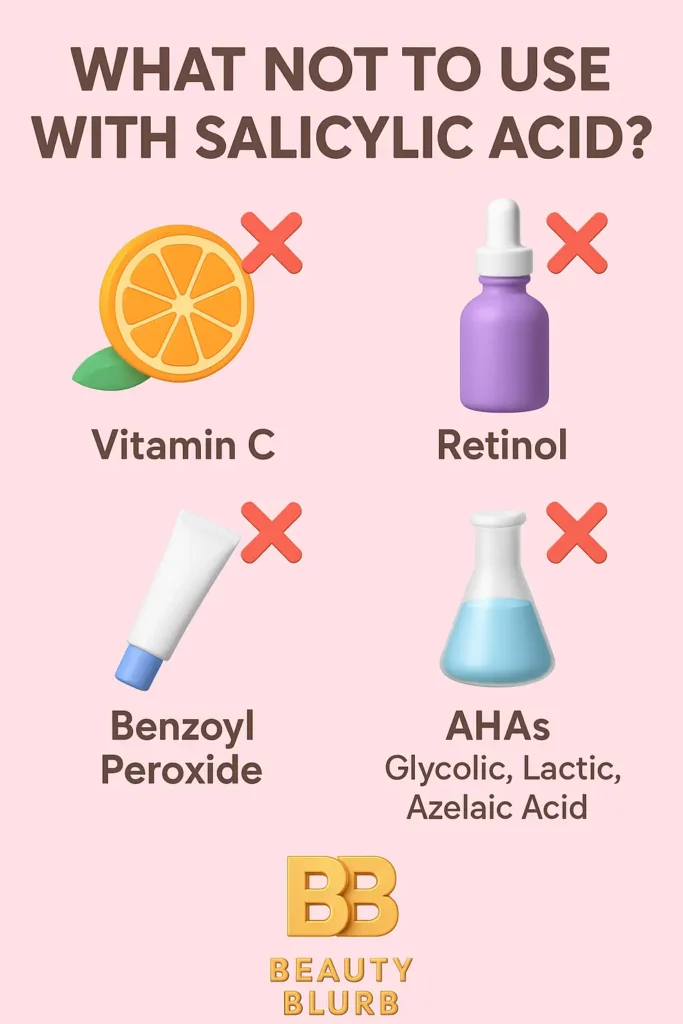
What Not to Use With Salicylic Acid? You should avoid combining it with other potent actives like glycolic acid or lactic acid, as this can lead to over-exfoliation, irritation, and a weakened skin barrier. I
t’s also best not to pair it with retinol or benzoyl peroxide, since using them together may cause excessive dryness and redness.
Another common mistake is mixing salicylic acid with vitamin C at the same time—because of their different pH levels, the combination can reduce effectiveness and trigger sensitivity.
The safest approach is to separate these ingredients by using them at different times of day or on alternate nights, so your skin gets the benefits without the side effects.

In this article, we’ll explore What not to mix with salicylic acid, why certain pairings can backfire, and how to build a routine that keeps your skin clear and balanced.
You’ll also discover expert tips, safe alternatives, and dermatologist-backed answers to the most common questions about layering this powerful ingredient.
How Salicylic Acid Works
Before we dive into the ingredients to never mix with salicylic acid, it’s important to first understand how this powerful ingredient works on your skin. By knowing its mechanism, you’ll see why certain combinations can either maximize results—or lead to irritation.
Salicylic acid belongs to the beta hydroxy acids (BHAs) family, and unlike water-soluble acids such as glycolic acid, it is oil-soluble.
This makes it especially effective for penetrating deep into the pores, dissolving excess sebum, and clearing out dead skin cells.
That’s why dermatologists often recommend salicylic acid for oily skin and acne-prone complexions—it directly targets the root causes of breakouts.
Another unique benefit of salicylic acid is its ability to provide gentle exfoliation without being too harsh, making it suitable for daily or alternate-day use when formulated at the right concentration (typically 0.5%–2%).
It not only helps reduce acne but also improves skin texture, unclogs blackheads, and minimizes the appearance of enlarged pores.
At the same time, because salicylic acid is so effective, pairing it incorrectly with other actives can disrupt the skin barrier and cause redness, dryness, or sensitivity.
That’s why understanding how salicylic acid works is the key to learning what not to mix with salicylic acid—which we’ll cover in the next section.
What Not to Use With Salicylic Acid?
What can you not mix salicylic acid with? This is one of the most common questions people ask when they start using this powerhouse ingredient.
While salicylic acid is highly effective for oily and acne-prone skin, pairing it with the wrong actives can cancel out its benefits—or worse, cause irritation, dryness, and barrier damage.
Some combinations reduce effectiveness due to conflicting pH levels, while others double up on exfoliation and overwhelm your skin.
In the next sections, we’ll explore the ingredients you should never mix with salicylic acid, why they don’t work well together.
1: Salicylic Acid and Vitamin C
If you’re wondering, Can I layer vitamin C and salicylic acid? — the answer is: yes, but with care. Using salicylic acid for oily skin can help unclog pores, reduce oil, and manage breakouts.
Meanwhile, vitamin C (especially L-ascorbic acid) is a powerful antioxidant that brightens skin, fights pigmentation, and supports collagen.
When used correctly, they can complement each other — but when mixed incorrectly, they can irritate, reduce effectiveness, or damage the skin barrier.
⚠️ Why Mixing Them Incorrectly Can Be Risky
- pH conflict: Vitamin C (L-ascorbic acid) works best at a low pH; salicylic acid also works in acidic environments, but using both together can alter skin pH in a way that reduces the potency of vitamin C or increases irritation.
- Over-exfoliation: Salicylic acid is already an exfoliant; adding vitamin C (especially strong formulas) might strip too many layers of dead skin or protective oils, leading to dryness, flaking, sensitivity, or redness.
- Higher risk for oily/acne-prone skin: Even though oily skin tolerates salicylic acid better than other skin types, combining potent actives improperly can still trigger breakouts or compromise skin barrier.
✅ How to Use Salicylic acid and vitamin C serum together
- Use vitamin C in the morning — antioxidants in vitamin C help protect your skin from daylight damage. Use salicylic acid at night to treat pores and clean out oil.
- If using both in evening, leave a time gap — wait 15-30 minutes after applying one before using the other.
- Start with lower strengths: for instance, vitamin C at 10-15%, salicylic acid at 1-2% (or even lower if you’re new).
- Always support with a good moisturizer and daily sunscreen — these help protect the skin barrier and reduce risk of irritation or pigmentation.
📚 PubMed-Backed Evidence:
- A clinical study in J Cosmet Laser Ther, compared salicylic acid peeling + vitamin C mesotherapy vs salicylic acid peeling alone in patients with mixed melasma.
- They used 30% salicylic acid peel every two weeks for two months.
- The group receiving vitamin C in addition showed significantly greater improvement in pigmentation and melasma severity scores, with only mild irritation (burning sensation) as a side effect. Source.
At the end of the day, using vitamin C and salicylic acid together isn’t off limits — but it definitely takes strategy, patience, and the right products.
And you might still ask yourself: Can I layer vitamin C and salicylic acid? If the answer is yes, then let’s move to how to do it safely.
💬 Your Experience Matters
Have you ever tried using salicylic acid and vitamin C together in your skincare routine? Did you notice any side effects like dryness or irritation.
or did you see positive results such as clearer, brighter skin? We’d love to hear your personal experience in the comments below!
2: Salicylic Acid and Retinol
Retinol and salicylic acid are two of the most talked-about actives in skincare.
Both are powerful on their own — salicylic acid benefits for oily skin clears out clogged pores, reduces oil buildup, and gently exfoliates, while retinol encourages cell turnover, smooths fine lines, and prevents future breakouts.
But when layered together incorrectly, they can overwhelm your skin and cause more harm than good.
⚠️ Why You Should Be Careful Combining Retinol and Salicylic Acid
- Over-exfoliation risk: Retinol speeds up skin cell turnover, while salicylic acid dissolves oil and dead skin cells. Using both at the same time can cause peeling, redness, and sensitivity.
- Barrier damage: For oily and acne-prone skin, the temptation to double up on treatments is high, but too much exfoliation weakens the skin barrier, leading to irritation and flare-ups.
- Increased dryness: Even though oily skin produces excess sebum, it can still become dehydrated and inflamed when exposed to strong actives at once.
✅ How to Use Retinol and Salicylic Acid Together
- Alternate nights: One night use salicylic acid, the next night use retinol. This gives your skin time to adapt and heal.
- Start slow: If you’re a beginner, limit retinol to 1–2 nights per week and salicylic acid on alternate nights.
- Buffer with moisturizer: Always follow with a nourishing moisturizer to prevent dryness.
- Day vs Night strategy: Salicylic acid can be used in the morning (followed by sunscreen), while retinol is best reserved for nighttime routines.
- Layer strategically: If you must use them in the same night, apply salicylic acid first (to unclog pores), wait 20–30 minutes, then apply a gentle retinol formula — but this approach is better for advanced users only.
💡 Pro Tip: If you’re building a skincare routine focused on the Best Ingredients for Oily Skin, you don’t have to choose between salicylic acid and retinol.
You just need to space them out strategically so your skin reaps the benefits of both without the drawbacks.
🤔 Salicylic Acid or Retinol for Acne?
If you’re asking which one is better — Salicylic Acid or Retinol for Acne-prone skin — the answer depends on your skin’s needs.
- Salicylic acid works best for oily, clogged pores, blackheads, and surface-level acne.
- Retinol works deeper, helping with long-term acne control, scarring, and skin texture.
For most people with acne-prone, oily skin, the ideal approach is not choosing one over the other, but using both in a balanced routine — salicylic acid for immediate pore cleansing, and retinol for long-term skin renewal.
3: Salicylic Acid and Benzoyl Peroxide
Combining salicylic acid for oily skin with benzoyl peroxide can be a double‐edged sword: potent if done right, irritating if done wrong.
Benzoyl peroxide kills acne‐causing bacteria (Propionibacterium acnes), reduces inflammation, and clears existing pustules. Salicylic acid exfoliates and unclogs pores.
Together, they can give powerful results—but the risk of over-dryness, peeling, or irritation goes up.

⚠️ Why This Combination Can Be Risky
- Skin barrier stress: Both are strong actives. Benzoyl peroxide is antimicrobial and slightly oxidizing, which can dry out skin. Salicylic acid can disrupt lipids and exfoliate. Use together incorrectly → compromised skin barrier, redness, flaking.
- Overlap on exfoliation: Salicylic acid already provides chemical exfoliation (especially for oily / acne-prone skin); benzoyl peroxide adds oxidative stress—stacking them in high concentrations or too frequently leads to irritation.
- Product formulation matters: If both are in strong concentrations, or in leave-on products at once, risk increases. Also, vehicles (gels, creams, cleansers) and supporting skincare (moisturizers, barrier repair) are important.
✅ How to Use Salicylic Acid and Benzoyl Peroxide Safely
- Use benzoyl peroxide at alternate times or alternate nights with salicylic acid. Example: BP in the evening, salicylic acid in the morning, or one active every other night.
- Start with lower concentrations, maybe 2.5–5% benzoyl peroxide + 1% salicylic acid (or what your skin tolerates).
- Support with moisturizers that restore barrier lipids (ceramides, niacinamide) and use sunscreen daily (SPF 30+).
- Patch‐test first. If irritation happens, scale back frequency or separate both actives even more.
📚 Clinical Evidence
One randomized, single-blind, comparative clinical study by Sevgi Akarsu, M.D. (Department of Dermatology, Dokuz Eylul University, Turkey).
with 49 patients over 12 weeks, evaluated whether adding salicylic acid (SA) to a combination of clindamycin phosphate (CDP), + benzoyl peroxide (BPO), improves outcomes in mild to moderate facial acne vulgaris. PubMed
Results:
- Adding SA to CDP + BPO significantly reduced inflammatory lesions, non-inflammatory lesions, and total lesion counts earlier and more effectively than CDP + BPO alone.
- Patients experienced better global improvement scores both by investigators and by patient self‐assessment.
- Side effects: mild to moderate dryness was more common in the group using SA + CDP + BPO, but tolerance was acceptable.
Combining salicylic acid with benzoyl peroxide (even alongside clindamycin) can deliver faster and more effective acne clearance than benzoyl peroxide alone.
However, this combo may also cause extra dryness — so it’s powerful, but it requires careful use and strong skin barrier support.
4: Salicylic Acid and AHAs (Alpha Hydroxy Acids)
Using salicylic acid for oily skin together with AHAs (like glycolic acid, lactic acid, mandelic acid, ferulic acid, azelaic acid) can be tempting because both help exfoliation.
but if misused, they can irritate, disrupt the barrier, or cause sensitivity. Before mixing them, it’s essential to understand how AHAs work differently, and when combining them becomes risky.
⚠️ Why Combination Can Be Risky
- Double exfoliation: Salicylic acid (a BHA) exfoliates inside the pores, while AHAs work on the surface of the skin. If you use both in the same routine without spacing, your skin may peel, sting, or become overly dry.
- Increased photosensitivity: AHAs tend to thin out the stratum corneum and make skin more susceptible to UV damage. Without diligent sun protection, this can lead to irritation, pigmentation or burning.
- Overuse concerns: For oily skin, you might think “more exfoliation = more clarity,” but that can backfire—damaging the lipid barrier causes rebound oiliness, inflammation, or breakouts.
✅ How to Use Safely
- Use AHAs at night, and if possible, use salicylic acid at a different time (morning or alternate night).
- Start with lower concentrations: for instance, glycolic acid at 5-10%, salicylic acid at 1-2%, especially if your skin is sensitive.
- Use moisturizers and barrier-repair creams (look for ceramides, niacinamide) to support the skin.
- Always wear sunscreen during the day when using acids.
📚 Clinical Study:
One useful study is “Rapid treatment of mild acne with a novel skin care system containing 1% salicylic acid, 10% buffered glycolic acid and botanical ingredients”.
- a single-center clinical trial with 25 volunteers (male and female) over 6 weeks.
- They used a regimen with a cleanser and a treatment gel (containing these acids) twice daily.
- The inflammatory lesion count dropped by about 59% in week 1, then ~90% reductions by week 4–6. Non-inflammatory lesions also saw large reductions. Tolerance was good.
At the end, just to clear up a question many ask: Salicylic Acid or Glycolic Acid for Oily Skin — both can be great, but it’s not always “one or the other.
Glycolic acid for oily skin works well on surface texture and pigmentationand fades dark spots, salicylic acid works deeper in pores.
The best results often come from combining them strategically (e.g. alternate nights) rather than risking irritation by using both together heavily.
Quick Table: what not to mix with salicylic acid
| Ingredient | Risk / Why to Avoid | Safe Way to Use |
|---|---|---|
| Vitamin C | pH conflict, irritation | Use AM, SA PM |
| Retinol | Dryness, peeling | Alternate nights |
| Benzoyl Peroxide | Excessive dryness, redness | Separate usage |
| AHAs (Glycolic…) | Over-exfoliation | Alternate days |
What Can You Mix With Salicylic Acid?
When it comes to building a skincare routine, people often wonder: What can you actually mix with salicylic acid?
While some active ingredients can cause irritation when combined, others can complement salicylic acid perfectly.
These safe pairings not only minimize side effects but also maximize results — especially if you have oily or acne-prone skin. Let’s break it down.
1: Niacinamide and Salicylic Acid
Can you use niacinamide with salicylic acid? Yes — absolutely! In fact, they’re considered one of the best skincare combinations for oily and acne-prone skin.
Here’s why this duo works so well:
- Balancing act: Salicylic acid clears pores and reduces oil, while niacinamide strengthens the skin barrier and controls excess sebum production.
- Reduced irritation: Niacinamide is soothing and helps calm redness or dryness that salicylic acid might cause on sensitive skin.
- Brightening effect: While salicylic acid exfoliates, niacinamide fades dark spots and improves uneven tone — making them complementary.
- Versatility: They can be used together in the same routine (serums, toners, moisturizers), or layered in different steps for better results.

✅ Best practice: Apply salicylic acid first (since it’s a BHA and works better on clean skin), then follow with niacinamide serum or moisturizer. Always finish with SPF in the morning.
2: Hyaluronic Acid and Salicylic Acid
You might be wondering: Is it safe to combine hyaluronic acid with salicylic acid?
The answer is a big yes — in fact, this is one of the most recommended skincare pairings for oily skin.
Why it works so well:
- Hydration boost: While salicylic acid exfoliates and clears pores, hyaluronic acid locks in moisture to keep your skin plump and soft.
- Barrier protection: This combo helps prevent the dryness or tightness that can sometimes happen with salicylic acid use.
- Perfect layering: Apply salicylic acid first to unclog pores, then follow with hyaluronic acid to rehydrate deeply.
👉 This pairing is especially useful if you’re building a skincare routine for acne-prone and dehydrated skin.
3: 🛡️ Ceramides and Salicylic Acid
Many people ask: Can ceramides be used with salicylic acid?
The short answer is: Absolutely — they make a perfect match.
Here’s why:
- Repair + exfoliate: Salicylic acid exfoliates dead skin cells, while ceramides repair the skin barrier and lock in essential lipids.
- Gentle balance: If you struggle with dryness or sensitivity after using salicylic acid, ceramides are the ultimate soothing partner.
- Long-term benefits: This combination helps you treat acne without compromising your skin’s resilience.
💡 Best way to use: Apply salicylic acid first, then layer a ceramide-rich moisturizer to rebuild and protect.
4: Moisturizers and Salicylic Acid
A common question is: Do I need to moisturize after using salicylic acid?
The answer: Yes, always! Salicylic acid unclogs pores but can also strip away natural oils — which makes moisturizing essential.
Why they work together:
- Hydration balance: Moisturizers prevent excessive dryness or irritation from salicylic acid.
- Enhanced results: A well-moisturized skin barrier can tolerate active ingredients better, leading to clearer, smoother skin over time.
- Customizable routine: Choose a lightweight, non-comedogenic moisturizer for oily skin, or a richer one if your skin leans dry.
👉 Pairing moisturizers with salicylic acid ensures that your skincare routine remains both effective and comfortable.
✨ Now that you’ve seen What Not to Use With Salicylic Acid face wash or serum, also the safest ingredients to pair with salicylic acid, why not give one of these combinations a try?
Whether it’s the hydrating power of hyaluronic acid, the calming effect of niacinamide, or the barrier-repairing benefits of ceramides, each duo has something unique to offer.
💬 Have you tried any of these before? Share your experience in the comments — we’d love to hear how your skin responded!
How to Safely Use Salicylic Acid in Your Skincare Routine
Using salicylic acid the right way makes all the difference. You already know what not to mix with salicylic acid and which ingredients pair well with it.
but how do you actually use it in your daily skincare routine? Let’s keep it simple and practical:
- Start with a gentle cleanser
If your cleanser already contains salicylic acid, skip extra treatments to avoid over-exfoliation. For oily or acne-prone skin, a foaming cleanser with low-dose salicylic acid can be a great choice. - Apply your salicylic acid treatment
This could be a serum, toner, or spot treatment. Remember: start with a lower concentration (like 0.5–2%) and slowly build up as your skin adjusts. - Layer with safe ingredients
To avoid dryness, follow with hydrating partners like niacinamide, hyaluronic acid, or a ceramide-rich moisturizer. These help balance the exfoliating effect of salicylic acid. - Seal it in with moisturizer
Even if you have oily skin, don’t skip this step. Look for a lightweight, non-comedogenic formula that won’t clog your pores. - Never forget sunscreen
Salicylic acid can make your skin more sensitive to the sun. Daily SPF is non-negotiable — it protects your progress and prevents new breakouts or dark spots.
✨ Friendly tip: Less is more. Don’t rush to combine salicylic acid with every trending product at once. Start slow, listen to your skin, and adjust your routine as needed.
tip from My experience:
Some skincare experts used to recommend waiting 20–30 minutes between salicylic acid and niacinamide because of pH concerns.
But modern research shows it’s generally safe to use them together in the same routine. Still, if you have very sensitive skin, you can try applying salicylic acid first, wait a little, then follow with niacinamide.
this way you reduce the chance of redness or dryness while keeping both ingredients effective.
✨ Psst… want a step-by-step routine? Don’t miss our guide on the dermatologist recommended skin care routine for oily skin — it’s the perfect companion to what you’ve just learned here.
FAQ Of What not to mix with salicylic acid
Salicylic acid can cause irritation if layered with other potent exfoliants (like glycolic acid, lactic acid, or retinoids). Mixing with pure vitamin C (ascorbic acid) may also reduce stability. To avoid over-exfoliation, separate actives by routine or alternate days.
Combining salicylic acid with AHAs, strong retinoids, or benzoyl peroxide can lead to dryness, redness, and barrier damage. Instead, pair it with hydrating ingredients like hyaluronic acid or niacinamide for balance.
Salicylic acid exfoliates and clears pores, while vitamin E nourishes and provides antioxidant protection. Together, they balance exfoliation with moisture, reducing irritation risk.
Daily use of 0.5–2% salicylic acid can work for oily, acne-prone skin, but sensitive or dry skin may need 2–3 times per week. Always start slow and monitor for dryness.
By exfoliating dead cells and speeding skin renewal, salicylic acid helps fade post-acne marks over weeks. For stronger results, pair it with niacinamide or vitamin C, plus daily sunscreen.
Salicylic acid clears and exfoliates, while niacinamide soothes, reduces redness, and strengthens the skin barrier. This makes them an ideal pairing for oily and blemish-prone skin.
Thank you so much for joining me on this deep dive into What Not to Use With Salicylic Acid — and, of course, the ingredients you can safely mix with it.
Skincare is such a personal journey, and the best routine is always the one that fits your skin’s needs.
✨ I’d love for you to try some of the safe combinations we discussed today and see how your skin responds. Your story might inspire someone else who’s just starting their journey with salicylic acid.
💌 Don’t forget to subscribe so you never miss new tips, guides, and dermatologist-backed routines.
And please share your thoughts in the comments — have you tried mixing salicylic acid with niacinamide, hyaluronic acid, or other actives? How did it work for you? I can’t wait to read about your experience. 💕

Akram Boulaid is a dedicated Skincare Researcher and Analyst with over 7 years of intensive focus on dermatology and cosmetic ingredient science. As a globally recognized expert, his insights have been featured in major international publications, including the New York Post and GB News. A verified expert on Qwoted, Akram connects with health journalists to provide evidence-based analysis. He founded Beauty Blurb to bridge the gap between complex clinical data and practical skincare routines, specializing exclusively in the needs of oily and acne-prone skin through rigorous analysis of peer-reviewed scientific literature.