
What Not to Use with Azelaic Acid can make a big difference in keeping your skin healthy and irritation-free.
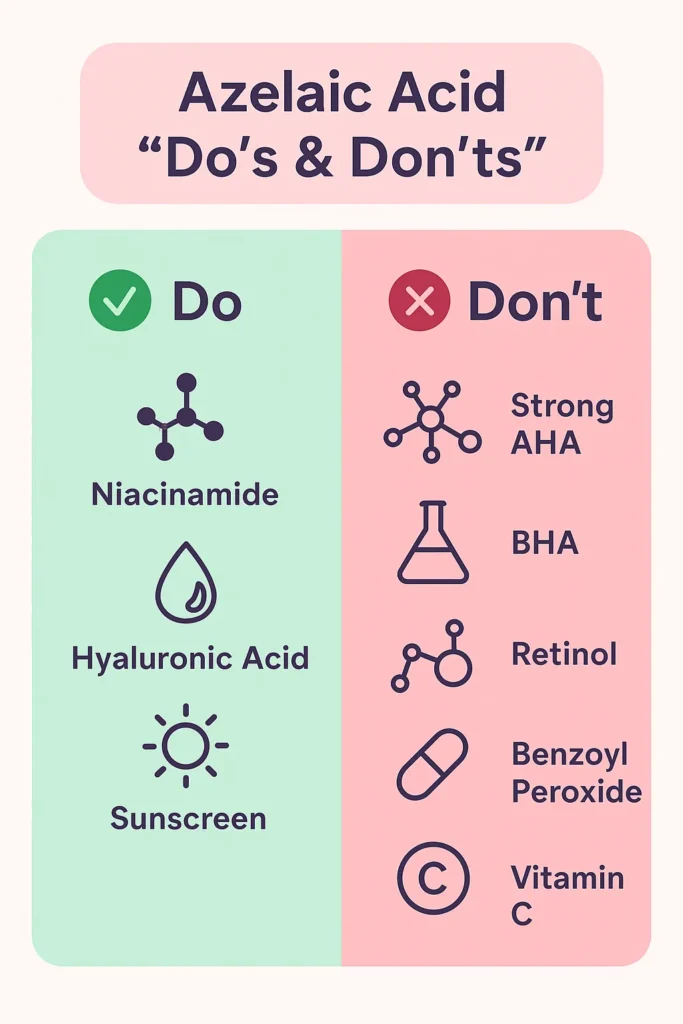
While azelaic acid is gentle for many skin types, combining it with strong exfoliating or active ingredients—like AHAs (glycolic acid, lactic acid), BHAs (salicylic acid), retinoids, Vitamin C, or harsh physical scrubs—can cause redness, dryness, and sensitivity.
Even alcohol-based cleansers, astringents, and other overly drying products can worsen irritation.
The good news? You don’t have to avoid these ingredients completely—you can still use them safely by adjusting timing, alternating days, or layering properly in your routine.
In this article, we’ll break down exactly azelaic acid what not to mix in your skincare routine.
You’ll discover which ingredients to avoid using at the same time, how to combine others safely, and practical tips to prevent irritation while getting the most out of azelaic acid.
By the end, you’ll have a clear, step-by-step guide to confidently use your favorite actives without compromising your skin’s health.
Quick Table: Azelaic Acid What Not to Mix
Azelaic acid offers plenty of benefits—especially for oily and acne-prone skin—but not every ingredient plays well with it.
To save you time, I’ve put together a quick reference table highlighting the key products you should be cautious about when combining with azelaic acid.
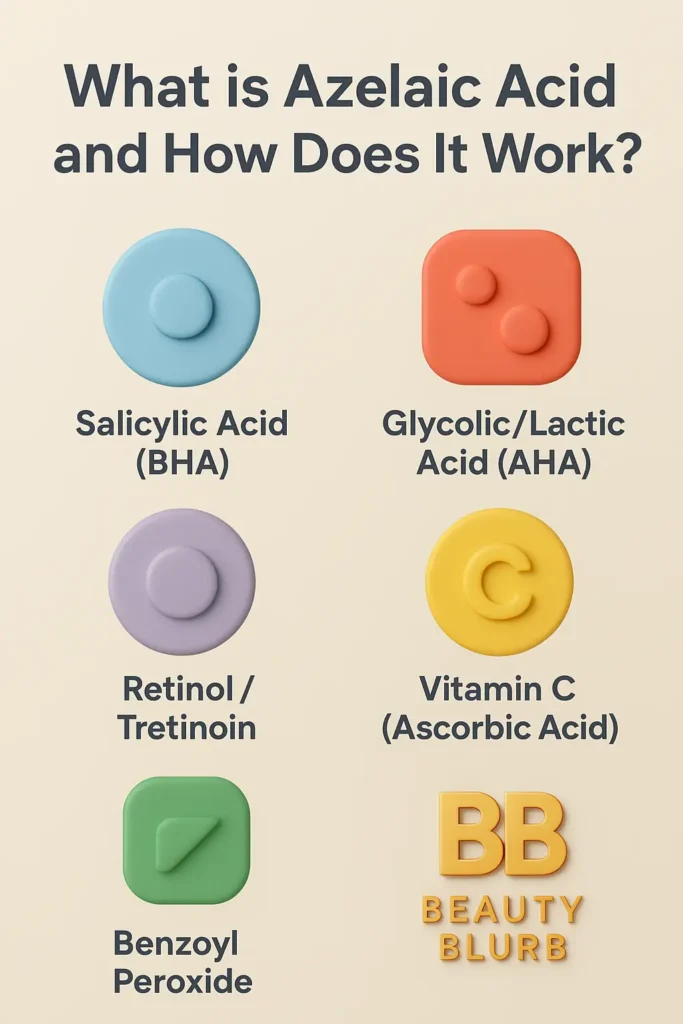
| Ingredient to Avoid | Why to Avoid | Safe Way to Use |
|---|---|---|
| Salicylic Acid (BHA) | Double exfoliation → dryness, irritation | Alternate days or use in AM while azelaic acid in PM |
| Glycolic/Lactic Acid (AHA) | Over-exfoliation and sensitivity | Space out by 12–24 hrs, or alternate nights |
| Retinol / Tretinoin | Strong combo can cause redness, peeling | Use on different nights (e.g., retinol Mon/Wed, azelaic Tue/Thu) |
| Vitamin C (Ascorbic Acid) | pH conflict, reduces effectiveness, irritation | Vitamin C in AM, azelaic acid in PM |
| Physical Scrubs / Harsh Exfoliants | Damage barrier + extra irritation | Replace with gentle cleanser, avoid same day |
| Alcohol-based Cleansers / Toners | Strips skin, worsens dryness & sensitivity | Use mild, hydrating cleansers/toners instead |
| Strong Peptides (e.g., copper peptides) | Limited research, possible interactions | Use separately or ask a dermatologist |
This quick table gives you a snapshot of the main skincare ingredients that don’t pair well with azelaic acid and safer ways to use them.
In the next section, we’ll dive deeper into each one—explaining why the combination can be risky, how to adjust your routine, and what alternatives actually work better.
What is Azelaic Acid and How Does It Work?
Azelaic acid is a naturally occurring dicarboxylic acid that dermatologists often recommend for its wide range of skincare benefits.
Unlike stronger exfoliants such as glycolic acid or salicylic acid, it is considered both gentle and effective, which makes it suitable for sensitive, acne-prone, and oily skin types.
When applied topically, azelaic acid works in multiple ways: it reduces acne-causing bacteria, unclogs pores, calms inflammation, and helps fade dark spots and hyperpigmentation over time.
This combination of properties makes it one of the most versatile skincare ingredients available today.
For those dealing with excess shine, clogged pores, or breakouts, Azelaic Acid for Oily Skin can be a game-changer.
It helps regulate sebum production, reduce congestion, and balance the skin without over-drying.
Many people find it a safer and more sustainable option compared to harsher actives like benzoyl peroxide or high-strength retinoids.
Whether your main concern is acne, redness, or uneven tone, azelaic acid can work behind the scenes to improve skin texture and support a healthier, clearer complexion.
What Not to Use with Azelaic Acid
Even though azelaic acid is one of the gentler actives out there, it doesn’t play well with every ingredient. Mixing it with the wrong products can leave your skin irritated, overly dry, or less responsive to treatment.
To help you avoid those mistakes, let’s break down the key ingredients you should be cautious about when pairing them with azelaic acid—and how to use them more safely in your routine.
1: Azelaic Acid and Vitamin C
You might be wondering: “Can I use azelaic acid and vitamin C together? yes — in many cases, using azelaic acid and vitamin C together can be safe and beneficial.
especially for targeting dark spots, pigmentation and improving overall skin tone. But it depends on the formulation, concentration, timing, and how sensitive your skin is.
Misusing them together (e.g. both at once in high strength) may cause irritation or reduce effectiveness.
How to Use Azelaic Acid and Vitamin C Safely
| Scenario | Safe Approach |
|---|---|
| Oily, acne-prone skin needing antioxidants | Use Vitamin C in the morning with sunscreen, and Azelaic acid at night. |
| Sensitive skin or strong formulations | Space them out: one in AM, the other in PM, or use on alternate nights. Always patch test first. |
| High-strength Vitamin C (low pH) | Choose buffered Vitamin C, or wait ~30 minutes before applying Azelaic acid. |
clinical Study From Pubmed:
- A clinical trial published in Journal of Cosmetic Dermatology (Markiewicz-Tomczyk et al., 2022) studied 20 women with Fitzpatrick skin types II & III.
- They received weekly treatments over 8 weeks: a 20% azelaic acid formulation + phytic acid across the full face, followed by 40% L-ascorbic acid on only one side.
- Skin parameters were measured at baseline, after 8 treatments (8 weeks), and one month later (week 12).
- Results showed significant improvements in hyperpigmentation and erythema (redness) on forehead & cheeks, better skin hydration, firmness, elasticity.
- more even tone—and all participants reported being satisfied with the results. Importantly, adverse effects were minimal. PubMed
At the end of the day, both azelaic acid and vitamin C can be powerful allies for brighter, clearer skin—if you use them wisely. Our advice is simple:
try separating them by time of day or alternating nights to enjoy the best of both worlds without the irritation.
Based on our humble experience, this approach often delivers visible results while keeping your skin barrier happy.
If you’ve ever tried combining azelaic acid with vitamin C, we’d love to hear how it worked for you—share your experience in the comments below and let’s learn from each other!
2: Salicylic Acid and Azelaic Acid
I found that many women ask: “Can you use azelaic acid with salicylic acid?” The honest answer: Yes, you often can—but it matters how and when.
Used smartly, they can work together to clear pores, reduce breakouts, and refine skin texture; but used wrongly (same time, high strength, sensitive skin), they may cause irritation or peeling.
Confirmed clinical evidence
Study: A randomized clinical trial published in the Journal of Clinical Medicine (MDPI) by Anna Deda et al. (2025) evaluated a multi-component chemical peel containing Azelaic Acid and Salicylic Acid (as part of a “Yellow Peel” complex) for the treatment of moderate acne and post-acne scarring.
Protocol: The study involved patients receiving professional peeling sessions spaced four weeks apart, focusing on the synergistic effects of combining beta-hydroxy acids (Salicylic) with dicarboxylic acids (Azelaic).
Findings: The researchers found a significant reduction (85%) in inflammatory lesions and a 20% improvement in acne scar depth.
Comparison & Tolerability: Similar to the Hay et al. study, this combination demonstrated high tolerability with minimal discomfort, specifically noting a decrease in skin sebum levels and improved hydration without the harsh recovery time associated with deeper monotherapy peels (Source).
Conclusion: The trial concluded that the combination of Azelaic and Salicylic acid is highly effective for inflammatory acne, providing comparable results to aggressive treatments but with a superior safety profile and better patient compliance.
How To Use Salicylic Acid and Azelaic Acid
| Scenario | Safe Approach |
|---|---|
| If you have oily or acne-prone skin and want stronger exfoliation | Use salicylic acid in the morning (as leave-on serum or toner), and azelaic acid at night. This avoids over-exfoliation. |
| If both products are potent or skin is sensitive | Alternate nights: one night salicylic acid, the next night azelaic acid; or use lower concentrations. Patch test on a small area first. |
| If using stronger SA formulations (e.g., peel or high % SA) | Don’t layer them in the same time slot—allow at least several hours gap or use SA on non-face days; apply azelaic acid when skin is calm. |

When done with care, combining salicylic acid with azelaic acid can give you the best of both worlds:
deep pore clearance plus soothing, evening benefits—all without harsh peeling or irritation (if applied properly!).
In the next section, we’ll explore another active that many mix with azelaic acid but may need even more caution: strong AHAs and how to use them safely.
3: Glycolic Acid and Azelaic Acid
Many women ask: “Can I use azelaic acid with glycolic acid?” The short answer: Yes—but only if you manage strength, timing, and your skin’s tolerance properly.
Used together correctly, they can enhance each other’s pigmentation-fading and texture-refining benefits.
Used incorrectly (high % of both, same routine, sensitive skin), you may deal with irritation, flaking, or even setbacks in barrier function.
Proven Clinical Study
- A randomized controlled trial by Surabhi Dayal et al., 2017 evaluated the combination of serial glycolic acid peels and 20% azelaic acid cream vs. azelaic acid alone in 60 patients with epidermal melasma over 24 weeks.
- Patients in the combo group received a GA peel every three weeks while applying 20% azelaic acid cream twice daily.
- The results showed that starting around week 12, the combo group had significantly greater MASI (Melasma Area Severity Index) improvements compared to azelaic acid only.
- Also, patients reported better quality of life (via MELASQOL) without serious side effects. Source.
How To Use Glycolic Acid and Azelaic Acid together
| Scenario | Safe Approach |
|---|---|
| Oily or acne-prone skin aiming for smoother texture | Try a gentle glycolic acid peel (5–15%) every 2–3 weeks, and apply azelaic acid 20% at night on non-peel days. |
| Sensitive skin or stronger GA formulations | Alternate nights: one night glycolic acid, the next night azelaic acid. Always add a hydrating moisturizer and SPF in the morning. |
| Irritation, redness, or peeling appears | Reduce GA strength or frequency. Pause GA if needed and keep azelaic acid only until skin calms down. |
So yes, you can pair glycolic acid and azelaic acid—they can be like that power couple in skincare:
offering serious glow and smoother texture—just don’t try to make them do every heavy lifting at once or you might end up with “dramatic redness” as an unwanted sidekick.
If you try this combo, tell us: did your skin glow, or did it throw a mini tantrum first? Either story helps others learn. 😄
4: Azelaic Acid and Retinol / Tretinoin
Many people ask: Can I use azelaic acid with retinol (or tretinoin)? Yes, you can — but only if you introduce them carefully and respect your skin’s limits.
used properly, this combo can help with acne, evening out skin tone, fading post-inflammatory hyperpigmentation, and improving texture.
But if both are used aggressively at the same time, or your skin is sensitive, you may experience peeling, irritation, or even barrier breakdown.
Scientific study
A recent original study from Katkhanova O.A. et al. (2024) evaluated 50 patients aged 12–50 with mild to moderate acne.
They compared monotherapy with adapalene 0.1% cream (a retinoid), versus combined therapy of 0.1% adapalene cream + 20% azelaic acid cream (products: Adaclean in the evening and Azix-Derm in the morning).
Over six months, the combination group achieved “clinical remission” in about 70% of cases. with significant improvement in inflammatory lesions, reduction in redness, and improved skin evenness.
The two-ingredient combo was tolerated well with manageable side effects. Source.
How to Use Azelaic Acid and Retinol Together Safely
| Scenario | Safe Approach |
|---|---|
| If you’re using over-the-counter retinol or adapalene and want to fade acne / dark spots | Use retinol (or adapalene) 2-3 times per week at night; on non-retinol nights, use azelaic acid 15-20%. Always finish with a rich moisturizer and apply SPF in the morning. |
| If your skin is sensitive or new to retinoids/azelaic acid | Start with lower concentrations (e.g., 0.025-0.05% retinol + 10-15% azelaic acid). Patch test behind your jawline. Increase frequency gradually (every other night → nightly). |
| If signs of over-exfoliation occur (stinging, peeling, tightness) | Reduce retinol nights, pause for a few days, stick with azelaic acid alone until skin recovers. Use barrier-repair creams, hyaluronic acid serums, avoid harsh physical exfoliants. |
Think of azelaic acid and retinol like two superheroes teaming up — one calms and balances, the other turns over old skin and brings glow-power.
But even superheroes need a plan, not “both attacking at once” chaos. If you try this duo, ease in slowly, listen to your skin, and don’t expect perfection overnight.
And hey — if your retinol ever feels jealous of the azelaic acid, just alternate nights & give each its turn in the spotlight. 😄
5: Azelaic Acid and Benzoyl Peroxide
Can I use azelaic acid with benzoyl peroxide? The short answer: Yes — but with caution. These two can be effective together, especially for active acne.
but using both too aggressively or at high concentrations in the same routine can lead to irritation, dryness, or even compromise your skin barrier.
Shaky Rumors & What We’ve Found
There are a couple of rumors floating around:
- Rumor 1: “BP + Azelaic acid neutralize each other, so using both is pointless.” → False when used correctly.
- Rumor 2: “BP will bleach everything and severely dry your skin if used with AzA.” → Partially true only if overused or left on too long; most studies show it’s tolerable with proper usage.
What did science say?
- One strong clinical trial from PubMed.
showed that using 15% azelaic acid gel compared against 5% benzoyl peroxide gel in 351 patients over 4 months, twice daily.
resulted in ~70% median reduction in inflamed lesions, similar to BPO, but with less burning and irritation. Source - Another study (Schaller et al., 2016) .
compared benzoyl peroxide 3% / clindamycin 1% vs azelaic acid 20% cream.
for mild-to-moderate acne (age 12-45). Azelaic acid did well but had more local reactions; BP combo was effective faster. Source.
These show that while Azelaic Acid can be slightly gentler, BP is powerful — combining requires strategy.
How to Use Azelaic Acid and Benzoyl Peroxide Together
| Scenario | Safe Approach |
|---|---|
| If acne is active, you want fast action, and skin tolerates BP | Use benzoyl peroxide (2.5-5%) as a spot treatment or wash in the morning, then azelaic acid (15-20%) at night. Use moisturizer and always SPF in the morning. |
| If skin is sensitive or new to actives | Start with low strength BP or leave it on for shorter time; alternate nights between BP and AzA. Patch test on small area before full face. |
| If over-drying or peeling starts | Reduce BP frequency or concentration; skip BP for a few consecutive nights; keep Azelaic Acid and a barrier-repair moisturizer. Avoid using both strong acids/actives same night. |
If you play the combo of azelaic acid and benzoyl peroxide smartly, you can get stronger acne control and smoother skin without the wildfire of irritation.
Just remember: start low, go slow, listen to your skin. Too much too quickly = red regrets. Try it gently, observe results over weeks, adjust as needed.
Too much too quickly = red regrets. Try it gently, observe results over weeks, adjust as needed. Your skin will thank you ‒ and you’ll avoid that nasty peeling phase (because nobody wants to look like they exfoliated their face with sandpaper 😅).
So, what should you not mix azelaic acid with? In reality, it’s less about banning ingredients and more about balance.
avoid layering it with too many strong actives like high-strength AHAs, BHAs, retinol, benzoyl peroxide, or pure vitamin C at the same time, since that can lead to irritation and barrier damage.
Instead, think strategy: alternate them between morning and night, or use on different days, so you still get the brightening, acne-fighting, and calming benefits of each without overwhelming your skin.
What to Use with Azelaic Acid
After learning about what not to use with azelaic acid, you’re probably wondering: What can you pair azelaic acid with?
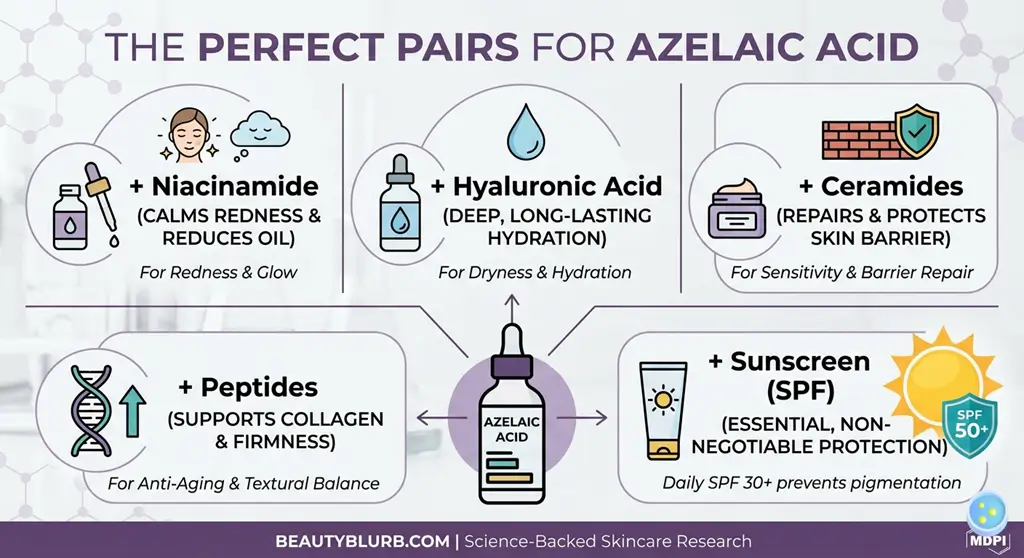
You can safely pair Azelaic Acid with hydrating and barrier-repairing ingredients like Niacinamide, Hyaluronic Acid, and Ceramides to boost results without irritation.
While Azelaic Acid is a powerhouse on its own, combining it with these skincare heroes helps soothe redness, lock in moisture, and strengthen your skin barrier. Below, we break down the best scientific combinations to elevate your routine safely.”
Below are the best combinations explained simply.
Can I mix azelaic acid with niacinamide?
Absolutely. Azelaic acid and niacinamide are a power duo for calming inflammation, reducing redness, and fading hyperpigmentation.
Both are gentle and suitable for oily, acne-prone skin. Pairing them strengthens the skin barrier while targeting uneven tone, making this one of the safest and most effective combos.
Can I mix azelaic acid with hyaluronic acid?
Yes, and it’s highly recommended. Hyaluronic acid with azelaic acid ensures your skin stays hydrated while AzA tackles acne and pigmentation.
Since dryness can sometimes occur with active ingredients, HA balances things out and leaves skin plump and comfortable.
Can I mix azelaic acid with ceramides?
Definitely. Ceramides and azelaic acid are a dream team for repairing and protecting the skin barrier. If you have sensitive or easily irritated skin, layering ceramides after azelaic acid will minimize dryness and improve long-term tolerance.
Can I mix azelaic acid with peptides?
Yes. Peptides and azelaic acid complement each other beautifully: azelaic acid evens skin tone and reduces breakouts, while peptides support collagen production and skin firmness.
Together, they create an anti-aging and acne-friendly skincare routine.
Can I mix azelaic acid with sunscreen?
Not only can you — you must. Sunscreen with azelaic acid is non-negotiable, since AzA can increase sun sensitivity.
Using a broad-spectrum SPF daily not only prevents further hyperpigmentation but also allows azelaic acid to work more effectively.
How to Combine Azelaic Acid with Other Ingredients Safely
When it comes to active skincare, combining products the right way can make all the difference. If you’re using azelaic acid for oily skin, knowing the correct concentrations ensures results without irritation.
Below we’ve outlined the Best Ingredients for Oily Skin that pair well with AzA and how to use them effectively.
| Azelaic Acid % | Other Active & % | How to Use Safely |
|---|---|---|
| 10–15% | Salicylic Acid 1–2% | Alternate nights; or use SA cleanser in AM, AzA cream in PM. |
| 15–20% | Glycolic Acid 5–7% | Use glycolic acid max 2–3x/week at night; apply AzA on alternate days. |
| 10–15% | Retinol 0.25–0.5% | Start slowly: Retinol 2x/week at night, AzA on other nights. |
| 15% | Tretinoin 0.025% | Never layer same night if skin is sensitive; alternate nights recommended. |
| 15–20% | Benzoyl Peroxide 2.5–5% | BP in the morning (spot or wash), AzA at night; moisturize heavily. |
How to Place Azelaic Acid in Your Routine
The safest method is the “alternate-night” approach: don’t overload your skin with multiple strong actives at once.
If you want to use both azelaic acid and another active, alternate their usage across the week, or separate them into AM/PM routines. Always finish with moisturizer and SPF in the morning.
Here’s a practical way to apply the table above into your daily life without overwhelming your skin:
Morning (AM):
- Gentle cleanser (optional: salicylic acid cleanser 1–2%).
- Hydrating toner or essence.
- Azelaic acid (10–15%) OR benzoyl peroxide (if you’re targeting active acne).
- Lightweight moisturizer with ceramides or peptides.
- Broad-spectrum sunscreen SPF 30+.
Evening (PM):
- On nights with exfoliants (glycolic acid or salicylic acid leave-on):
- Cleanser.
- Exfoliant (glycolic acid 5–7% or salicylic acid 2%).
- Hydrating serum (hyaluronic acid or niacinamide).
- Moisturizer.
- On alternate nights with retinol/tretinoin:
- Cleanser.
- Retinol (0.25–0.5%) or tretinoin (0.025%).
- Moisturizer (always buffer with ceramides to reduce dryness).
- On azelaic acid nights:
- Cleanser.
- Azelaic acid (15–20%).
- Moisturizer.
Pro Tip (From Our Experience)
Skincare isn’t a sprint — it’s a marathon. Even if you’re tempted to throw every powerhouse ingredient into your routine, building tolerance slowly will get you clearer, healthier skin with fewer setbacks.
Note: For a step-by-step daily plan, check our full guide: Dermatologist Recommended Skin Care Routine for Oily Skin.
FAQ Of What does azelaic acid conflict with?
Azelaic acid in low to moderate strengths (10–15%) is usually well tolerated and can be used daily once your skin builds tolerance. Start with every other night or a few times per week and increase to nightly if no irritation appears. Always pair daily use with a gentle moisturizer and morning sunscreen.
Topical azelaic acid is often recommended as a pregnancy-safe option for acne and pigmentation because it has low systemic absorption. However, always confirm with your obstetrician or dermatologist before starting any active during pregnancy or breastfeeding.
Azelaic acid can make your skin more prone to sun sensitivity and it’s used to treat pigmentation — so a broad-spectrum SPF 30+ is non-negotiable every morning. Apply sunscreen as the final step in your AM routine and reapply during prolonged sun exposure.
Improvements in redness and breakouts can appear within a few weeks, but meaningful reduction in hyperpigmentation or texture often takes 8–12 weeks (or longer). Consistency, sunscreen, and patience are key for lasting results.
Azelaic acid is prized for being milder than many exfoliants, making it a good option for sensitive or rosacea-prone skin. Start with a lower % (10%), patch test behind the ear or jawline, and introduce it slowly. If irritation occurs, reduce frequency or consult a dermatologist.
If you use The Ordinary’s azelaic acid (typically 10% suspension), the same rules apply: avoid combining it simultaneously with high-strength acids (strong AHAs/BHAs), concentrated vitamin C serums, or potent retinoids in the same application. The Ordinary products are affordable and effective, but always check product form and patch test. Use timing/alternating strategies instead.
Ferulic acid is typically used to stabilize and boost antioxidant serums (often with vitamin C). Pairing azelaic acid with ferulic acid is usually safe: use antioxidants in the morning, azelaic acid at night, or space them out. If your ferulic product contains strong vitamin C (low pH), consider AM vitamin C/ferulic and PM azelaic acid to avoid pH conflicts and irritation.
Niacinamide pairs well with azelaic acid: together they reduce inflammation, strengthen the barrier, and improve pigmentation. Apply niacinamide before azelaic acid if using multiple serums, or use a combined product containing both ingredients for convenience.
Layer lightweight serums (like hyaluronic acid, niacinamide) first, then apply azelaic acid as a treatment step, and finish with a moisturizer. Avoid applying multiple potent actives (high % acids, retinoids) at the same time — instead, alternate nights or use AM/PM separation to reduce irritation.
Thank you so much for spending your time with us and diving deep into this guide 💜. We hope it gave you clarity on What Not to Use With azelaic acid and how to pair it wisely in your skincare routine.
If you found this article helpful, don’t forget to subscribe so you never miss our dermatologist-backed tips and ingredient breakdowns.
We’d also love to hear from you: share your personal journey with azelaic acid in the comments below — what worked, what didn’t, and how your skin responded.
Your experience could inspire and guide another reader who’s just starting her skincare journey ✨. And remember: skincare is not about perfection, but about consistency, patience, and learning what your skin loves most.

Akram Boulaid is a dedicated Skincare Researcher and Analyst with over 7 years of intensive focus on dermatology and cosmetic ingredient science. As a globally recognized expert, his insights have been featured in major international publications, including the New York Post and GB News. A verified expert on Qwoted, Akram connects with health journalists to provide evidence-based analysis. He founded Beauty Blurb to bridge the gap between complex clinical data and practical skincare routines, specializing exclusively in the needs of oily and acne-prone skin through rigorous analysis of peer-reviewed scientific literature.