
If you’re wondering which acid is best for oily skin, the clear winner is Salicylic Acid — but not for the reason most people think.
Unlike other exfoliating acids, salicylic acid is oil-soluble, meaning it can slip through your skin’s natural oils to deeply cleanse clogged pores from within.
It doesn’t just remove excess sebum; it also prevents future buildup, calms inflammation, and keeps your skin barrier balanced rather than stripped.
Dermatologists also note that when used consistently in the right concentration, salicylic acid helps refine texture, control shine, and reduce breakouts & blackheads.
making it the most effective and reliable acid for oily, acne-prone, or combination skin types.

In this guide, you’ll discover everything you need to know to choose the best acid for oily skin.
from understanding how each acid works, to knowing which one suits your specific needs and how to use it safely.
We’ll break down dermatologist-approved options like glycolic, lactic, mandelic, and azelaic acids, compare their strengths and side effects.
By The end we will show you exactly how to build a balanced routine that delivers clear, shine-free, healthy skin.
To make things simple, here’s a quick dermatologist-backed comparison of the most effective acids for oily skin.
Each acid targets oil control in a different way — some focus on deep pore cleansing, others on gentle exfoliation or reducing inflammation.
The table below summarizes which acid works best for specific oily-skin concerns, their ideal strengths, and how to use them safely.
Use it as your quick reference before diving deeper into how each one actually transforms your skin.
| Acid | Best For | How It Works | Ideal Strength | Key Benefits | Precautions / When to Avoid |
|---|---|---|---|---|---|
| Salicylic Acid (BHA) | Oily, acne-prone, congested skin | Oil-soluble; penetrates deep into pores to dissolve sebum and dead cells | 0.5–2% | Clears blackheads, controls shine, reduces breakouts | Avoid overuse; start 2–3× weekly; always moisturize |
| Glycolic Acid (AHA) | Oily + dull or uneven skin tone | Water-soluble; gently exfoliates surface to brighten skin | 5–10% | Improves texture, fades spots, boosts radiance | Use SPF; may sting if skin is sensitive |
| Lactic Acid (AHA) | Oily + sensitive or dehydrated skin | Larger molecule; exfoliates gently while improving hydration | 5–10% | Smooths texture, hydrates, supports barrier | Patch test first; avoid mixing with retinol |
| Mandelic Acid (AHA) | Oily + acne + dark spots (PIH) | Antibacterial and pigmentation-fading properties | 5–10% | Reduces post-acne marks, balances oil | Slight tingling is normal; don’t combine with strong acids |
| Azelaic Acid (Dicarboxylic) | Oily + inflamed + rosacea-prone skin | Antimicrobial and anti-inflammatory; regulates keratin production | 10–20% | Calms redness, prevents clogged pores, evens tone | Introduce gradually; mild dryness may occur |
Understanding Acids for Oily Skin
When it comes to caring for oily skin, acids are not harsh chemicals — they’re actually the smart, science-backed ingredients that help restore balance and clarity.
In skincare, acids are used as chemical exfoliants to remove dead skin cells, unclog pores, and regulate excess sebum production without damaging the skin barrier.
Unlike traditional scrubs that can scratch or irritate oily skin, chemical exfoliation works on a microscopic level, gently dissolving the bonds that hold dull, rough skin together.
This process reveals smoother, brighter, and clearer skin over time.
Most people confuse chemical exfoliation with physical exfoliation, but they’re very different.
Physical exfoliation uses grains or brushes to manually scrub away buildup — effective at first, but often too abrasive for oily or acne-prone skin.
On the other hand, chemical exfoliation for oily skin relies on acids like salicylic, glycolic, and lactic acid to deeply cleanse pores, reduce oil production, and improve skin texture in a much safer and more controlled way.
It’s like letting chemistry do the gentle polishing instead of friction.
Another key element that often gets overlooked is the skin’s pH balance. Healthy skin naturally sits at a slightly acidic pH (around 4.5 to 5.5).
When this balance shifts — for example, through harsh cleansers or over-exfoliation — oily skin may react by producing even more sebum to compensate.
Using the right acids at the proper concentration helps maintain this optimal pH range, keeping your skin barrier strong, hydrated, and less prone to breakouts or irritation.
Types of Acids Commonly Used for Oily Skin
Acids used in skincare are not one-size-fits-all — especially when you have oily or acne-prone skin.
Some acids focus on clearing excess oil and clogged pores, others on smoothing texture or calming inflammation. Below is a clear breakdown of the main categories of acids — AHA, BHA, PHA, and other “helper” acids.
plus how they differ and why each may matter for your oily skin routine.
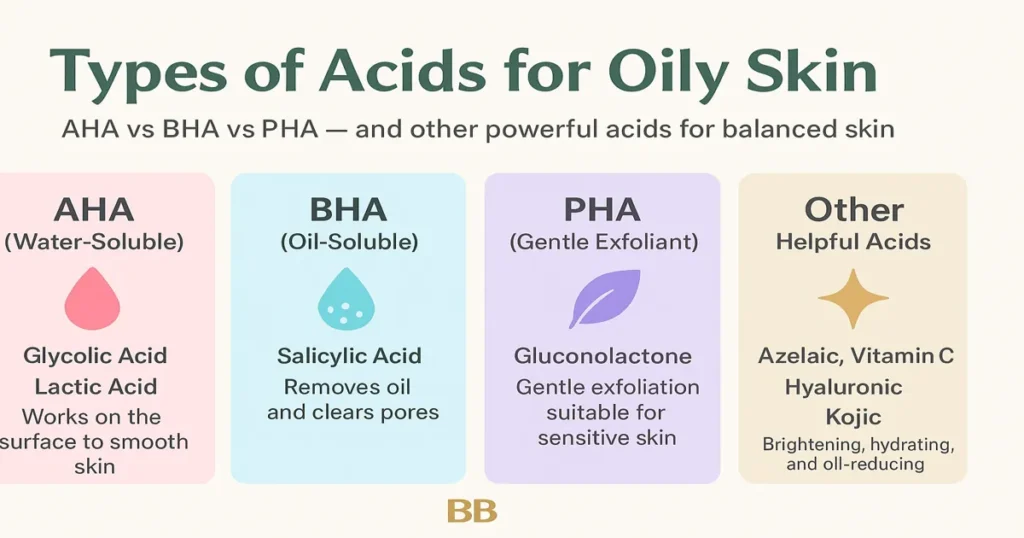
1. AHA Acids (Water-Soluble)
Alpha Hydroxy Acids, or AHAs, are water-soluble exfoliants derived from natural sources like sugar cane, milk, and fruits.
They work mainly on the surface layer of the skin, helping to dissolve dead skin cells, smooth roughness, and improve radiance.
For oily skin, AHAs are excellent for tackling dullness and uneven tone while keeping the pores clear and balanced. AHAs are perfect if your goal is to achieve a smoother, brighter complexion without aggressive scrubbing.
A: Glycolic Acid
Glycolic acid for oily skin, Known as one of the smallest-molecule AHAs, glycolic acid penetrates easily and dissolves the “glue” holding dead skin cells together.
This helps exfoliate dull, rough skin, refine pores, and improve overall clarity.
- Studies show that AHAs like glycolic support exfoliation and improved skin texture, which is particularly useful for oily skin with dullness or uneven tone. Source
B: Lactic Acid
Lactic acid for oily skin, A gentler AHA, ideal for oily skin that’s also sensitive or easily irritated. Lactic acid not only exfoliates but offers mild hydration benefits and helps support the skin barrier.
- In one double-blind study with 8% lactic acid, roughness and hyper-pigmented areas improved significantly. Source
2. BHA Acids (Oil-Soluble)
Beta Hydroxy Acids, or BHAs, are oil-soluble acids that can penetrate deep into pores — making them ideal for oily and acne-prone skin types.
Unlike AHAs, which work on the surface, BHAs target the inside of pores to dissolve excess sebum, clear congestion, and prevent blackheads.
They also have natural anti-inflammatory and antibacterial properties, which help calm breakouts and redness. BHAs are a must-have if you struggle with oily shine or persistent acne.
A: Salicylic Acid
salicylic acid for oily skin is The gold standard for oily and acne-prone skin.
Because it’s oil-soluble, it can travel deep into the pores to dissolve excess sebum and dead skin cells, effectively preventing breakouts and blackheads.
- One review published on PMC discussed salicylic acid’s use in acne and oily skin, noting its dual exfoliating and sebostatic (oil controlling) effects. Source
3. PHA Acids (Gentle Exfoliants)
Polyhydroxy Acids (PHAs) are the newer generation of exfoliants. They have larger molecular sizes compared to AHAs and BHAs, which means they work more gently and irritate less.
This makes them ideal for oily skin that is also sensitive, reactive, or post-treatment. PHAs help refine pores, reduce buildup, and support the skin barrier without harshness.
A: Gluconolactone
A PHA (polyhydroxy acid) which has larger molecules than AHAs or BHAs, meaning it exfoliates more gently, making it very appropriate for oily skin that is also sensitive, post-treatment, or prone to redness
- bibliographic review indicates that PHAs help remove dead skin cells and unclog pores with less irritation.
4: Other Helpful Acids
A: Azelaic Acid
Azelaic Acid for oily skin is A dicarboxylic acid known for reducing inflammation, redness, and oil production.
A study published in PubMed (2021) showed that 20% azelaic acid helped reduce sebum secretion and acne lesions over eight weeks. It’s perfect for those who experience both oiliness and redness. Source
Best for: oily, acne-prone, or rosacea-prone skin.
B: Vitamin C (Ascorbic Acid)
Though not an exfoliating acid, it’s an antioxidant powerhouse. It helps brighten dull oily skin, reduce acne marks, and even skin tone.
Dermatologists often recommend pairing Vitamin C with AHAs or BHAs in alternating routines for best results. its Best for oily skin with dark spots or dullness.
C: Hyaluronic Acid
is hyaluronic acid good for oily skin? quick answer is yes Sure ,This hydrating acid balances moisture levels and prevents dehydration-triggered oiliness.
Contrary to popular belief, oily skin still needs hydration — and hyaluronic acid helps maintain that balance. its Best for: oily but dehydrated skin.
D: Kojic Acid
Kojic acid is A natural acid derived from fungi, kojic acid is known for its pigment-fading and tone-evening properties. It’s an excellent choice for oily skin dealing with post-acne hyperpigmentation.
This acid is Best for: oily skin with acne scars or pigmentation.
- According to a 2023 comparative study in Clinical, Cosmetic and Investigational Dermatology, kojic acid (1%) reduced dark spots by up to 50% in 8 weeks. Source
Each acid plays a unique role in managing oily skin — AHAs resurface, BHAs purify, PHAs soothe, and others like azelaic or kojic acid correct uneven tone.
Instead of focusing on one ingredient, think of them as tools that work together to balance oil, clear pores, and enhance your skin’s natural glow.
Which Acid Is Best for Oily Skin?
I know you’re probably feeling a little confused right now — with so many acids out there, it’s hard to know which one your oily skin actually needs. You might even be wondering: “Is AHA or BHA better for oily skin?”
Here’s the simple truth 👇
If your skin tends to get shiny, congested, and prone to breakouts, BHAs (like salicylic acid) are usually your best friend.
Because BHAs are oil-soluble, they go deep inside the pores, dissolve excess sebum, and clear out buildup that causes acne and blackheads.
On the other hand, AHAs (like glycolic or lactic acid) are great surface exfoliators — they help smooth texture, brighten tone, and reduce dullness caused by dead skin buildup.
So, the best approach isn’t “AHA or BHA,” but rather knowing when and how to use each:
- BHA for daily oil and acne control,
- AHA once or twice a week to keep your skin clear and glowing.
1: which acid is best for oily acne prone skin?
If your main concern is pimples, blackheads, or breakouts, the clear winner is Salicylic Acid — a BHA that’s specifically designed for acne-prone oily skin.
Because it’s oil-soluble, salicylic acid penetrates pores deeply, breaks down sebum, and helps reduce inflammation from existing pimples
✨ Pro tip: Pairing salicylic acid with niacinamide can further control sebum and improve skin texture.
2: Which Acid Is Best for Oily Skin and Open Pores?
Enlarged pores are one of the biggest concerns with oily skin. To minimize their appearance, Glycolic Acid is your best choice.
As an AHA, it removes the surface layer of dead cells that make pores look more visible and helps stimulate collagen for tighter-looking skin.
3: Which Acid Is Best for Oily Skin and Dark Spots?
When your oily skin also struggles with post-acne marks or uneven tone, go for Azelaic Acid or Kojic Acid.
- Azelaic Acid works by reducing melanin production and calming inflammation — perfect for oily, acne-prone skin that scars easily.
- Kojic Acid, derived from fermented rice or mushrooms, brightens hyperpigmentation and gives oily skin a more even glow without heavy residue. It’s also safe to combine with niacinamide or lactic acid.
Think of acids as your skin’s reset button: they work wonders when used with the right concentration, frequency, and layering technique.
Up next, we’ll walk you through how to build a safe exfoliation routine — one that clears pores, evens out your tone, and keeps your skin barrier healthy and strong.
How to Use Acid for oily skin Safely
Using acids on oily skin can transform your complexion — but only if you use them the right way.
Overdoing it, mixing too many actives, or skipping sunscreen can do more harm than good. Here’s how to build a safe, dermatologist-approved exfoliation routine that keeps your oily skin clear, balanced, and glowing — without irritation.

1. Before You Begin: Prepare Your Skin
✅ Patch Test First
Always test a new acid on a small area (like behind your ear or jawline). Wait 24 hours to make sure your skin doesn’t sting or turn red.
Dermatologists emphasize that patch testing reduces the risk of acid sensitivity and allergic reactions.
✅ Choose the Right Acid for Your Skin Type
Start with gentle options:
- Salicylic acid (BHA) – for clogged pores and acne.
- Azelaic acid – for oil control and brightening.
- Glycolic or mandelic acid (AHA) – for texture and dullness.
Begin with low concentrations (1–2% for BHA, 5–8% for AHA) and simple formulas with no harsh alcohols or fragrances.
✅ Start Slow and Build Tolerance
Use your acid once a week at night for the first 2–3 weeks.
If your skin adjusts well, gradually increase to 2–3 times weekly — never daily at first.
This “slow introduction” method helps your skin strengthen its barrier while reaping the benefits.
2. During Application: Apply Smartly
🌙 Apply at Night — or Morning with SPF
While acids are often recommended for your nighttime routine because they can make skin more sensitive to sunlight.
it’s perfectly fine to use certain mild acids (like azelaic acid, lactic acid, or PHAs) in the morning — as long as you apply a broad-spectrum sunscreen (SPF 30–50) right after.
The key is protection: sunscreen prevents UV damage and helps your skin maintain the bright, even tone your acids worked so hard to achieve.
💧 Apply on Dry Skin
After cleansing, make sure your skin is completely dry. Applying acids on damp skin can increase irritation, especially with AHAs or BHAs.
🧴 Follow with a Lightweight Moisturizer
Once the acid has fully absorbed (about 10 minutes), apply an oil-free, soothing moisturizer with ingredients like niacinamide, ceramides, or panthenol.
This locks in hydration and prevents over-drying, keeping your skin barrier healthy.
You don’t have to completely avoid acids, retinol, or vitamin C. But never apply them at the same time. Each active ingredient has a different pH level and potency, and layering them together can trigger redness, dryness, or sensitivity.
Instead, alternate their use. Apply your acid exfoliant at night. Use vitamin C in the morning, or retinol on a different night.
This way, you’ll enjoy the benefits of all three without irritation, dryness, or barrier damage.
3. After Application: Protect and Balance
☀️ Use Sunscreen Every Morning
Acids make your skin more sensitive to UV damage. Apply a broad-spectrum SPF 30–50 every morning, even on cloudy days.
🧘♀️ Listen to Your Skin
If you notice dryness, tightness, or stinging, pause acid use for a few days and focus on hydrating products.
🔄 Alternate If You’re Using Multiple Acids
If you’re combining AHA and BHA, use them on alternate nights — for example, BHA on Monday/Thursday and AHA on Saturday. This keeps exfoliation consistent but gentle.
| Step | Product Type | Example Ingredient | Frequency |
|---|---|---|---|
| 1 | Cleanser | Gentle foaming gel | Daily (AM/PM) |
| 2 | Exfoliant | Salicylic Acid (BHA) 2% | 2× weekly |
| 3 | Toner/Essence | Niacinamide | Daily (AM/PM) |
| 4 | Moisturizer | Lightweight gel-cream | Daily (AM/PM) |
| 5 | Sunscreen | SPF 50 broad-spectrum | Every morning |
Final Reminder
- The safest way to use acids on oily skin is to start simple, stay consistent, and protect your skin barrier.
- Acids don’t need to sting or peel to work — they just need patience, balance, and sun protection.
- When used wisely, they can turn oily, breakout-prone skin into clear, refined, and healthy-looking skin that feels amazing to touch.
💡 Pro Tip:
Now that you know how to use acids safely, it’s time to see how they fit into a full skincare plan.
Check out our dermatologist recommended skincare routine for oily skin — it’s a quick, practical guide that’ll make your daily routine as smooth as your new glow. ✨
Common Mistakes to Avoid When Using Acids for Oily Skin
Even the best acid for oily skin can cause more harm than good if used the wrong way. Here are the most common skincare mistakes — and how to fix them like a pro:
⚠️ 1. Overusing Acids Too Quickly
Many people think using acids daily will clear oily skin faster — but that’s a myth.
Over-exfoliating can strip your skin’s protective barrier, leading to redness, tightness, and even more oil production as your skin tries to compensate.
💡 Dermatologist Tip: Start with 1–2 times per week using low concentrations (like 2% salicylic acid or 5% glycolic acid).
Gradually increase frequency only when your skin shows no signs of irritation.
🌞 2. Ignoring Sun Protection
- Acids like AHAs, BHAs, and even azelaic acid increase your skin’s sensitivity to sunlight.
- Skipping sunscreen after exfoliating is one of the biggest mistakes people with oily skin make.
- Always finish your morning routine with a broad-spectrum SPF 30–50, even on cloudy days.
This step protects against hyperpigmentation and prevents premature aging — both common issues for those who use exfoliating acids regularly.
💧 3. Forgetting to Moisturize After Acids
Acids remove dead skin cells, but they can also temporarily deplete moisture.
Neglecting to apply a light, non-comedogenic moisturizer afterward can leave oily skin dehydrated, which ironically leads to more oil production.
Look for hydrating ingredients like hyaluronic acid, ceramides, and niacinamide — these help restore balance without clogging pores.
🧪 4. Mixing Too Many Actives at Once
Using multiple exfoliating acids (like combining AHA + BHA + PHA) or layering retinol on top of an acid is a fast track to irritation.
Instead, use one active per night.
You can alternate between exfoliating nights and recovery nights — use your acid toner for oily skin one day, and a soothing moisturizer or niacinamide serum the next.
🩹 5. Applying Acids on Broken or Irritated Skin
- Never apply acids on inflamed acne, open wounds, or after shaving.
- Your skin barrier needs to be intact to handle chemical exfoliants safely.
- If your skin feels sore or stings after application, take a 3–4-day break and focus on hydration and barrier repair.
🌸 6. Using Acid Toners Daily Without Caution
Daily use of acid toners can be effective — but only for well-conditioned skin. If you’re new to acids, overusing a glycolic or lactic acid toner can lead to micro-peeling or sensitivity.
Start with every other day use, preferably at night, and pair it with a calming moisturizer. Once your skin adjusts, you can build up frequency gradually.
✅ Quick Recap:
Using acids safely on oily skin means moderation, moisture, and sun protection.
Avoid the temptation to rush results — balance and patience are what make acids truly transform your skin.
Dermatologist-Approved Acid Combinations for Oily Skin
I know you’re wondering how to layer acids together when you have oily skin — should you stick with one, or is it okay to combine them? The good news is: you don’t have to pick just one acid forever.
When done thoughtfully, certain combinations can work synergistically to help control oil, clear pores, and calm inflammation — while staying safe and effective.
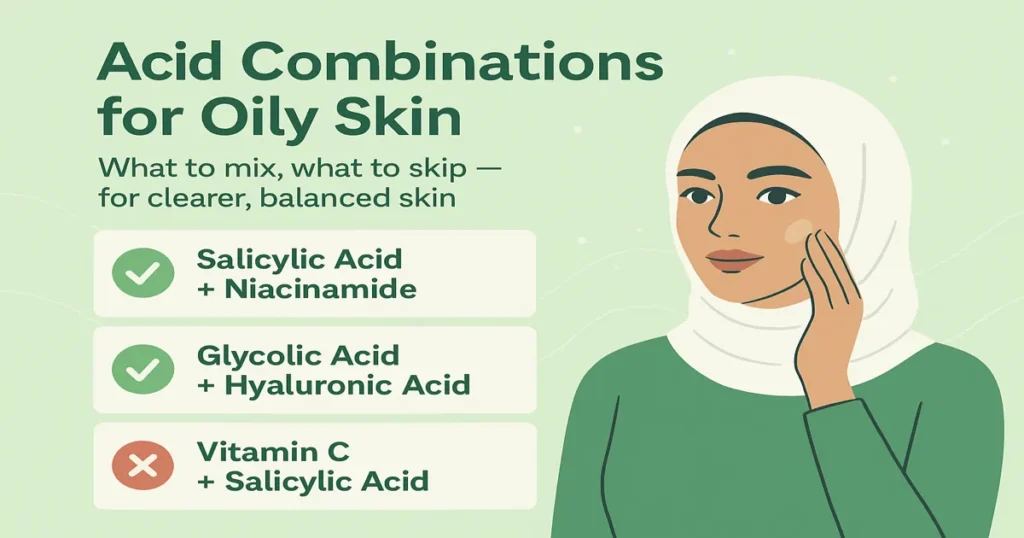
✅ Salicylic Acid and Niacinamide for oily skin
Why this combo works:
- Salicylic acid (a BHA) penetrates deep into oily pores to dissolve excess sebum and reduce blackheads.
- Niacinamide complements this by strengthening the skin barrier, reducing surface oil, and calming any inflammation.
clinical study:
- A study published via PMC found that a multi-acid complex and niacinamide serum, significantly reduced inflammatory lesions and improved pore appearance in oily, acne-prone skin over 8 weeks (Dr. Delphine Kerob et al.). PMC
How to layer: Cleanse → apply salicylic acid 2-3 ×/week → wait 5-10 min → apply niacinamide serum → moisturizer.
✅ Glycolic Acid + Hyaluronic Acid
Why this combo works:
- Glycolic acid (an AHA) exfoliates surface dead skin cells, helping reduce texture, brighten tone, and minimise the appearance of pores & oil-shed buildup.
- Hyaluronic acid brings hydration, which is key for oily skin that may strip and over-produce oil when dry.
layer them At night, cleanse → dry skin → apply glycolic acid (5-10 %) → wait 2 min → apply hyaluronic acid serum → lightweight gel moisturizer.
❌ Vitamin C and Salicylic Acid for oily skin (Use with caution)
Vitamin C (ascorbic acid) is an antioxidant acid → beneficial for brightening and dark spots, but it has a different pH and absorption window than salicylic acid.
Layering them immediately can reduce effectiveness or increase irritation.
Dermatologists Of Allure recommend not applying strong actives simultaneously without a buffer or interval.
to use them safely, Use vitamin C in the morning (cleanse → vitamin C → moisturizer → SPF). Use salicylic acid at night on alternate evenings.
Which Acid Is Not Good for Oily Skin?
Now that we’ve explored what acids are good for oily skin, it’s time to highlight the flip side — which acid(s) you should steer clear of, or at least use with caution, when you have oily or breakout-prone skin.
| Acid / Ingredient | Why It’s Problematic for Oily Skin | Possible Effects | Better Alternative |
|---|---|---|---|
| Oleic Acid (and oleic-rich oils) | Too heavy and occlusive — traps sebum and clogs pores. | Leads to excess shine, blackheads, and breakouts. | Niacinamide + Hyaluronic Acid for balance and hydration. |
| High-Strength AHAs (>10% Glycolic Acid) | Over-exfoliates and disrupts the barrier, triggering rebound oiliness. | Redness, flaking, and worsened congestion. | Use 5–8% Glycolic or Lactic Acid 1–2x per week. |
| DIY Acids (Lemon, Vinegar, etc.) | Unstable pH can burn or irritate oily skin with open pores. | Post-inflammatory hyperpigmentation or stinging. | Choose formulated acids with balanced pH (like Azelaic or PHA). |
| Heavy Creams with Acids | Thick textures trap oil and heat, blocking pores. | Greasy feel, dull complexion, increased breakouts. | Opt for gel-cream textures with oil-control finish. |
Clinical Study:
- A recent clinical investigation by Zhang et al.
- found that when oleic acid (a monounsaturated fatty acid) was applied at 5–10% concentrations, lipid droplet formation in sebaceous glands increased significantly.
- highlighting why heavy fatty acids/esters may worsen oiliness in seborrheic skin. Source
What Are the Best acid products for oily skin
Based on my experience and deep research, I picked one standout product for each acid — options that dermatologists and editors commonly recommend and that work well for oily skin.
| Acid | Recommended Product (Best Pick) | Why it’s good for oily skin | Usage tip |
|---|---|---|---|
| Salicylic Acid (BHA) | Paula’s Choice Skin Perfecting 2% BHA Liquid Exfoliant | Proven leave-on BHA that unclogs pores, controls oil and reduces blackheads. Widely recommended by dermatologists/editors. | Use 2–3×/week (or daily if tolerated). Follow with moisturizer. |
| Glycolic Acid (AHA) | SkinCeuticals Glycolic 10 Renew Overnight (best overall) / The Ordinary Glycolic Acid 7% Toner (budget) | Surface exfoliation to refine texture and reduce the look of enlarged pores and dullness. | Start 1–2×/week (5–10% leave-on). Use SPF in the morning. |
| Lactic Acid (AHA) | Sunday Riley Good Genes (All-in-One Lactic Acid Treatment) | Gentler AHA that exfoliates while adding mild hydration — great for oily but sensitive skin. | Use 1–3×/week depending on tolerance; pair with hydrating serum. |
| Mandelic Acid (AHA) | The Ordinary Mandelic Acid 10% + HA | Larger-molecule AHA — effective on texture & acne with lower irritation risk for oily/sensitive skin. | Good for alternating nights with BHA; gentle daily use possible for some. |
| Azelaic Acid | The Ordinary Azelaic Acid Suspension 10% (budget) / SkinCeuticals Phyto A+ (splurge) | Reduces inflammation, evens tone and helps control sebum — excellent for oily, red or acne-prone skin. | Use daily (AM/PM) as tolerated; pairs well with niacinamide. |
| Kojic Acid (brightening) | PCA SKIN Pigment Bar (kojic) / Good Molecules Kojic Acid products (budget options) | Useful for post-acne pigmentation on oily skin when used in low, controlled concentrations. | Start low, patch test; always follow with SPF in the morning. |
| Vitamin C (Ascorbic Acid) | SkinCeuticals C E Ferulic (gold standard) / e.l.f. Bright Icon (budget pick) | Brightens, protects as antioxidant — best used morning under SPF for oily skin with dark spots. | Use in AM; avoid layering with strong acids at the same time. |
| Hyaluronic Acid (hydration) | The Ordinary Hyaluronic Acid 2% + B5 / Vichy Mineral 89 (non-greasy picks for oily skin) | Lightweight hydration prevents dehydration-triggered oil overproduction; safe to use daily. | Apply after acids absorb; use a lightweight gel moisturizer on top. |
Brand name matters less than what’s inside the bottle. The real secret — and what brands rarely shout about — is the ingredient list and concentration.
Look for the active (e.g., “2% salicylic acid”, “10% azelaic acid”), simple supporting ingredients (niacinamide, hyaluronic acid), and lightweight, non-comedogenic bases — that’s where the results come from, not the logo.
FAQ About best acid for oily skin
Beautiful, you’ve reached the end — and now you truly understand what makes each acid unique and how to find and which acid is best acid for oily skin that actually works for you. 💧
Skincare isn’t about perfection — it’s about patience, balance, and consistency. Every routine is a journey, and every glow-up starts with a single step (or drop of serum!). ✨
If this guide helped you make sense of the skincare maze, I’d love to hear from you! 💬
Share your experience in the comments — tell me which acid transformed your skin, or what you’re excited to try next. Your story might inspire someone else who’s still searching for their glow. 🌿
And before you go, don’t forget to subscribe to our newsletter — you’ll get dermatologist-backed tips, gentle product recommendations, and exclusive skincare secrets delivered straight to your inbox. 💌
Here’s to balanced pores, fewer breakouts, and that healthy, confident shine that’s uniquely yours. 🌷

Akram Boulaid is a dedicated Skincare Researcher and Analyst with over 7 years of intensive focus on dermatology and cosmetic ingredient science. As a globally recognized expert, his insights have been featured in major international publications, including the New York Post and GB News. A verified expert on Qwoted, Akram connects with health journalists to provide evidence-based analysis. He founded Beauty Blurb to bridge the gap between complex clinical data and practical skincare routines, specializing exclusively in the needs of oily and acne-prone skin through rigorous analysis of peer-reviewed scientific literature.